danieluyter said:
I built a guitar (fuzz) effect
That's cool! I was actually taking a pause from testing my new Zoom guitar multieffect box when I noticed an alert in this thread from
@berkeman.

danieluyter said:
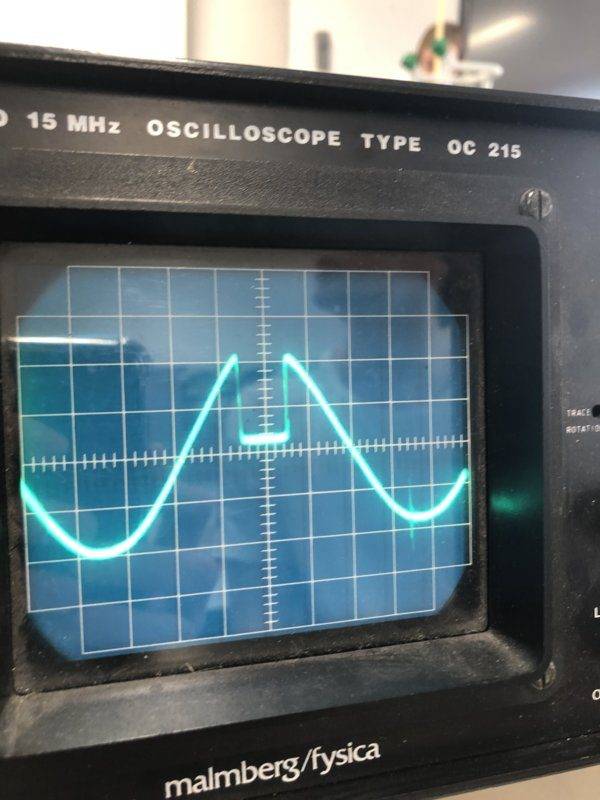
Wondering what the wave means
Hmm... my first impression that it looks like a voltage drop due to a part in the circuit going over a certain "limit" voltage.
danieluyter said:
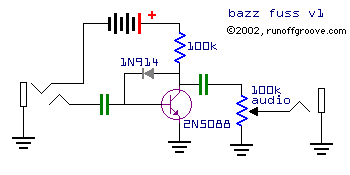
Wondering what the wave means and how it got to be the way it is. I will attach a picture of the oscilloscope screen + the circuit I used for the Fuzz effect. My question is what the cause of the square drop in the sine at the top is. Any information/help would be immensely appreciated!
Since the voltage drop only occurs in the positive region of the sine wave, I think it is the diode (1N914) that is the origin; it is connected to the base of the transistor so it probably alters the transistor base-to-emitter voltage (V
BE). But it was a while since I last did electronics myself, so I can't say for sure, but that is what I think.
If I were you I would try to use
SPICE (software that does electronics simulations and analysis) or some other
alternatives to it. With such software you can quite easily modify and experiment with circuits. I have used some free SPICE-like software for electronics, but I don't remember the name of it at the moment.
In short, since the sine wave is significantly altered by the circuit, you have succeeded in building some sort of distorsion effect. But I don't know how it sounds, of course.


 You drop components into a virtual circuit and then you can do various analyses, in this case small signal AC analysis.