- 19,865
- 10,859
Definition/Summary
A diffraction grating is formed by an evenly spaced series of lines, slits, or other periodic array of reflective or transmissive elements. It is typically used for analyzing the spectrum or measuring the wavelength of electromagnetic waves, particularly in or near the visible part of the spectrum.
Equations
For a normally incident wave, waves are diffracted at angles such that
d\ \sin \theta_m = m\ \lambda
where m is any integer.
For other angles of incidence, the diffraction condition is
d\ ( \sin \theta_m - \sin \theta_i ) = m\ \lambda
For nonzero m, a requirement for diffraction is
d > \lambda
Extended explanation
Definitions of terms
Note: it is common practice to specify the number of lines per mm, cm, or m for a diffraction grating. This is simply the reciprocal of d; eg. a 1000 lines/mm grating has d=0.001mmReflection and transmission
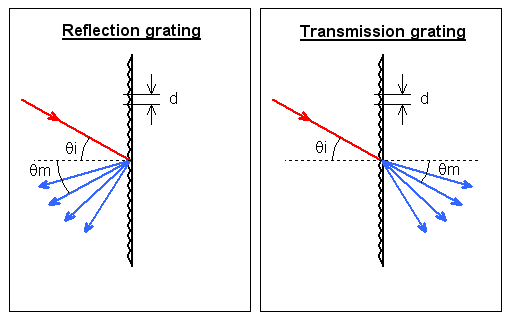
A diffraction grating may work either in reflection or transmission, as shown here:
* This entry is from our old Library feature, and was originally created by @Redbelly98.
A diffraction grating is formed by an evenly spaced series of lines, slits, or other periodic array of reflective or transmissive elements. It is typically used for analyzing the spectrum or measuring the wavelength of electromagnetic waves, particularly in or near the visible part of the spectrum.
Equations
For a normally incident wave, waves are diffracted at angles such that
d\ \sin \theta_m = m\ \lambda
where m is any integer.
For other angles of incidence, the diffraction condition is
d\ ( \sin \theta_m - \sin \theta_i ) = m\ \lambda
For nonzero m, a requirement for diffraction is
d > \lambda
Extended explanation
Definitions of terms
θm = diffracted angle of mth-order wave
θi = incident angle of wave
m = (any integer) order of the diffracted wave
λ = wavelength
d = line spacing, or period of diffractive elements
Note: it is common practice to specify the number of lines per mm, cm, or m for a diffraction grating. This is simply the reciprocal of d; eg. a 1000 lines/mm grating has d=0.001mmReflection and transmission
A diffraction grating may work either in reflection or transmission, as shown here:
* This entry is from our old Library feature, and was originally created by @Redbelly98.
Last edited: