What Is Gain Narrowing in Lasers?

  • Context: Graduate 
  • Thread starter Thread starter unscientific
  • Start date Start date
  • Tags Tags
    Gain Laser Lasers
Click For Summary

Discussion Overview

The discussion centers on the concept of gain narrowing in lasers, exploring its implications for spectral intensity and amplification. Participants examine the relationship between the gain medium's bandwidth and the input beam's bandwidth, as well as the effects on output beam characteristics.

Discussion Character

  • Technical explanation
  • Conceptual clarification
  • Debate/contested

Main Points Raised

  • One participant presents the mathematical formulation of laser amplification and the small-signal gain coefficient, noting that gain is strongest at the central frequency, ##\omega_0##.
  • Another participant proposes that the gain medium acts as a frequency filter, suggesting that if the gain bandwidth is narrower than the input beam bandwidth, the output will be limited, leading to gain narrowing.
  • A later reply reiterates the filtering concept, emphasizing that only the portion of the input beam close to ##\omega_0## is significantly amplified, resulting in a narrower output beam.
  • Further clarification is provided regarding the small signal case, where all frequencies in the beam's spectrum are amplified but with varying degrees, leading to stronger gain near ##\omega_0##.
  • Another participant highlights that the issue of gain narrowing is significant because the laser pulse duration is influenced by the normalized profile of the field spectrum rather than the absolute magnitude, affecting the output pulse duration.

Areas of Agreement / Disagreement

Participants express varying interpretations of gain narrowing, with some focusing on the filtering aspect while others emphasize the implications for pulse duration and spectral characteristics. No consensus is reached on a singular definition or understanding of gain narrowing.

Contextual Notes

Participants discuss the dependence of gain narrowing on the relationship between the gain bandwidth and the input beam bandwidth, as well as the effects on pulse duration, without resolving the complexities involved.

unscientific
Messages
1,728
Reaction score
13
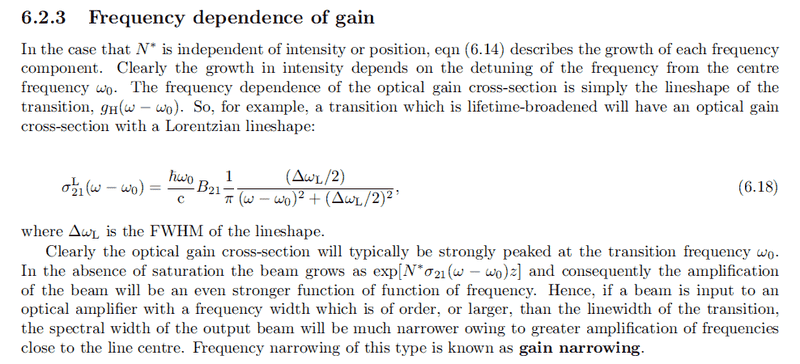
A laser is amplified exponentially, with spectral intensity

I (\omega,z) = I (\omega,0) e^{\alpha z}

The small-signal gain coefficient is given by
\alpha_{21}(\omega-\omega_0) = N^* \sigma_{21}(\omega-\omega_0) = N^* \frac{\hbar \omega_0}{c}B_{21} g_B(\omega-\omega_0) = N^* \frac{\hbar \omega_0}{c}B_{21} \frac{1}{\pi} \frac{(\frac{\Delta \omega_L}{2})}{(\omega-\omega_0)^2+(\frac{\Delta \omega_L}{2})^2}

So obviously, the gain will be the strongest when ##\omega=\omega_0##. But I don't understand the concept of 'Gain narrowing' as described:
gainnarrowing.png
 
Physics news on Phys.org
An alternative way to understand power density amplification is to think the gain medium as a frequency filter. If the width of the filter, or the gain bandwidth, is smaller than the input beam bandwidth, the output will obviously be cut off by some fraction resulting in narrower bandwidth, which termed as gain narrowing.
 
blue_leaf77 said:
An alternative way to understand power density amplification is to think the gain medium as a frequency filter. If the width of the filter, or the gain bandwidth, is smaller than the input beam bandwidth, the output will obviously be cut off by some fraction resulting in narrower bandwidth, which termed as gain narrowing.

So you're saying: Input wide beam, only part of beam that is close to ##\omega_0## gets amplified exponentially. Then output beam: narrow close to ##\omega_0##.
 
unscientific said:
So you're saying: Input wide beam, only part of beam that is close to ω0\omega_0 gets amplified exponentially. Then output beam: narrow close to ω0\omega_0.
For small signal case, every part in the beam's spectrum will get amplified exponentially. It's just that the amount of amplification is nonuniform such that frequencies near ##\omega_0## experience much stronger gain than those farther from ##\omega_0##.
Actually the main reason of why people arouse this issue of gain narrowing is due to the fact that the laser pulse duration is insensitive to the absolute magnitude of the spectrum, it's only sensitive to the normalized profile of the field spectrum (imagine two Gaussian profile spectra with equal FWHM but different max values, then their time domain fields will have the same FWHM). Therefore even if all parts in the spectrum get amplified, but the output pulse will be longer in time compared to the input due to the narrowing the output.bandwidth.
 

Similar threads

  • · Replies 0 ·
Replies
0
Views
3K
Replies
8
Views
3K
Replies
3
Views
2K
  • · Replies 9 ·
Replies
9
Views
2K
  • · Replies 1 ·
Replies
1
Views
3K
Replies
4
Views
2K
  • · Replies 1 ·
Replies
1
Views
3K
  • · Replies 1 ·
Replies
1
Views
3K
  • · Replies 1 ·
Replies
1
Views
1K
  • · Replies 2 ·
Replies
2
Views
2K