What is the absorption coefficient of black-colored water?

Click For Summary

Discussion Overview

The discussion revolves around the absorption coefficient of black-colored water, particularly in the context of electromagnetic absorption and its relation to attenuation. Participants explore the definitions and implications of these coefficients, questioning their units and the physical interpretations involved.

Discussion Character

  • Technical explanation
  • Conceptual clarification
  • Debate/contested

Main Points Raised

  • Some participants question why the absorption coefficient is expressed in units of m-1 and whether it should be less than 1, suggesting a misunderstanding of the concept.
  • Others clarify that "m-1" means "per meter" and discuss the distinction between the attenuation coefficient and the absorption coefficient, noting that they are often used interchangeably but can differ in certain contexts.
  • A participant explains that the absorption coefficient should theoretically be less than 1 when considering reflection, transmission, and absorption coefficients, which sum to 1.
  • One participant provides an equation related to intensity loss through a material, indicating that if a certain distance through the material removes a specific percentage of light, the coefficient could exceed 1, prompting further discussion on dimensional analysis.

Areas of Agreement / Disagreement

Participants express differing views on the interpretation of the absorption and attenuation coefficients, with no consensus reached on their definitions or implications. The discussion remains unresolved regarding the relationship between these coefficients and their expected values.

Contextual Notes

There are limitations in understanding the definitions and contexts of the coefficients discussed, as well as the mathematical relationships involved. Participants have not fully resolved the implications of scattering versus absorption in their discussions.

Basimalasi
Messages
45
Reaction score
0
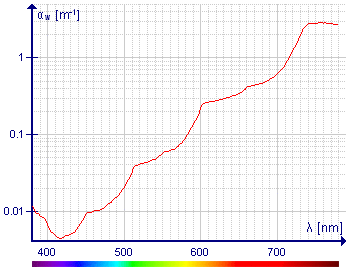
I saw this on Wikipedia
http://en.wikipedia.org/wiki/Electromagnetic_absorption_by_water
Water_light_absorption_coefficient.gif


Isnt it supposed to less than 1 ?
maybe it has something to do with the unit ..why is it in m^-1?
 
Physics news on Phys.org
"m^-1" reads "per meter". What dimensions were you expecting?

It's a good point: how can you possibly absorb more than 100% of the incident radiation?

But that ##\alpha_w## which is on the vertical axis is the "attenuation coefficient", is this the same as "absorption coefficient"? There is a link to the definition under the top graph in your link, did you check it out?
 
Simon Bridge said:
"m^-1" reads "per meter". What dimensions were you expecting?

It's a good point: how can you possibly absorb more than 100% of the incident radiation?

But that ##\alpha_w## which is on the vertical axis is the "attenuation coefficient", is this the same as "absorption coefficient"? There is a link to the definition under the top graph in your link, did you check it out?

well obviously but I was expecting it to have no units .. there are three types of coefficients you take into consideration when a beam of light hits an object: the reflection co ,the transmission co, and the absorption coefficient and they're all equal to 1
α+β+τ=1
so the absorption co α has to be less than 1

http://en.wikipedia.org/wiki/Attenuation_coefficient

Attenuation versus absorption

The terms "attenuation coefficient" and "absorption coefficient" are generally used interchangeably. However, in certain situations they are distinguished, as follows.[4]

When a narrow (collimated) beam of light passes through a substance, the beam will lose intensity due to two processes: The light can be absorbed by the substance, or the light can be scattered (i.e., the photons can change direction) by the substance. Just looking at the narrow beam itself, the two processes cannot be distinguished. However, if a detector is set up to measure light leaving in different directions, or conversely using a non-narrow beam, one can measure how much of the lost intensity was scattered, and how much was absorbed.

In this context, the "absorption coefficient" measures how quickly the beam would lose intensity due to the absorption alone, while "attenuation coefficient" measures the total loss of narrow-beam intensity, including scattering as well. "Narrow-beam attenuation coefficient" always unambiguously refers to the latter. The attenuation coefficient is always larger than the absorption coefficient, although they are equal in the idealized case of no scattering.

and this is where i got the chart, I clicked on that link but I could not understand s***
http://en.wikipedia.org/wiki/Electromagnetic_absorption_by_water
 
That page gives you an equation: $$I(z)=I_0e^{-\alpha z}$$ ... where z is the distance through the material. I0 is the incoming flux, and I(z) is the flux after distance z.

This means that $$\alpha_z = -\frac{1}{z}\ln\left|\frac{I(z)}{I_0}\right|$$ ... so if a particular distance through the material removes roughly 35% or less of the incoming light, then the coefficient will be bigger than 1. A dimensional analysis will tell you what units ##\alpha## should have.
 

Similar threads

  • · Replies 3 ·
Replies
3
Views
9K
  • · Replies 2 ·
Replies
2
Views
13K
Replies
5
Views
5K
Replies
2
Views
3K
  • · Replies 1 ·
Replies
1
Views
1K
  • · Replies 5 ·
Replies
5
Views
2K
  • · Replies 6 ·
Replies
6
Views
3K
  • · Replies 4 ·
Replies
4
Views
2K
  • · Replies 3 ·
Replies
3
Views
2K
  • · Replies 60 ·
3
Replies
60
Views
7K