What is the acceleration of the minimum mass needed to prevent slipping?

Click For Summary

Homework Help Overview

The discussion revolves around a physics problem involving a block resting on a slope connected to a hanging mass via a pulley. The original poster seeks to determine the acceleration of the minimum mass needed to prevent slipping when nudged slightly.

Discussion Character

  • Exploratory, Assumption checking, Conceptual clarification

Approaches and Questions Raised

  • Participants discuss the coefficients of friction involved, with some clarifying the difference between static and kinetic friction. There are attempts to understand the forces acting on the blocks once motion begins, and questions about the specific values of the coefficients of friction are raised.

Discussion Status

Participants have provided some clarifications regarding the coefficients of friction and the implications of motion on the forces involved. There is an ongoing exploration of how these factors contribute to the acceleration of the system, but no explicit consensus or solution has been reached yet.

Contextual Notes

There is mention of specific values for the coefficients of static and kinetic friction, which are relevant to the problem, but the overall setup and additional details may still be under discussion.

SherBear
Messages
81
Reaction score
0
Figure shows a block of mass resting on a slope. The block has coefficients of friction and with the surface. It is connected via a massless string over a massless, frictionless pulley to a hanging block of mass 2.0 kg.
i got this first one: What is the minimum mass that will stick and not slip?

1.83 kg
Correct

But can't get the second part:
If this minimum mass is nudged ever so slightly, it will start being pulled up the incline. What acceleration will it have?
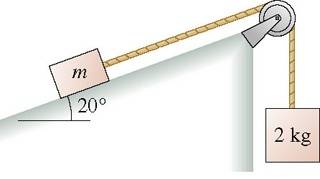
knight_Figure_08_36.jpg


Thank you! :)
 
Physics news on Phys.org
SherBear said:
Figure shows a block of mass resting on a slope. The block has coefficients of friction and with the surface.


Correct the sentence in red please. What are the coefficients of friction?

ehild
 
SherBear said:
Figure shows a block of mass resting on a slope. The block has coefficients of friction and with the surface. It is connected via a massless string over a massless, frictionless pulley to a hanging block of mass 2.0 kg.
i got this first one: What is the minimum mass that will stick and not slip?

1.83 kg
Correct

But can't get the second part:
If this minimum mass is nudged ever so slightly, it will start being pulled up the incline. What acceleration will it have?

knight_Figure_08_36.jpg


Thank you! :)

Once the block starts moving, the coefficient of friction is then the kinetic coefficient, which will mean a smaller friction. Thus there is a net force up the slope [and down on the hanging mass] which causes the system to accelerate.
 
I'm really sorry about that ehild! The mu(s) is .8 but the mu(k) which I assume we use on this problem because it's moving therefore kinetic is .5 =-)
 
PeterO said:
Once the block starts moving, the coefficient of friction is then the kinetic coefficient, which will mean a smaller friction. Thus there is a net force up the slope [and down on the hanging mass] which causes the system to accelerate.

Thank you Peter!
 
SherBear said:
I'm really sorry about that ehild! The mu(s) is .8 but the mu(k) which I assume we use on this problem because it's moving therefore kinetic is .5 =-)

Everything is clear then. Can you solve the second part or still need help?

ehild
 
ehild said:
Everything is clear then. Can you solve the second part or still need help?

ehild

Yes, it's clear. Thank you ehild! :)
 

Similar threads

Replies
13
Views
3K
  • · Replies 3 ·
Replies
3
Views
2K
  • · Replies 21 ·
Replies
21
Views
11K
  • · Replies 42 ·
2
Replies
42
Views
6K
  • · Replies 10 ·
Replies
10
Views
5K
  • · Replies 5 ·
Replies
5
Views
2K
Replies
16
Views
3K
  • · Replies 5 ·
Replies
5
Views
2K
Replies
44
Views
4K