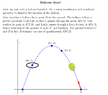
Using the vertex form for a quadratic, we may state:
$$y=-a(x-7)^2+9$$
To determine $a$, we may use the other known point:
$$8=-a(9-7)^2+9\implies a=\frac{1}{4}$$
Hence:
$$y=-\frac{1}{4}(x-7)^2+9$$
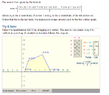
To determine the $x$-coordinates of points $C$ and $D$, we solve:
$$0=-\frac{1}{4}(x-7)^2+9$$
$$(x-7)^2=6^2$$
$$x-7=\pm6$$
$$x=7\pm6$$
To find $b$, we solve:
$$5=-\frac{1}{4}(x-7)^2+9$$
$$(x-7)^2=4^2$$
Take the smaller root:
$$x=7-4=3$$
So, I agree with all of the coordinates you found. Now, how about we find the areas of $$\triangle{BCD}$$ and $$\triangle{ABD}$$ and add them together.
Or, you can drop vertical lines down from points $A$ and $B$ to the $x$-axis, and draw the segment $\overline{AB}$, and you have two right triangles and a trapezoid.
Can you proceed?