What is the center of a globular clusters made of?
- Level: Undergrad
- Thread starter vrmuth
- Start date
Join the discussion
Registration is free. Start your own thread to ask a follow-up.
50 replies · 10K views
Astronomy news on Phys.org
Science Advisor
Gold Member
- 1,284
- 208
Yes G2 star. The colors on his chart are illustrative,not accurate.davenn said:
Science Advisor
Gold Member
- 1,284
- 208
About the color of the sun, a good summary is found at http://solar-center.stanford.edu/SID/activities/GreenSun.html
liometopum
- 126
- 24
You can see the view from different locations within a globular cluster at Jeremy Webb's page,
http://www.physics.mcmaster.ca/~webbjj/liagc.html
Three images:
1. View from the center
2. View from near the half-light radius of the cluster
3. View from apogalacticon
http://www.physics.mcmaster.ca/~webbjj/liagc.html
Three images:
1. View from the center
2. View from near the half-light radius of the cluster
3. View from apogalacticon
Last edited by a moderator:
liometopum
- 126
- 24
Here is a link to a globular cluster lecture by Dr. William E. Harris of McMaster University.
http://physwww.mcmaster.ca/~harris/mcgill09aug.pdf
He covers a number of interesting things, among them being:
The Milky Way has 150 GCs
The Sombrero galaxy has about 1900 GCs
Discusses the size distribution of GCs
Formation via Young Massive Clusters in starburst dwarf galaxies
Some have black holes, and some do not
Globular clusters evaporate (the stars leave the GC). They all evaporate, except the big ones take a long time to do so.
http://physwww.mcmaster.ca/~harris/mcgill09aug.pdf
He covers a number of interesting things, among them being:
The Milky Way has 150 GCs
The Sombrero galaxy has about 1900 GCs
Discusses the size distribution of GCs
Formation via Young Massive Clusters in starburst dwarf galaxies
Some have black holes, and some do not
Globular clusters evaporate (the stars leave the GC). They all evaporate, except the big ones take a long time to do so.
Science Advisor
Gold Member
- 9,747
- 11,967
cool link and nice artistic impressionsliometopum said:You can see the view from different locations within a globular cluster at Jeremy Webb's page,
http://www.physics.mcmaster.ca/~webbjj/liagc.html
Three images:
1. View from the center
2. View from near the half-light radius of the cluster
3. View from apogalacticon
 thankyou
 I think it would be amazing to be able to look down on the Milky Way from above the galactic plane from such a "close" distance,
rather than from edge on as we currently do
The last image gives a hint of that view
Dave
Last edited by a moderator:
Science Advisor
Gold Member
- 9,747
- 11,967
liometopum said:Globular clusters evaporate (the stars leave the GC). They all evaporate, except the big ones take a long time to do so.
Yeah, I would suggest a very long time. Spectral analysis of GC stars indicate that many of them are very old stars
vrmuth
- 80
- 0
even if you are in remote suburbs you will be able to see the MW only for half of the year . can you see how ?wabbit said:You'd need to be in its remote suburbs though, otherwise I suspect the sky would be so bright from all the nearby stars surrounding you that you wouldn't see the milky way at all. Which would be quite a sight in its own right...
Science Advisor
Gold Member
- 1,284
- 208
Oh it's even worse than that : you also need your star to be on the right part of its orbit around the center of the cluster lest the cluster blocks the view. Lots of geometric constraints to combine...vrmuth said:even if you are in remote suburbs you will be able to see the MW only for half of the year . can you see how ?
liometopum
- 126
- 24
The Senior Editor of Astronomy Magazine, Michael E. Bakich, has given approval for us to post the article, "Life Inside a Globular Cluster", written by William E. Harris and Jeremy Webb, from the July 2014 issue, on Physics Forums. See the attached pdf.
I wish to thank Michael E. Bakich, and Astronomy Magazine, for this gracious gift to the members of Physics Forums!
Please thank Astronomy Magazine by liking this post, or better yet, giving a gift subscription to a friend, or even yourself. (I am fully responsible for that plug)
I wish to thank Michael E. Bakich, and Astronomy Magazine, for this gracious gift to the members of Physics Forums!
Please thank Astronomy Magazine by liking this post, or better yet, giving a gift subscription to a friend, or even yourself. (I am fully responsible for that plug)
Attachments
liometopum
- 126
- 24
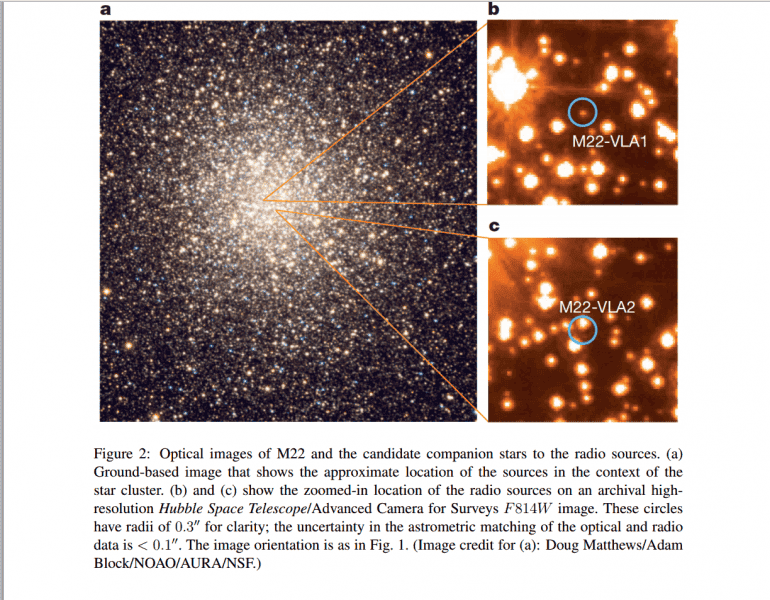
I recently spotted this arXiv article, and it fits this post well.
Two stellar-mass black holes in the globular cluster M22
The paper made it into http://www.nature.com/nature/journal/v490/n7418/full/nature11490.html.
I'd not seen it before, but the Milky Way globular cluster, M22, apparently has at least TWO black holes. From the abstract:
"...we report the presence of two flat-spectrum radio sources in the Milky Way globular cluster M22, and we argue that these objects are black holes of stellar mass (each ∼ 10–20 times more massive than the Sun) that are accreting matter." and M22 may contain a total population of ∼ 5–100 black holes."
Here are a few interesting extracts from the arXiv paper:
1. ...the objects cannot be black-hole/black-hole binaries, and instead are probably in binary systems with Roche lobe-overflowing companions
[ for an explanation of the Roche Lobe, see ]
2. Stellar-mass black holes will mass-segregate to the core of the cluster.
3. The presence of black holes in a globular cluster can lead to an expansion of the core radius through interactions between black holes and stars. This could explain why M22 has the fifth largest core radius among luminous ( >∼ 2 × 10⁵L ) Milky Way globular clusters
Two stellar-mass black holes in the globular cluster M22
The paper made it into http://www.nature.com/nature/journal/v490/n7418/full/nature11490.html.
I'd not seen it before, but the Milky Way globular cluster, M22, apparently has at least TWO black holes. From the abstract:
"...we report the presence of two flat-spectrum radio sources in the Milky Way globular cluster M22, and we argue that these objects are black holes of stellar mass (each ∼ 10–20 times more massive than the Sun) that are accreting matter." and M22 may contain a total population of ∼ 5–100 black holes."
Here are a few interesting extracts from the arXiv paper:
1. ...the objects cannot be black-hole/black-hole binaries, and instead are probably in binary systems with Roche lobe-overflowing companions
[ for an explanation of the Roche Lobe, see ]
2. Stellar-mass black holes will mass-segregate to the core of the cluster.
3. The presence of black holes in a globular cluster can lead to an expansion of the core radius through interactions between black holes and stars. This could explain why M22 has the fifth largest core radius among luminous ( >∼ 2 × 10⁵L ) Milky Way globular clusters
Last edited by a moderator:
Science Advisor
Gold Member
- 11,420
- 750
IMO, globular clusters probably preceded ordinary galaxies in the universe. I suspect most of them harbor black holes of significant mass. There is observational evidence favoring this idea, which also explains why they tend to be populated by ancient stars.
liometopum
- 126
- 24
Black holes in globular clusters appear to be rare, or at least, mostly undiscovered. This quote, "In 2007, Maccarone made the first discovery of a black hole in a globular star cluster in the neighboring NGC4472 galaxy." from PHYSICISTS FIND BLACK HOLES IN GLOBULAR STAR CLUSTERS, UPSETTING 40 YEARS OF THEORY shows how recent the discovery of black holes in globular clusters actually is. I think only a few GCs are currently known to harbor black holes. And if you look at the image above, showing the location of the two BHs, you'll see that they are not actually in the center, but near it, which might be more of a reflection on statistics than an 'evolution of globular cluster' occurrence.
What struck me about the paper was that there appear to be many black holes in this one GC. As it stands now, there are only a few GC known to have black holes. And new to me was the idea that the black holes get ejected. If so, there should be renegade black holes flying through space.
What struck me about the paper was that there appear to be many black holes in this one GC. As it stands now, there are only a few GC known to have black holes. And new to me was the idea that the black holes get ejected. If so, there should be renegade black holes flying through space.
Similar threads
- mancini
- · Replies 1 ·
- Astronomy, Astrophysics, Cosmology
- Replies
- 1
- ohwilleke
- · Replies 1 ·
- Astronomy, Astrophysics, Cosmology
- Replies
- 1
- Gordon Potter IV
- · Replies 6 ·
- Astronomy, Astrophysics, Cosmology
- Replies
- 6
- pstq
- · Replies 1 ·
- Astronomy, Astrophysics, Cosmology
- Replies
- 1
- Jordi Heguilor
- · Replies 3 ·
- Other Physics Topics
- Replies
- 3
- liometopum
- · Replies 12 ·
- Astronomy, Astrophysics, Cosmology
- Replies
- 12
- kderakhshani
- · Replies 4 ·
- Astronomy, Astrophysics, Cosmology
- Replies
- 4
Graduate
Globular cluster ejected from M87
- liometopum
- · Replies 3 ·
- Astronomy, Astrophysics, Cosmology
- Replies
- 3
Undergrad
Globular cluster luminosity function
- John Titor
- · Replies 3 ·
- Astronomy, Astrophysics, Cosmology
- Replies
- 3
- trina1990
- · Replies 3 ·
- Astronomy, Astrophysics, Cosmology
- Replies
- 3