What is the correct method for counting poles in a 3-phase induction motor?

  • Thread starter Thread starter BlackMelon
  • Start date Start date
  • Tags Tags
    Induction motor
Click For Summary

Discussion Overview

The discussion revolves around the method for counting poles in a 3-phase induction motor, focusing on the interpretation of coil arrangements and current flow. Participants explore the implications of these factors on the number of poles, with references to specific motor configurations and operational characteristics.

Discussion Character

  • Technical explanation
  • Debate/contested

Main Points Raised

  • One participant claims that the motor has 6 poles based on the current waveform and the application of the right-hand rule.
  • Another participant suggests that the number of poles should be defined per phase, questioning the initial claim of 6 poles.
  • A different perspective indicates that while analyzing one phase may suggest 4 poles, the overall count remains 4 due to the nature of 3-phase currents.
  • A later reply asserts that the distribution of winding positions was incorrect and provides a revised understanding of how adjacent phase zones contribute to pole formation.

Areas of Agreement / Disagreement

Participants express differing views on the correct method for counting poles, with no consensus reached on the final interpretation of the motor's pole count. Multiple competing views remain regarding the definitions and calculations involved.

Contextual Notes

Participants highlight potential observational mistakes and the need for practical tests to verify pole count, indicating that the discussion is influenced by the specific configurations and assumptions made about the motor's design.

BlackMelon
Messages
43
Reaction score
7
(I have modified the picture a little bit for clarity)

Hi there!

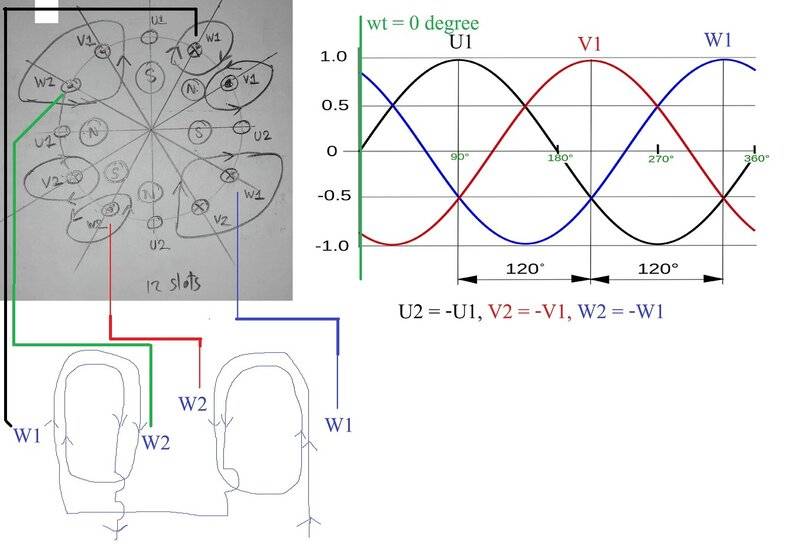
I had a chat with my colleague. He believes that the 3-phase induction motor on the picture below has 2-poles.
There are 12 slots. Each phase contain 2 coils. I have showed how the coils are connected for the phase W at the bottom.
The waveform belongs to current of each phase. For notations, when the current is entering the slot W1 (crossed symbol in the hand drawing), the same current leaves the slot W2 (dotted symbol in the hand drawing).

So from the waveform, I take a sample of current flows when wt = 0 degree, where w is angular frequency (U1 = 0, W1 = positive, V1 = negative). Using the right hand rule, I founded that there are 6 poles.

I would like to know whether me or my colleague made any mistakes?Melon.
1694708297878.jpeg
 

Attachments

  • 1694703027030.jpeg
    1694703027030.jpeg
    41.1 KB · Views: 144
Last edited:
Engineering news on Phys.org
If you made a mistake, then it is probably observational, and we have been presented with the same data.

The ultimate test needs to be: does the unloaded motor run just below synchronous speed, or just below half twice synchronous speed.
 
Last edited:
Aren't number of poles is usually defined per phase?
 
Averagesupernova said:
Aren't number of poles is usually defined per phase?
Well, I understand your point. You bring the phase W like I drew and then examine its number of poles (4 poles).
However, when you input the 3 phase currents into the motor, the number of poles will not be 4x3. Rather, it will still be 4, considering the directions of all the currents in the stator.
Baluncore said:
If you made a mistake, then it is probably observational, and we have been presented with the same data.

The ultimate test needs to be: does the unloaded motor run just below synchronous speed, or just below half twice synchronous speed.
Thank you for the advice. :) :)
 
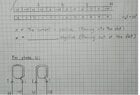
Guys, I got the answer for the question I asked. The distribution of windings' positions are incorrect. (The way I analyzed the number of poles was correct and showed abnormality). Rather, the distribution should be done as the picture below.
According to the right and rule (The thumb is the magnetic field. The rest of the fingers are the current). Please not that 6 adjacent phase zones form 1 pole in the air gap.
For example at 30 degree electrical angle, U, -V, W and -U, V, -W form a south pole.
1695272824009.jpeg


1695271093009.jpeg

1695271170161.jpeg
 

Attachments

  • 1695271081822.jpeg
    1695271081822.jpeg
    37.6 KB · Views: 131
  • 1695271104429.jpeg
    1695271104429.jpeg
    52 KB · Views: 118
Last edited:
  • Like
Likes   Reactions: Baluncore

Similar threads

Replies
2
Views
4K
  • · Replies 22 ·
Replies
22
Views
6K
  • · Replies 3 ·
Replies
3
Views
5K
  • · Replies 1 ·
Replies
1
Views
14K
Replies
2
Views
2K
Replies
4
Views
3K
Replies
3
Views
2K
Replies
23
Views
7K
  • · Replies 1 ·
Replies
1
Views
2K
  • · Replies 3 ·
Replies
3
Views
4K