What is the correct method for counting poles in a 3-phase induction motor?

  • Thread starter Thread starter BlackMelon
  • Start date Start date
  • Tags Tags
    Induction motor
Click For Summary
SUMMARY

The correct method for counting poles in a 3-phase induction motor involves analyzing the distribution of windings and the phase currents. The discussion clarifies that while the initial assumption suggested 2 poles, the accurate count is 6 poles based on the right-hand rule and the arrangement of the coils. The motor's behavior, specifically its operation just below synchronous speed, serves as a definitive test for pole count. The final conclusion emphasizes that 6 adjacent phase zones collectively form one pole in the air gap.

PREREQUISITES
  • Understanding of 3-phase induction motor design
  • Familiarity with the right-hand rule for magnetic fields
  • Knowledge of electrical angles in motor operation
  • Basic principles of synchronous speed in motors
NEXT STEPS
  • Study the principles of 3-phase induction motor winding configurations
  • Learn about the right-hand rule applications in electromagnetism
  • Research synchronous speed calculations for induction motors
  • Examine the impact of coil arrangement on motor performance
USEFUL FOR

Electrical engineers, motor design specialists, and students studying electromechanical systems will benefit from this discussion, particularly those focused on 3-phase induction motor functionality and performance analysis.

BlackMelon
Messages
43
Reaction score
7
(I have modified the picture a little bit for clarity)

Hi there!

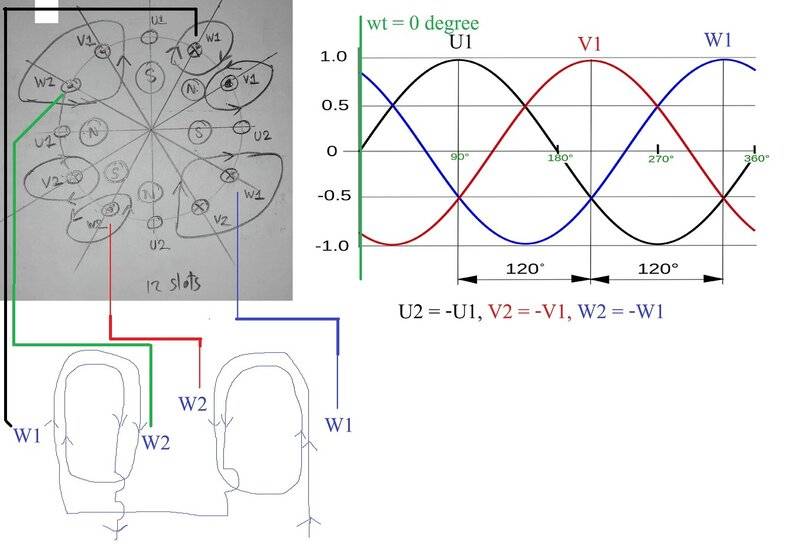
I had a chat with my colleague. He believes that the 3-phase induction motor on the picture below has 2-poles.
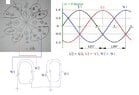
There are 12 slots. Each phase contain 2 coils. I have showed how the coils are connected for the phase W at the bottom.
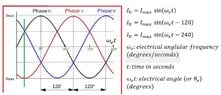
The waveform belongs to current of each phase. For notations, when the current is entering the slot W1 (crossed symbol in the hand drawing), the same current leaves the slot W2 (dotted symbol in the hand drawing).

So from the waveform, I take a sample of current flows when wt = 0 degree, where w is angular frequency (U1 = 0, W1 = positive, V1 = negative). Using the right hand rule, I founded that there are 6 poles.

I would like to know whether me or my colleague made any mistakes?Melon.
1694708297878.jpeg
 

Attachments

  • 1694703027030.jpeg
    1694703027030.jpeg
    41.1 KB · Views: 140
Last edited:
Engineering news on Phys.org
If you made a mistake, then it is probably observational, and we have been presented with the same data.

The ultimate test needs to be: does the unloaded motor run just below synchronous speed, or just below half twice synchronous speed.
 
Last edited:
Aren't number of poles is usually defined per phase?
 
Averagesupernova said:
Aren't number of poles is usually defined per phase?
Well, I understand your point. You bring the phase W like I drew and then examine its number of poles (4 poles).
However, when you input the 3 phase currents into the motor, the number of poles will not be 4x3. Rather, it will still be 4, considering the directions of all the currents in the stator.
Baluncore said:
If you made a mistake, then it is probably observational, and we have been presented with the same data.

The ultimate test needs to be: does the unloaded motor run just below synchronous speed, or just below half twice synchronous speed.
Thank you for the advice. :) :)
 
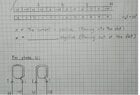
Guys, I got the answer for the question I asked. The distribution of windings' positions are incorrect. (The way I analyzed the number of poles was correct and showed abnormality). Rather, the distribution should be done as the picture below.
According to the right and rule (The thumb is the magnetic field. The rest of the fingers are the current). Please not that 6 adjacent phase zones form 1 pole in the air gap.
For example at 30 degree electrical angle, U, -V, W and -U, V, -W form a south pole.
1695272824009.jpeg


1695271093009.jpeg

1695271170161.jpeg
 

Attachments

  • 1695271081822.jpeg
    1695271081822.jpeg
    37.6 KB · Views: 127
  • 1695271104429.jpeg
    1695271104429.jpeg
    52 KB · Views: 112
Last edited:
Most likely this can only be answered by an "old timer". I am making measurements on an uA709 op amp (metal can). I would like to calculate the frequency rolloff curves (I can measure them). I assume the compensation is via the miller effect. To do the calculations I would need to know the gain of the transistors and the effective resistance seen at the compensation terminals, not including the values I put there. Anyone know those values?

Similar threads

Replies
2
Views
4K
  • · Replies 22 ·
Replies
22
Views
5K
  • · Replies 3 ·
Replies
3
Views
5K
  • · Replies 1 ·
Replies
1
Views
14K
Replies
2
Views
2K
Replies
4
Views
3K
Replies
3
Views
2K
Replies
23
Views
6K
  • · Replies 1 ·
Replies
1
Views
2K
  • · Replies 3 ·
Replies
3
Views
4K