What is the definite definition of strength?

Click For Summary
SUMMARY

The term "strength" in materials science is often ambiguous and can refer to various measurable properties such as yield strength, ultimate strength, shear strength, or fatigue strength. In the context of Titanium, it typically refers to yield strength, especially when discussing its comparison to materials like Steel. Titanium alloys, particularly Ti 6AL-4V, exhibit high yield strength-to-weight ratios, making them advantageous in applications requiring lightweight yet strong materials. Clear definitions using qualifiers like "yield" or "ultimate" are essential for precise communication in mechanical engineering.

PREREQUISITES
  • Understanding of material properties such as yield strength and ultimate strength
  • Familiarity with stress-strain diagrams in mechanical engineering
  • Knowledge of Titanium alloys, specifically Ti 6AL-4V
  • Basic concepts of mechanical engineering terminology
NEXT STEPS
  • Research the properties and applications of Ti 6AL-4V alloy
  • Study the differences between yield strength and ultimate strength in materials
  • Learn about stress-strain curves and their significance in material testing
  • Explore the implications of material selection in engineering design
USEFUL FOR

Mechanical engineers, materials scientists, and anyone involved in the design and analysis of structural components will benefit from this discussion, particularly those working with Titanium and its alloys.

scoutfai
Messages
70
Reaction score
0
I have access to definite definition to terminology like stress(Pa), strain(dimensionless), ultimate strength(Pa), yield strength(Pa), etc. But I often get confused when someone just write "strength".

I give an example. Consider the following sentence:

"Titanium has high strength and high stiffness."

What is the strength referring here? Is it a measurable variable, or a qualitative description? If it is measurable, what is its unit, and in a typical stress-strain graph of a ductile material, where is this variable located?
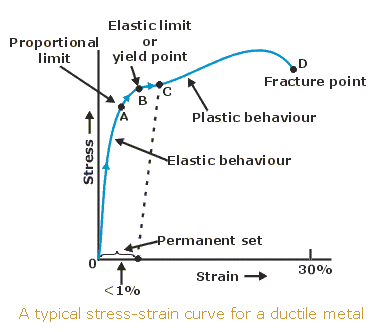
stress-strain-curve.gif
 
Engineering news on Phys.org
You're not alone in being confused. The word "strength" alone is ambiguous; it could refer to the yield strength in uniaxial tension, the ultimate strength in uniaxial tension, the shear strength, the fatigue strength, etc.

As an everyday (non-precise) term, it probably corresponds to the highest point on the engineering stress-strain diagram (not marked on yours), also known as the "ultimate strength," the point where a metal will begin to neck.
 
scoutfai said:
I have access to definite definition to terminology like stress(Pa), strain(dimensionless), ultimate strength(Pa), yield strength(Pa), etc. But I often get confused when someone just write "strength".

I give an example. Consider the following sentence:

"Titanium has high strength and high stiffness."

What is the strength referring here? Is it a measurable variable, or a qualitative description? If it is measurable, what is its unit, and in a typical stress-strain graph of a ductile material, where is this variable located?
stress-strain-curve.gif

Used in that context the word strength generally means the material strength. So if you were to compare Titanium to Steel, you would see a higher overall strength (both yield and ultimate) for Titanium.

But like Mapes said...it's important to clearly define what one is referring to by using a qualifier like yield or ultimate...

CS
 
As a general rule, in the context of Mechanical Engineering a material's "strength" is it's yield strength or fatigue strength. Ultimate strength might be used for worst-case failure analyses but usually isn't used for design purposes because once the yield strength is passed the part has been permanenetly damaged. If a part is designed to fail at a certain time or in a specific location, then ultimate strength would be used.

The statement "Titanium has high strength and high stiffness" is most likely referring to Titanium's yield strength and elastic modulus. As a general rule Titanium's yield strength is not all that impressive, but when alloyed properly (such as Ti 6AL-4V) it's yield strength gets very high, and more importantly it's yield strength to weight (density) ratio goes through the roof.

Overall Titanium's elastic modulus (stiffness) is only slightly higher than aluminum and lower than steel, but Ti is also half the density of steel and specific alloys have a yield strength that can surpass high alloy steels, far beyond anything Aluminum is capable of. So parts properly designed with high strength alloys of Titanium can be around 50%-75% lighter than steel componnets while being as strong or stronger (based on yield strength), and far stonger than Aluminum alloy components.
 
Last edited:
Thank you to Mech_Engineer, stewartcs, & Mapes. Yours explanations are indeed very helpful in clarifying my confusion.
 

Similar threads

  • · Replies 3 ·
Replies
3
Views
3K
  • · Replies 4 ·
Replies
4
Views
2K
  • · Replies 4 ·
Replies
4
Views
15K
  • · Replies 4 ·
Replies
4
Views
4K
  • · Replies 2 ·
Replies
2
Views
6K
  • · Replies 9 ·
Replies
9
Views
7K
  • · Replies 2 ·
Replies
2
Views
3K
  • · Replies 2 ·
Replies
2
Views
3K
Replies
3
Views
5K
Replies
3
Views
2K