Difference between Elastic Limit & Yield Point

Click For Summary

Discussion Overview

The discussion revolves around the differences between the Elastic Limit and the Yield Point in the context of a stress/strain curve for ductile materials. Participants explore definitions, characteristics, and implications of these terms, focusing on their significance in material behavior under stress.

Discussion Character

  • Conceptual clarification
  • Debate/contested
  • Technical explanation

Main Points Raised

  • One participant defines the Elastic Limit as the point where a material behaves elastically and returns to its original shape, while the Yield Point indicates the transition from elastic to plastic behavior.
  • Another participant suggests that the Yield Point is where strain begins to increase with little or no additional stress, noting that ductile materials may exhibit a wider region between the Elastic Limit and Yield Point compared to brittle materials.
  • A different viewpoint mentions that some materials lack a well-defined Yield Point, proposing that it can be defined as 0.2% plastic strain, and highlights the existence of upper and lower yield points (Y1 and Y2) in certain ductile materials.
  • One participant asserts that it is possible for a material to have a higher Elastic Limit than Yield Point, indicating that the material can endure more stress without permanent deformation until the Yield Point is reached.
  • Another participant posits that between the Elastic Limit and Yield Point, the material exhibits both elastic and plastic properties, while after the Yield Point, it only exhibits plastic properties.

Areas of Agreement / Disagreement

Participants express differing views on the definitions and implications of the Elastic Limit and Yield Point, indicating that there is no consensus on the exact relationship between these points on the stress/strain curve.

Contextual Notes

Some participants note that the definitions and characteristics of the Elastic Limit and Yield Point may vary depending on the material type, and that not all ductile materials exhibit the same behavior regarding these points.

tomtomtom1
Messages
160
Reaction score
8
Hi All

I am trying to understand a stress / strain curve for a ductile material.

But I am struggling with understanding the difference between the Elastic Limit and the Yield Point. I define these terms as:-

Elastic Limit - Is the point on the stress/strain curve where the material will behave elastically i.e. will return to its original shape without leaving any permanent deformations.

Yield Point - The yield point is the point on a stress–strain curve that indicates the limit of elastic behaviour and the beginning of plastic behaviour.

Assuming that you agree with these definitions then the Elastic limit and Yield Point should be the same point on the stress strain curve - But they are NOT?

To help me better understand I created a stress strain curve for a ductile material and labelled them.
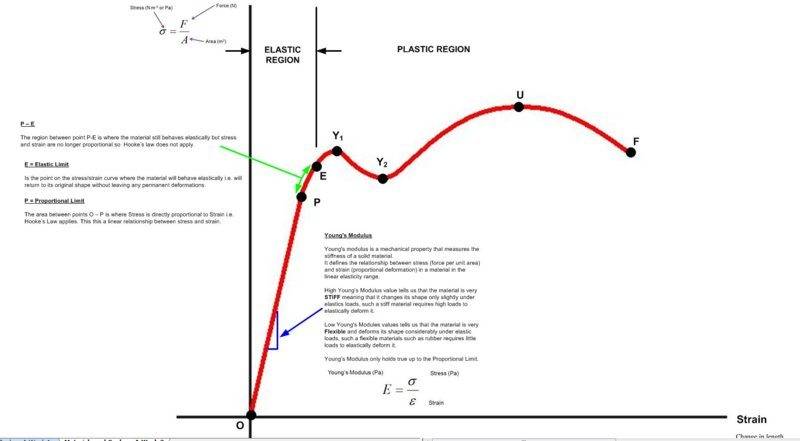
ffffffffffffffffffffffff.JPG


I understand everything up to point E which is the elastic limit.

I have been told that Y1 and Y2 are yield points but why are there two of them and why is E and Y1 on different points on the curve?

What is happening between E and Y1?

Can anyone help explain?

Thank you.
 

Attachments

  • ffffffffffffffffffffffff.JPG
    ffffffffffffffffffffffff.JPG
    23.5 KB · Views: 5,356
Engineering news on Phys.org
I might be wrong but I thought the yield point was the point at which strain started to increase without much or any extra stress being added. So ductile materials have wider region between the two points than brittle materials.
 
Some materials do not have a well defined yield point, so the yield point is defined as 0.2% plastic strain. That could be point E on your curve. Points Y1 and Y2 apply to some (not all) ductile materials, where the stress decreases immediately after yielding. They are the upper and lower yield points. So "the" yield point could be point E, point Y1, or somewhere between those two points.

Wikipedia has a good article: https://en.wikipedia.org/wiki/Yield_(engineering)
 
Yes, it is possible for a material to have a higher elastic limit than yield point. This means that the material can withstand greater stress without permanently deforming, but once it reaches the yield point, it will begin to deform plastically.

but don't plastic deformation and permanent deformation mean the same thing?
 
I think until the elastic limit, the material has only elastic properties, and in the region between the elastic limit and the yield point, the material has both elastic and plastic properties, but after the yield point, the material has only plastic properties
 

Similar threads

  • · Replies 2 ·
Replies
2
Views
3K
  • · Replies 2 ·
Replies
2
Views
6K
  • · Replies 1 ·
Replies
1
Views
2K
  • · Replies 1 ·
Replies
1
Views
2K
  • · Replies 6 ·
Replies
6
Views
13K
  • · Replies 2 ·
Replies
2
Views
5K
  • · Replies 2 ·
Replies
2
Views
9K
  • · Replies 9 ·
Replies
9
Views
7K
  • · Replies 3 ·
Replies
3
Views
3K
  • · Replies 1 ·
Replies
1
Views
5K