What is the derivation of the second equation for area velocity?

  • Thread starter Thread starter Shreya
  • Start date Start date
  • Tags Tags
    Formula Velocity
Join the discussion
Registration is free. Ask a follow-up in this thread, or start your own.
3 replies · 3K views
Shreya
Messages
187
Reaction score
64
Homework Statement
I want to understand the second equation for Areal velocity as given below.
Relevant Equations
Refer below.
Screenshot from 2023-01-19 20-29-43.png
Screenshot from 2023-01-19 20-30-05.png

I think I understand how the first equation comes about.

Screenshot from 2023-01-19 20-43-16.png

In ##dt## the particle travels by ##dr##, I considered it as a triangle with altitude ##r## and base ##dr##. On dividing the area travelled in ##dt## by ##dt## we get the above equation.
A similar argument can be applied to ##\frac 1 2 \rho^2 \frac {d\phi} {dt}## as ##\rho## is same as r and ##\rho \frac {d\phi} {dt}## is same as ##\frac {dr} {dt}##

But, I am not able to understand the 2nd equation. I can provide a similar argument for ##xv_y## but can,t seem to reason any further.
Please be kind to help.
 
Attachments
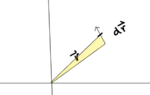
  • Screenshot from 2023-01-19 20-39-16.png
    Screenshot from 2023-01-19 20-39-16.png
    3.8 KB · Views: 175
Physics news on Phys.org
The unsigned area swept out in time [itex]\delta t[/itex] is approximately [tex]|\delta S| \approx \tfrac12 <br /> \|\mathbf{r} \times (\mathbf{r} + \mathbf{v}\delta t)\| = <br /> \tfrac12 \|\mathbf{r} \times \mathbf{v}\| |\delta t|.[/tex] This is because the magnitude of the cross-product gives the area of the parallelogram bounded by [itex]\mathbf{r}[/itex] and [itex]\mathbf{r} + \mathbf{v} \delta t[/itex], and the area swept out is approximately the area of a triangle which is one half of the parallelogram. Dividing by [itex]\delta t[/itex] and taking the limit [itex]\delta t \to 0[/itex] gives [tex] \left|\frac{dS}{dt}\right| = \tfrac12 \|\mathbf{r} \times \mathbf{v}\|.[/tex] This is essentially the derivation of the first formula.

To derive the second, in the case of motion in the [itex](x,y,0)[/itex] plane we can calculate [itex]\frac12\|\mathbf{r} \times \mathbf{v}\|[/itex] either in cartesians or in plane polars using the standard formulae [tex]\begin{split}<br /> \mathbf{r} &= r\mathbf{e}_r(\theta) \\<br /> \mathbf{v} &= \dot r \mathbf{e}_r(\theta) + r\dot \theta \mathbf{e}_{\theta}(\theta) \end{split}[/tex] where [tex] \mathbf{e}_r(\theta) \times \mathbf{e}_\theta(\theta) \equiv \mathbf{e}_z.[/tex] We can then adopt the convention that [itex]S[/itex] increases in the direction of increasing [itex]\theta[/itex] to remove the absolute value signs.
 
pasmith said:
To derive the second, in the case of motion in the (x,y,0) plane we can calculate 12‖r×v‖ either in cartesians or in plane polars using the standard formulae r=rer(θ)v=r˙er(θ)+rθ˙eθ(θ) where er(θ)×eθ(θ)≡ez. We can then adopt the convention that S increases in the direction of increasing θ to remove the absolute value signs.
Thank You so much @pasmith !
##\vec r = x \hat i + y \hat j##
##\vec v = v_x \hat i + v_y \hat j##

##\vec r \times \vec v = (x v_y - y v_x) \hat k##
##\frac {dS} {dt} = \frac 1 2 (xv_y-yv_x)##
Is the above right?