What is the derivative of the inverse secant function?

Click For Summary

Discussion Overview

The discussion centers on the derivative of the inverse secant function, specifically exploring the conditions under which the function is defined and the implications of those conditions on the domain of the function. Participants examine the mathematical inequalities involved and the behavior of the function in relation to its inverse.

Discussion Character

  • Technical explanation
  • Conceptual clarification
  • Debate/contested
  • Mathematical reasoning

Main Points Raised

  • Some participants discuss the condition that for the expression under the root to be valid, it must hold that ##5x^4 \geq 1##, as ##5x^4 < 1## would lead to a negative number under the root.
  • Others express confusion about the implications of having a negative number under the root and seek clarification on the domain of the function.
  • It is suggested that the domain of the secant function is restricted to certain intervals to ensure it is one-to-one, which is necessary for defining the inverse function.
  • Some participants propose that the requirement for ##|u|## should be ##|u| > 1##, while others challenge the interpretation of inequalities related to this condition.
  • A later reply emphasizes the importance of understanding the graph of the secant function to clarify the behavior of its inverse.
  • Participants also discuss the implications of the absolute value in the context of the secant function and its inverse, noting that ##|sec y| = |5x^4| = 5x^4 >= 1##.

Areas of Agreement / Disagreement

Participants express various interpretations of the conditions for the domain of the inverse secant function, with no clear consensus on the implications of the inequalities discussed. Multiple competing views remain regarding the correct understanding of the domain and the behavior of the function.

Contextual Notes

There are limitations in the discussion regarding the assumptions made about the domain of the function and the interpretation of inequalities. Some participants reference external resources to clarify their points, but these do not resolve the ongoing uncertainties.

askor
Messages
168
Reaction score
9
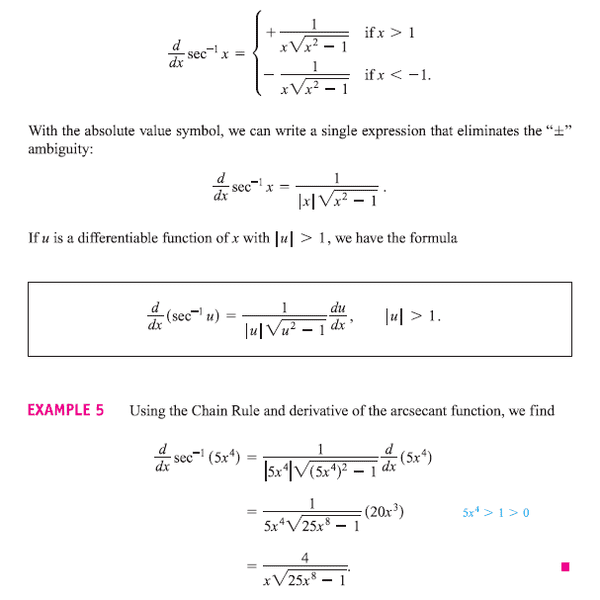
Please refer to the below image (Example 5).

Do anyone know how 5x^4 > 1 > 0?
derivative.png
 
Last edited:
Physics news on Phys.org
askor said:
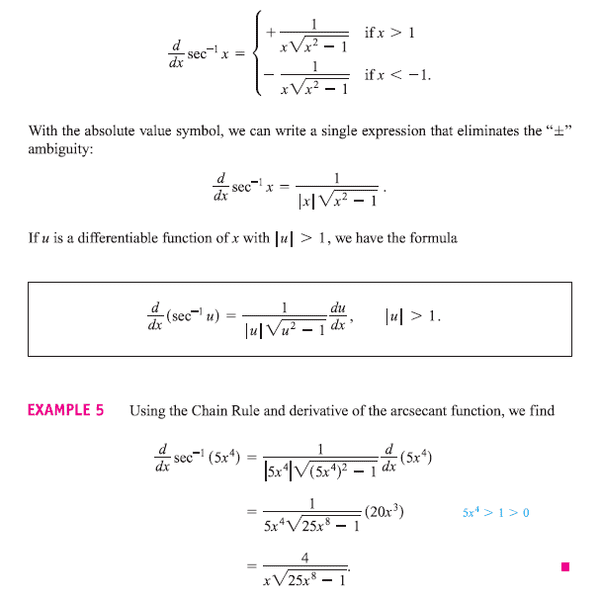
Please refer to the below image (Example 5).

Do anyone know how 5x^4 > 1 > 0?
derivative.png

If ##5x^4 < 1## there would be a negative number under the root thus this is not part of the domain of the function.Therefore they assume ##5x^4 \geq 1##.
 
Math_QED said:
If ##5x^4 < 1## there would be a negative number under the root thus this is not part of the domain of the function.Therefore they assume ##5x^4 \geq 1##.

I still don't understand. Could someone explain this please. So, what happen if there is a negative number under the root?
 
Last edited:
I suspect that the domain here are the real numbers, although not explicitly mentioned. But for ##|u| < 1## the root ##\sqrt{u^2-1}## becomes negative, and square roots of negative numbers like ##\sqrt{-1}## aren't real. ##|u|=1## is forbidden since the denominator would be zero.
For ##u=5x^4## this translates to the requirement ##|u|=|5x^4|=5x^4 > 1##.
 
fresh_42 said:
I suspect that the domain here are the real numbers, although not explicitly mentioned. But for ##|u| < 1## the root ##\sqrt{u^2-1}## becomes negative, and square roots of negative numbers like ##\sqrt{-1}## aren't real. ##|u|=1## is forbidden since the denominator would be zero.
For ##u=5x^4## this translates to the requirement ##|u|=|5x^4|=5x^4 > 1##.

So, if ##|u| < 1## and ##|u| = 1## are forbidden, what the value of ##|u|## should be?

Is it ##|u| > 1##?

If yes, isn't ##|u| > 1## is equal to ##-1 > u > 1## (from what I learned about inequality property)?

I still don't understand.
 
askor said:
So, if ##|u| < 1## and ##|u| = 1## are forbidden, what the value of ##|u|## should be?

Is it ##|u| > 1##?
Yes.
If yes, isn't ##|u| > 1## is equal to ##-1 > u > 1## (from what I learned about inequality property)?
No.

##-1 > u > 1## doesn't make sense. Smaller than ##-1## cannot be greater than ##1##.
##|u| > 1## means: ##u > 1## if ##u## is positive and ##-u>1## if ##u## is negative, have a look
https://en.wikipedia.org/wiki/Absolute_value
 
The explanation lies in the definition of sec-1(x) and the reason for this definition.

First we need to understand the graph of y = sec(x). Check out for example the 5th graph down on this page: http://cs.bluecc.edu/calculus/trigtools/graphs/trigGraphs/index.html .

In order to define an inverse function, we first need to find a portion of the domain of sec(x) on which sec(x) does not take the same value more than once. Ideally the function will also take all possible values at least once on this selected portion of the domain. This fussing is important!

A convenient portion of the domain of sec(x) for this purpose is the union of the two half-open intervals [0,π/2) and (π/2, π] — in other words the set X given by

X = [0, π/2) ∪ (π/2, π]​

— and this is what the standard convention is for obtaining the inverse function. Note that since sec(x) = 1/cos(x) by definition, and cos(x) takes values only between -1 and +1, it follows that sec(x) takes values only in the range

Y = (-∞, -1] ∪ [1, ∞).​

Now, to get the graph of the inverse function we need to consider the graph of y = sec(x) only on the restricted domain X, and then interchange the x- and y-axes. (This has the effect of flipping the graph about the 45° line y = x.) Thus the inverse function sec-1(x) has as its domain the set Y above, and takes values in the set X above.

Thus for all x where sec-1(x) makes sense, we have either x ≤ -1 or x ≥ +1. So x2 ≥ 1 in either case, which shows why the expression inside of the square root sign in the original problem is always greater than 0.
 
Last edited by a moderator:
How do I know if x > 1 or x < -1?
 
fresh_42 said:
I suspect that the domain here are the real numbers, although not explicitly mentioned. But for ##|u| < 1## the root ##\sqrt{u^2-1}## becomes negative
I know you don't mean what you said. If |u| < 1, then ##u^2 - 1 < 0##, so ##\sqrt{u^2 - 1}## isn't real.
fresh_42 said:
, and square roots of negative numbers like ##\sqrt{-1}## aren't real. ##|u|=1## is forbidden since the denominator would be zero.
For ##u=5x^4## this translates to the requirement ##|u|=|5x^4|=5x^4 > 1##.
 
  • #10
askor said:
How do I know if x > 1 or x < -1?
By which branch of the graph of y = sec-1(x) you're on. See the graph here: http://www.wolframalpha.com/input/?i=y=arcsec(x)

In the first plot, change the plot type from Complex-valued plot to Real-valued plot.

BTW, arcsec(x) is just different notation for sec-1(x).
 
  • #11
## 5x^4=sec y = \frac 1 {cos y} ##, because |cos y| <=1, we have ## |sec y| = |5x^4| = 5x^4 >= 1.##
 

Similar threads

  • · Replies 4 ·
Replies
4
Views
2K
  • · Replies 11 ·
Replies
11
Views
2K
  • · Replies 2 ·
Replies
2
Views
2K
  • · Replies 6 ·
Replies
6
Views
2K
  • · Replies 1 ·
Replies
1
Views
2K
  • · Replies 1 ·
Replies
1
Views
2K
  • · Replies 6 ·
Replies
6
Views
4K
  • · Replies 8 ·
Replies
8
Views
3K
  • · Replies 1 ·
Replies
1
Views
4K
  • · Replies 2 ·
Replies
2
Views
2K