What Is the Difference Between Moment and Bending Moment in Beam Calculations?

  • Thread starter Thread starter ___
  • Start date Start date
  • Tags Tags
    Bending Moments
Click For Summary

Discussion Overview

The discussion revolves around the differences between moments and bending moments in beam calculations, particularly in the context of distributed and point loads. Participants explore the mathematical formulations and conceptual understanding of these terms as they relate to beam mechanics.

Discussion Character

  • Technical explanation
  • Debate/contested
  • Mathematical reasoning

Main Points Raised

  • One participant questions the fundamental difference between the bending moment and the resultant moment on one side of the beam, suggesting they may be conceptually similar.
  • Another participant points out difficulties in the original approach, emphasizing the importance of following conventional left-to-right integration for clarity.
  • Concerns are raised about the applicability of the integration method to point loads versus distributed loads.
  • A later reply introduces Macaulay's method as a potential solution for handling varying loading conditions along the beam.
  • Participants discuss the complications arising from piecewise definitions of loading and the need for expressions that relate distances from cuts to the overall beam structure.

Areas of Agreement / Disagreement

Participants express differing views on the interpretation of moments and bending moments, with no consensus reached on their fundamental differences or the best approach to calculate them.

Contextual Notes

Limitations include the need for clear definitions of loading conditions and the challenges of integrating functions that vary along the length of the beam. The discussion highlights unresolved mathematical steps and the complexity of applying different methods to various loading scenarios.

___
Messages
61
Reaction score
0
Hello, I have a small question about moments and bending moments.

So, if I have a beam with a loading given by q (N/m) which is given as a function of x then what do these calculations get me?

\int xq(x) dx
\int (\int q(x) dx) dx

The first integral gives me the moment about a point because I am taking a differential distance and multiplying it with the value of Force there given by q(x) and adding up all these differential moments.

The second integral gives me the bending moment about a point..

And here is what has been troubling me.

Isn't the bending moment the resultant moment on one side of the beam? I mean:
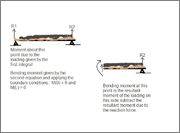
Untitled.jpg


So, isn't the bending moment at a point simply the first equation where you integrate from the point you are interested into the end and then subtract the moment due to the reaction?

So, bending moment = (\int_{x}^L xq(x) dx ) - R2x

But that that doesn't seem right. Since the bending moment is \int (\int q(x) dx) dx
and you fill in the boundary conditions and plug in the value of where you want it...

In short, what is the fundamental difference between the bending moment and the resultnt moment on one side of the beam. To me it seems they are the same, the bending moment is the moment the beam is having to apply at that point to counteract the resultant moment on the other side of the beam, but mathematically they seem different.
 
Last edited:
Engineering news on Phys.org
There are several difficulties with your approach.

Why are you not following convention and working from left to right?

If you do not do this you need a negative sign in you equations since the positive x increasing direction is left to right.

Secondly the integration only works like this with distributed loads, not with point loads.
 
Studiot said:
There are several difficulties with your approach.

Why are you not following convention and working from left to right?

If you do not do this you need a negative sign in you equations since the positive x increasing direction is left to right.

Oh ok, fair enough.

Secondly the integration only works like this with distributed loads, not with point loads.

Yeah. I was looking at beams with point loads but it was too difficult to come up with an expression that described the bending moment (because it was described piecewise with discontinuity in shear forces) so I gave up.


I think I see the problem with my expressions though. Once I take a cut like I have done in the picture, I should still be able to use the force X distance method to work out the moment due to the load and the reaction. But however, since I took my cut this way I need to look at the fact that the loading is described by q as a function of x which begins from the reaction at the left hand side.

So, the expression for moment using the Force X distance becomes a little more complicated since the distance is the distance from the point where I have taken the cut, and the loading is being described through the variable x which is measuring the distance from the left reaction. So I need to find an expression that associates the distance x with the distance from the cut, which is going to be a little difficult.

Thanks for the reply.
 
Whatever direction conventions you choose you will have to cope with the fact that for many loading conditions the relevant equations, expressed as functions of x, are different on different parts of the beam.

An elegant solution to this is Macaulay's method

A google search will reveal many hits eg

http://www.colincaprani.com/files/notes/SAIII/Macaulay's Method 1011.pdf

There are also some worked examples in recent threads in Physics Forums on this - try a search.

go well
 

Similar threads

Replies
2
Views
3K
  • · Replies 4 ·
Replies
4
Views
4K
Replies
3
Views
3K
  • · Replies 6 ·
Replies
6
Views
5K
  • · Replies 1 ·
Replies
1
Views
2K
  • · Replies 4 ·
Replies
4
Views
3K
  • · Replies 2 ·
Replies
2
Views
7K
  • · Replies 7 ·
Replies
7
Views
3K
Replies
3
Views
1K
  • · Replies 2 ·
Replies
2
Views
3K