What is the difference between static friction and rolling resistance?

  • Thread starter googly_eyes
  • Start date
  • Tags Tags
    Motor Torque
5 replies · 3K views · last reply
googly_eyes
Messages
3
Reaction score
1
Hi, it's probably a frequent question, but I can't seem to wrap my hear around. I'm trying to understand how I reach that value, not just how to get the value.
I'm designing a vehicle with 4 wheels. It'll climb a surface with a slope theta (in degrees).
This is the FBD that I've come up with of a wheel. Following my analysis, the torque M that the motor needs to provide is simply Fr*R, where Fr is the friction force.
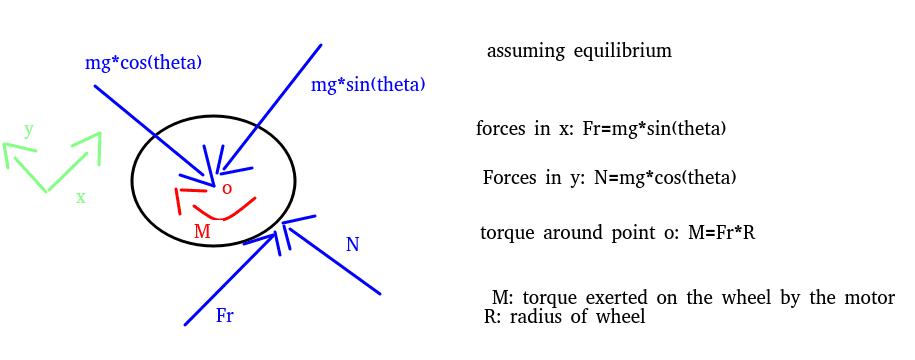
Free-body diagram of a wheel on a slope: weight mg split into mg*cos(theta) and mg*sin(theta), friction Fr and normal N at the contact point, motor torque M at the centre o, with equilibrium equations written beside it.

However, I've seen docs on the internet (page 35/60) that instead considers that the required torque includes an extra force (let's forget about the acceleration and wind force), which is mg*sin(theta)*R. This completely changes the torque analysis, and I don't know why it's like that (not explanation/analysis is given, just that). And I've seen the same equation on other places, including this extra member to the equation force. But alas, I'm clueless as to why it's like that. If you could please enlighten me, an explanation/FBD, whatever fits you, to explain this to me.
Many thanks
 
If you had a rack railway which can't slip at all (infinite friction?) then you would only have the mg*sin(theta)*R term.
The friction force term corresponds to the maximum torque without slipping.
 
Keith_McClary said:
If you had a rack railway which can't slip at all (infinite friction?) then you would only have the mg*sin(theta)*R term.
I'm sorry, I fail to see how that term appears if you take momentum with respect to the center of mass.
Keith_McClary said:
The friction force term corresponds to the maximum torque without slipping.
The worst case scenario, correct?
 
Your 'Fr*R' and 'mg*sin(theta)*R ' are the same (as you define Fr). The paper that you cited defines Fr as 'rolling resistance' - that's a dynamic force - not relevant in a static analysis.

I would call your Fr the 'traction' (not 'friction') force.
 
Dullard said:
Your 'Fr*R' and 'mg*sin(theta)*R ' are the same (as you define Fr). The paper that you cited defines Fr as 'rolling resistance' - that's a dynamic force - not relevant in a static analysis.

I would call your Fr the 'traction' (not 'friction') force.

Now that you mention it, that's true. But for example, in this page make an analysis and turns out that M=mg*(sinθ+cosθ*μr)*R - the maximum static friction is added. This analysis only considers forces, and then derives the motor torque. Shouldn't I reach the same result?

And you can also find this similar equation in this online calculator. They consider other factors such as number of wheels (n1) and the weight of each wheel (md1), but it's basically the total mass of the system. The other term doesn't matter because it's all zero, so it doesn't affect.
Calculator worksheet titled Load Torque: F = 9.8((m1 + n1 x mD1)(sin a + mu1 cos a) + (m2 + n2 x mD2) x N (sin a + mu2 cos a)), filled in with values 45, 4, .4, 10, 0.3 and 10, giving F = 214.2 N; then TL = (F x D1 x 10^-3)/(2 eta x 0.01) with 214.2, 200, 90 giving 23.80 N·m.
 
You're confusing static friction and rolling resistance. Static friction is what keeps the tire from slipping. As long as it is not exceeded, it doesn't matter to your calculations. 'Rolling friction' is (mostly) the effort wasted into changing the shape of the tire as it rolls. Rolling friction is not relevant to a static analysis (which is what you appear to be attempting).
 
  • Like
Likes   Reactions: Keith_McClary