What is the Effect of Mass on Earth's Angular Velocity?

Click For Summary
SUMMARY

The discussion centers on the effect of mass on Earth's angular velocity, concluding that an increase in Earth's mass would lead to an increase in inertia, thereby decreasing its angular velocity. The reasoning is supported by Kepler's third law, which states that the orbital period is related to the distance from the Sun. The consensus is that while mass increases, the angular velocity decreases, maintaining Earth's orbit.

PREREQUISITES
  • Understanding of angular velocity and inertia
  • Familiarity with Kepler's laws of planetary motion
  • Basic knowledge of physics concepts related to mass and motion
  • Concept of orbital mechanics
NEXT STEPS
  • Research the implications of mass changes on planetary motion
  • Study Kepler's laws in detail, focusing on their mathematical formulations
  • Explore the relationship between inertia and angular momentum
  • Investigate the effects of mass on other celestial bodies' orbits
USEFUL FOR

Students of physics, educators teaching orbital mechanics, and anyone interested in the dynamics of celestial bodies and their motion.

temaire
Messages
275
Reaction score
0
Homework Statement
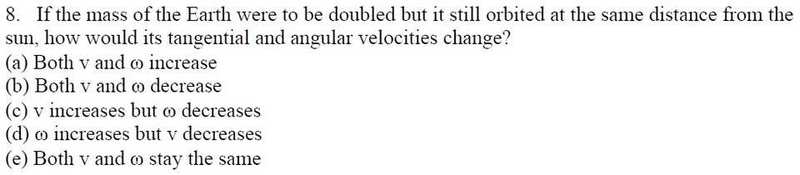
4id0mx.jpg


The attempt at a solution
I think the answer is (b) because an increase in mass would cause an increase in inertia of Earth. This would decrease the velocity of Earth, and since velocity is proportional to angular velocity, both would decrease. Am I right?
 
Physics news on Phys.org
The Earth stays on the same orbit. Think of Kepler's third law about the relation between distance from Sun and orbital period.

ehild
 

Similar threads

  • · Replies 1 ·
Replies
1
Views
842
  • · Replies 30 ·
2
Replies
30
Views
4K
  • · Replies 12 ·
Replies
12
Views
2K
Replies
67
Views
5K
Replies
3
Views
1K
Replies
335
Views
17K
  • · Replies 3 ·
Replies
3
Views
2K
Replies
25
Views
2K
Replies
10
Views
3K
Replies
17
Views
2K