What is the Effect of Motion on the Velocity Vector of Light?

Click For Summary

Discussion Overview

The discussion revolves around the effects of motion on the velocity vector of light, particularly in the context of different observers and their frames of reference. It explores the implications of the principle of constancy of the speed of light, as well as the relativistic transformations that govern how light is perceived by observers moving at different velocities. The scope includes conceptual and theoretical considerations related to special relativity.

Discussion Character

  • Conceptual clarification
  • Debate/contested
  • Mathematical reasoning

Main Points Raised

  • One participant suggests that an observer at rest along the x-axis would measure the speed of light as c.cos θ and along the y-axis as c.sin θ, raising questions about the resolution of these measurements.
  • Another participant asserts that the speed of light is invariant, but the components depend on the chosen axis, emphasizing that the direction of light is frame dependent.
  • A participant introduces a scenario where an observer moves in the x direction at speed c.cos θ, claiming that this observer would perceive the light moving parallel to the y-axis at a speed of c.sin θ, which they argue is not equal to c.
  • In response, another participant counters that the observer would actually see the light moving at speed c in the y-direction, suggesting a need to consider relativistic velocity transformations.
  • One participant expresses confusion regarding the effects of time dilation and length contraction, noting that these effects are not apparent in the y direction due to its perpendicularity to motion, leading to a perceived speed of light of c.sin(θ).
  • This participant contrasts this with the scenario where motion is aligned with the propagation of light, where relativistic effects ensure the speed remains c.

Areas of Agreement / Disagreement

Participants express differing views on how observers moving at various speeds perceive the velocity vector of light. There is no consensus on the implications of relativistic transformations in this context, and the discussion remains unresolved.

Contextual Notes

Participants highlight the dependence of measurements on the observer's frame of reference and the complexities introduced by relativistic effects, particularly in distinguishing between components of velocity in different directions.
bgq
Messages
162
Reaction score
0
Hi,

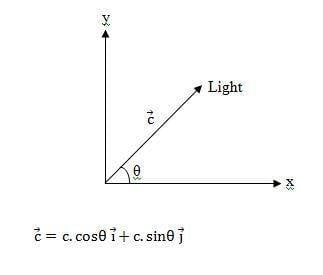
Consider a source of light transmitting light at an angle θ with x-axis as seen in the following figure:

Forums.jpg


Now an observer looking at x-axis will determine the speed of light to be c.cos θ, and the one looking at y-axis determine c.sin θ.

How can we resolve this according to the principle of constancy of speed of light.
 
Physics news on Phys.org
bgq said:
How can we resolve this according to the principle of constancy of speed of light.
What's to resolve? The speed of light is constant (invariant), but any component depends on what axis you choose. (And furthermore, the direction of a given light pulse is also frame dependent.)
 
Thanks Doc Al to your reply.

Consider an observer moving in the x direction with a speed c.cos θ.
According to this observer, there is no motion of the light along x-axis, so he will see the light moving parallel to y-axis with a speed c.sin θ ≠ c !
 
bgq said:
Consider an observer moving in the x direction with a speed c.cos θ.
According to this observer, there is no motion of the light along x-axis, so he will see the light moving parallel to y-axis with a speed c.sin θ ≠ c !
No, it doesn't work that way. What he'll see is the light moving with speed c in the y-direction.

You might want to look up the relativistic velocity transformations. They will show that different observers will see the light traveling in different directions, but always with speed c.
 
What confused me here is that time dilation and length contraction are not evident in the y direction because it is perpendicular to the motion. So the observer sees the light covers same distance during the same time along y-axis yielding v = c.sin (theta).

This is different to the case where the motion is along the propagation of light where time dilation and length contraction effects assure obtaining c for the speed of light.
 

Similar threads

  • · Replies 34 ·
2
Replies
34
Views
4K
  • · Replies 5 ·
Replies
5
Views
2K
  • · Replies 13 ·
Replies
13
Views
1K
  • · Replies 25 ·
Replies
25
Views
2K
  • · Replies 20 ·
Replies
20
Views
3K
  • · Replies 28 ·
Replies
28
Views
2K
  • · Replies 57 ·
2
Replies
57
Views
8K
  • · Replies 1 ·
Replies
1
Views
2K
  • · Replies 12 ·
Replies
12
Views
2K
  • · Replies 8 ·
Replies
8
Views
2K