What is the Equation on My T-Shirt?

Click For Summary

Discussion Overview

The discussion revolves around identifying an equation printed on a t-shirt, with participants speculating on its relation to physics, particularly in the context of light, mechanics, and general relativity. The conversation explores various interpretations and mathematical notations associated with the equation.

Discussion Character

  • Exploratory
  • Technical explanation
  • Debate/contested

Main Points Raised

  • One participant suggests the equation may relate to d'Alembert's principle in mechanics, noting similarities in its structure.
  • Another participant identifies the symbol ##\Gamma## as resembling a Christoffel symbol, indicating a possible connection to general relativity.
  • Some participants discuss the notation of the Christoffel symbols, debating whether they should have two subscripts and one superscript or vice versa, with no clear consensus on the convention.
  • A participant raises concerns about the equation's structure, questioning the ranks of tensors involved and the ambiguity of mathematical notation.
  • Another participant proposes a more conventional tensor notation for the equation, suggesting a transcription error regarding the symbol ##R##, and expresses confusion over an extra term in the equation.
  • One participant speculates that the equation may be a contrived design meant to look appealing rather than a meaningful scientific expression.

Areas of Agreement / Disagreement

Participants express multiple competing views regarding the interpretation of the equation, its notation, and its potential meaning, with no consensus reached on its significance or correctness.

Contextual Notes

There are unresolved questions regarding the notation and mathematical structure of the equation, including assumptions about tensor ranks and the correct representation of Christoffel symbols.

DelfinDelfin
Messages
2
Reaction score
1
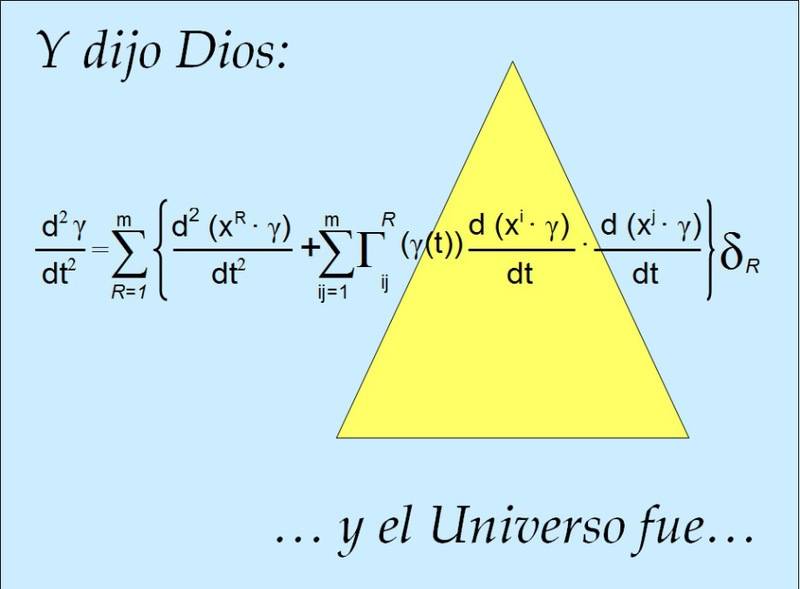
I have a t-shirt with a next print:

sin-tc3adtulo.jpg


But I am not sure what equation is. I only know that is something related with light. But I haven't found it. I am not sure if it is one from quantum electrodynamics or some advanced course in physics. I would appreciate that somebody could tell me which one is
 
  • Like
Likes   Reactions: Delta2
Science news on Phys.org
I don't have much of a guess, but since nobody else has responded, I'll tell you that to a mechanical engineer, the general form looks similar to d'Alembert's[/PLAIN] principle (see equation 1 in that link) in mechanics in that you seem to have an infinitesimal displacement on the far right and an acceleration on the left-hand side. But more broadly, d'Alembert's principle is a variational approach (see, e.g., Fermat's[/PLAIN] principle, which is an example of variational methods applied to light propagation). Not much, but it might help your search.
 
Last edited by a moderator:
The ##\Gamma## looks like a Christoffel symbol (although it should have two indices as superscripts and one as subscript), and the equation seems to be about general relativity.
 
Last edited:
mfb said:
The ##\Gamma## looks like a Christoffel symbol (although it should have two indices as superscripts and one as subscript), and the equation seems to be about general relativity.
The Christoffel symbols usually have two subscripts and one superscript, which the equation has.
 
All examples I found had it the opposite way. Maybe both ways are common. Well, just a matter of convention of course.

Edit: I got confused, ignore this post.
 
mfb said:
All examples I found had it the opposite way. Maybe both ways are common.
The Wikipedia page you link to has it the "normal" way. Two down and one up. I have never seen two up and one down.
 
Wait, I got confused. Yes, one up, two down. Ignore my previous post.
 
Something looks funny about that equation. It looks like there are dot products ##x^R \cdot \gamma##. Which means that ##x## and ##\gamma## are tensors. But if that's the case, then what rank is ##\gamma##? The rank of the LHS and RHS ought to be the same, but it doesn't seem possible. The second term in the curly brace seems to have a dot between the two derivatives, but this might just be a multiplication. All the dots might be simply multiplications. It's too bad that mathematical notation can be so ambiguous.
 
First, I think the ##R## really should be a ##k## and has been transcribed incorrectly.

I would guess this is supposed to be what, in more conventional tensor notation, would be written:

And God said:$$
\frac{D^2\gamma^k}{dt^2} = \frac{d^2\gamma^k}{dt^2} + \Gamma^k{}_{ij} \frac{d\gamma^i}{dt} \frac{d\gamma^j}{dt}
$$... and there was the Universe...*​

It expresses acceleration along a curve ##\vec{\gamma}(t)## in non-Cartesian coordinates, where ##\vec{x}^k## is the ##k##th coordinate dual basis covector and so ##\gamma^k = \vec{x}^k \cdot \vec{\gamma}##. But they seem to have messed it up and I can't work out why there's an extra ##(\gamma(t))## in the middle of it all. Presumably the ##\delta_k## is the basis vector too.

*Translation assisted by Google Translate
 
  • Like
Likes   Reactions: jedishrfu
  • #10
I think its an artificially contrived equation designed to look cool similar to Japanese t-shirt logos with nonsense English.

But Dr Greg's explanation is quite plausible too.
 

Similar threads

  • · Replies 1 ·
Replies
1
Views
3K
  • · Replies 24 ·
Replies
24
Views
3K
  • · Replies 1 ·
Replies
1
Views
2K
  • · Replies 2 ·
Replies
2
Views
2K
  • · Replies 21 ·
Replies
21
Views
5K
  • · Replies 7 ·
Replies
7
Views
3K
Replies
1
Views
2K
  • · Replies 9 ·
Replies
9
Views
4K
  • · Replies 1 ·
Replies
1
Views
979
  • · Replies 19 ·
Replies
19
Views
3K