What is the formula for converting decibels to a power ratio?

Click For Summary
SUMMARY

The discussion centers on converting decibels (dB) to a power ratio using the formula \( C = 10^{(A/B)} \). Specifically, the example provided involves a firework explosion measured at 100 dB at ground level. The confusion arises from understanding how the logarithmic relationship allows for the conversion of dB to a power ratio, particularly how the exponent of 10 is derived in the equation. The key takeaway is that the formula simplifies the logarithmic expression to yield the power ratio directly.

PREREQUISITES
  • Understanding of logarithmic functions
  • Familiarity with sound measurement in decibels
  • Basic knowledge of exponentiation
  • Concept of power ratios in acoustics
NEXT STEPS
  • Study the mathematical properties of logarithms and exponents
  • Learn about sound intensity and its relationship to decibels
  • Explore the derivation of the decibel formula in acoustics
  • Investigate practical applications of sound power ratios in engineering
USEFUL FOR

Students in physics or engineering, audio engineers, and anyone interested in understanding sound measurement and acoustics will benefit from this discussion.

AgustRunarsson
Messages
1
Reaction score
0
Note: I'm sorry if I have to use the template, but I already have the solution, I just do not understand it and need help understanding it.
1. Question: A firework explodes at a 40 metre height and gives off a bang which measures at 100 dB at ground level. What is the power of the sound that comes off the firework?

This is the solution:
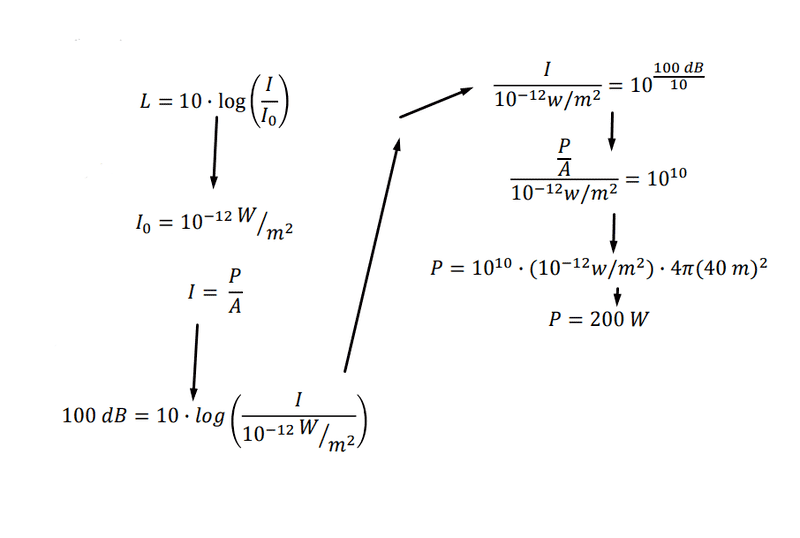
xlcdqf.png

I understand what is going on, for the most part.
What I do not understand exactly is at the second part the "100 dB" becomes 10^100dB/10 which removes the log. How? I understand that the exponent is 10 in "10*log" but I don't really understand how the 10 comes from in the exponent of the 10 itself.

Any help would be appreciated. Thanks!
 

Attachments

  • xlcdqf.png
    xlcdqf.png
    17.5 KB · Views: 570
Physics news on Phys.org
AgustRunarsson said:
What I do not understand exactly is at the second part the "100 dB" becomes 10^100dB/10 which removes the log. How? I understand that the exponent is 10 in "10*log" but I don't really understand how the 10 comes from in the exponent of the 10 itself.

If ##A = B \log_{10} C##, then ##A/B = \log_{10} C##, and ##C =##?
 

Similar threads

  • · Replies 5 ·
Replies
5
Views
2K
  • · Replies 5 ·
Replies
5
Views
2K
Replies
4
Views
2K
Replies
4
Views
2K
  • · Replies 4 ·
Replies
4
Views
7K
  • · Replies 8 ·
Replies
8
Views
3K
  • · Replies 1 ·
Replies
1
Views
2K
  • · Replies 5 ·
Replies
5
Views
2K
  • · Replies 2 ·
Replies
2
Views
3K
  • · Replies 3 ·
Replies
3
Views
2K