What is the Freshman Dream Quotient Rule?

  • Context: Graduate 
  • Thread starter Thread starter JasMath33
  • Start date Start date
  • Tags Tags
    Freshman quotient
Click For Summary

Discussion Overview

The discussion revolves around the Freshman Dream Quotient Rule (FDQR) and its implications in mathematics, particularly focusing on the relationships between two functions, \( f \) and \( g \), as defined by certain differential equations. Participants are exploring the existence of functions that satisfy these equations and the methods to derive them.

Discussion Character

  • Exploratory
  • Mathematical reasoning

Main Points Raised

  • One participant expresses interest in the FDQR and seeks insights into functions that satisfy the associated equations.
  • Another participant presents the differential equations \( g' = g^2 \) and \( f' = f \frac{g^2}{g-1} \) as conditions for the functions.
  • A different participant claims there are infinitely many solutions and provides a method to find an associated function \( f \) given any function \( g \) by solving a specific ordinary differential equation (ODE).
  • This participant gives examples with specific functions \( g(x) = e^x \) and \( g(x) = x^2 \), detailing the resulting forms of \( f(x) \) derived from the equations.
  • Another post questions the correctness of the equation presented, suggesting a possible error in the sign of the terms involving \( f' \) and \( g \).

Areas of Agreement / Disagreement

Participants do not reach a consensus on the correctness of the equations or the derivations presented. There are competing views regarding the formulation of the equations and the existence of solutions.

Contextual Notes

Some assumptions regarding the functions \( g \) and \( f \) remain unaddressed, particularly concerning the conditions under which the equations hold true. The discussion also reflects uncertainty about the implications of specific function choices and their impact on the derived equations.

JasMath33
Messages
21
Reaction score
1
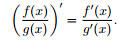
I have been interested in this idea of the FDQR. This idea states the following.
upload_2016-6-27_9-12-0.png


I have been trying to see if there is some 2 functions which make this true, but have not found it on research or with trying functions. Does anyone have any insight on this. I think it is just neat and want to know more about what people know about it.
 
Physics news on Phys.org
What ever satisifies:

g' = g^2

and

f' = f \frac{g^2}{g-1}
 
There are infinitely many solutions. Given any function ##g##, the associated function can be found by solving the following ODE:

f' g (g - g') = (g')^2 f

So for example, let ##g(x) = e^x##. Then this reduces to ##f(x) = 0##.
If ##g(x) = x^2##, then
f'(x) x^2 (x^2 - 2x) = 4x^2 f(x)
or
\frac{f'(x)}{f(x)} = \frac{4}{x(x-2)}
Integrating yields
\log(f(x)) = 2\log(2-x) - 2\log(x)
or
f(x) = \frac{(2-x)^2}{x^2}
In general, given any function ##g## not satisfying ##g=g'## or ##g=0##, we can find an associated function ##f## by
f(x) = g(x) + e^{\int \frac{g'}{g-g'}}
 
  • Like
Likes   Reactions: DuckAmuck
micromass said:
##f′g(g−g′)=(g′)^2f##

I think there a minus ##f'g(g-g')=-g'^{2}f## ...
 
  • Like
Likes   Reactions: SammyS

Similar threads

  • · Replies 9 ·
Replies
9
Views
6K
  • · Replies 3 ·
Replies
3
Views
2K
  • · Replies 5 ·
Replies
5
Views
2K
  • · Replies 1 ·
Replies
1
Views
2K
  • · Replies 0 ·
Replies
0
Views
2K
  • · Replies 4 ·
Replies
4
Views
4K
  • · Replies 20 ·
Replies
20
Views
2K
  • · Replies 11 ·
Replies
11
Views
2K
  • · Replies 8 ·
Replies
8
Views
3K
  • · Replies 9 ·
Replies
9
Views
3K