Priyadarshini
- 191
- 4
Homework Statement
Homework Equations
a=meu*g
The Attempt at a Solution
meu= 20/10
= 2
The answer's wrong
The normal force here is the driving force of the vehicle, which is it's mass times the accelerationSuraj M said:Myu*g? What is that suppose to be?
Don't just apply the formula you've learnt,
Identify the normal force
The firctional force is meu*normal force, so the frictional force is meu*M*aSuraj M said:Exactly so the formula for frictional force is?
Do you thing myu*g represent the frictional force now?
Isn't the acceleration 20m/s^2 for both the blocks?cnh1995 said:What is the acceleration of the smaller block?
Have you drawn a free body diagram showing the forces acting on the smaller mass, or do you feel like you have advanced to the point where you no longer need to use free body diagrams?Priyadarshini said:Isn't the acceleration 20m/s^2 for both the blocks?
Chestermiller said:Have you drawn a free body diagram showing the forces acting on the smaller mass, or do you feel like you have advanced to the point where you no longer need to use free body diagrams?[/QUOTE ]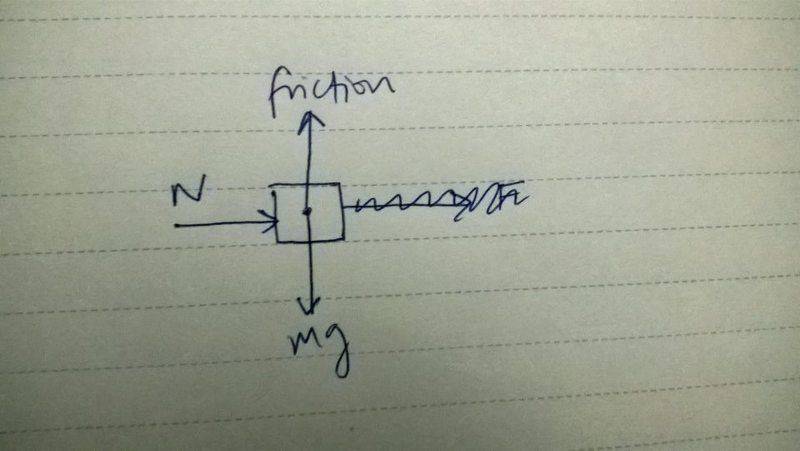
Chestermiller said:Have you drawn a free body diagram showing the forces acting on the smaller mass, or do you feel like you have advanced to the point where you no longer need to use free body diagrams?
cnh1995 said:Yes. That is what is needed. Write the equation for forces "on" the smaller block. You'll get the value of friction coeff just to avoid slipping. You'll see Chestermiller's reply makes true sense!
I knew the FBD would do the trick.Priyadarshini said:View attachment 95008
Got it! Thank you!