Cube-Rod Pendulum: Solving Homework Statement & Equations

  • Thread starter Thread starter lilphy
  • Start date Start date
  • Tags Tags
    Pendulum
Click For Summary

Homework Help Overview

The discussion revolves around a pendulum consisting of a thin rod and a cube bob, focusing on locating the center of mass, calculating the moment of inertia, and formulating the equation of motion. The problem involves concepts from mechanics, specifically dynamics and rotational motion.

Discussion Character

  • Mixed

Approaches and Questions Raised

  • Participants explore the calculation of the center of mass and moment of inertia, with some questioning the treatment of the rod as massless. There are discussions about the application of the parallel axis theorem and the implications of including the rod's mass in torque calculations.

Discussion Status

Participants have provided insights into the calculations for the center of mass and moment of inertia, with some expressing agreement on certain points. There is ongoing exploration of the torque expression and its dependence on the system's configuration, with no explicit consensus reached on all aspects.

Contextual Notes

Some participants note the complexity introduced by the rod's mass and the need for clarity on the axis of rotation when calculating the moment of inertia. There is a hint of confusion regarding the specifics of the problem setup and the assumptions being made.

lilphy
Messages
27
Reaction score
0
Hello
I am studying for my exam and found an interesting exercise that I'm trying to solve

1. Homework Statement

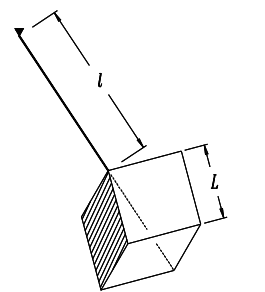
A pendulum consists of a thin rod of length ℓ and
mass m suspended from a pivot ∇ in the figure to the
right. The bob is a cube of side L and mass M, attached
to the rod so that the line of the rod extends through
the center of the cube, from one corner to the
diametrically opposite corner (dashed line).
.
upload_2016-2-15_13-23-45.png

(a) Locate the distance of the center of mass
from the point of support.
(b) Find the moment of inertia I of the (entire)
pendulum about the pivot point.
(Hint: obviously it is too hard to find the
moment of inertia of a uniform cube about an
arbitrary axis through its center of mass by
integrating directly, so there must be some simple trick…)
(c) Write down the equation of motion in terms of I and any
other relevant parameters.

(d) Find the frequency of small oscillations.

Homework Equations

The Attempt at a Solution


I don't know if this is correct :
a/ The center of mass of the cube is at a distance L√3/2 to the corner where the rod is fixed. So the distance between the two centers of mass is L√3/2+l/2.
So the center of mass of the whole system is at a distance m/(M+m)*(L√3/2+l/2) to the cube center of mass and at a distance d=m/(M+m)*(L√3/2+l/2) - L√3/2 to the corner ?

b/ For the moment of inertia of the cube about an axis through the cdm and a corner, I found that it is equal to the moment of inertia about an axis that passes through the center of mass and the center of one face =ML²/6 and for the rod about the corner I=ml²/3
so Itot=ml²/3+ML²/6

c/ If we take φ to be the angle made by the pendulum and the vertical (passes through the pivot) we have to use I*d²φ/dt²=τ with τ the torque
I don"t know what is the expression for the torque here considering that for this pendulum the rod has a mass ?
Thanks
 
Physics news on Phys.org
As I read the question, you are supposed to treat the rod as massless. Other than that, I agree with your answer ro a).
How do you arrive at your answer to b)? I agree with it, just interested in how you got there?
 
Last edited:
haruspex said:
As I read the question, you are supposed to treat the rod as massless. Other than that, I agree with your answer ro a).
How do you arrive at your answer to b)? I agree with it, just interested in how you got there?
Using cosine direction, and the angle between the axis passing through a corner-com and an edge is 55°
So for c/ he torque is just -mgl sin(φ) ? But what if the rod has a mass ?
 
Last edited:
lilphy said:
b/ For the moment of inertia of the cube about an axis through the cdm and a corner
I just realized that although I agree with the result you got for that, it isn't actually what b asks for. They want the MoI about the pivot point.
So you need the MoI about an axis that's through the cdm and orthogonal to a long diagonal, and then you need to use the parallel axis theorem.
lilphy said:
Using cosine direction, and the angle between the axis passing through a corner-com and an edge is 55°
Where/how are you using that?
lilphy said:
So for c/ he torque is just -mgl sin(φ) ?
Where l is the length of the rod? Haven't you forgotten something?

Adding in terms for MoI and torque from the rod is pretty straightforward, but let's get the question as posed sorted first.
 
haruspex said:
I just realized that although I agree with the result you got for that, it isn't actually what b asks for. They want the MoI about the pivot point.
So you need the MoI about an axis that's through the cdm and orthogonal to a long diagonal, and then you need to use the parallel axis theorem.

Where/how are you using that?

Where l is the length of the rod? Haven't you forgotten something?

Adding in terms for MoI and torque from the rod is pretty straightforward, but let's get the question as posed sorted first.
Oh I thought it was about the corner, i don't know why ..
But the moI that I found is about a diagonal, and the rod is aligned with the diagonal, isn't it the same then ?
if not, i don't think i understand your explanations...

I took the origin about the com
The moment of inertia Ixx Iyy Izz is ML2/6 and 0 everywhere else
So the moment of inertia about an arbitrary axis is
I= nIn = cos(a)2Ixx+cos(b)2Iyy+cos(c)2Izz
unit vector n going from origin to the corner n=(Cos(a), cos(b), cos(c))
No need to use the angle because we have I= (cos(a)2+cos(b)2+cos(c)2) ( ML2/6) and we know that for direction cosines : (cos(a)2+cos(b)2+cos(c)=1
 
lilphy said:
Oh I thought it was about the corner
Well, not quite. If you knew the MoI about an axis through the corner and perpendicular to the diagonal through the corner then that would do. You could get from there to the answer using the parallel axis theorem. But note that "through the corner" is not precise enough. You have to specify the axis direction.
lilphy said:
So the moment of inertia about an arbitrary axis is
I= nIn = cos(a)2Ixx+cos(b)2Iyy+cos(c)2Izz
unit vector n going from origin to the corner n=(Cos(a), cos(b), cos(c))
No need to use the angle because we have I= (cos(a)2+cos(b)2+cos(c)2) ( ML2/6) and we know that for direction cosines : (cos(a)2+cos(b)2+cos(c)=1
Yes, that's excellent. I just had not been able to understand why you seemed to care about the angle before.
Anyway, that gives you MoI about any axis through the c.o.m., so in particular about an axis through the c.o.m. perpendicular to the diagonal. So what do you have to do to get the MoI about the pivot point?
 
haruspex said:
Well, not quite. If you knew the MoI about an axis through the corner and perpendicular to the diagonal through the corner then that would do. You could get from there to the answer using the parallel axis theorem. But note that "through the corner" is not precise enough. You have to specify the axis direction.

Yes, that's excellent. I just had not been able to understand why you seemed to care about the angle before.
Anyway, that gives you MoI about any axis through the c.o.m., so in particular about an axis through the c.o.m. perpendicular to the diagonal. So what do you have to do to get the MoI about the pivot point?
Add Md² to the moment of inertia where d is the distance between the com and the pivot, that is √3L/2+l ?
 
lilphy said:
Add Md² to the moment of inertia where d is the distance between the com and the pivot, that is √3L/2+l ?
Yes.
 
haruspex said:
Yes.
For the torque tou told me that I forgot something. The force is applied at the center of the cube so it would be -mg(l+sqrt(3)L/2) sin(theta) ?
 
  • #10
lilphy said:
For the torque tou told me that I forgot something. The force is applied at the center of the cube so it would be -mg(l+sqrt(3)L/2) sin(theta) ?
Yes.
 
  • #11
haruspex said:
Yes.
thank you for your help :smile:
 
  • #12
haruspex said:
As I read the question, you are supposed to treat the rod as massless.
lilphy said:
A pendulum consists of a thin rod of length ℓ and
mass m suspended from a pivot ∇ in the figure to the
right.

Adding the effect of the mass of the rod shouldn't cause too much of a headache.
 
  • #13
TSny said:
Adding the effect of the mass of the rod shouldn't cause too much of a headache.
If we add the effect of the mass of the rod, for the torque Is it just going to be -(M+m)g(l+√3L/2) sinθ ?
 
  • #14
lilphy said:
If we add the effect of the mass of the rod, for the torque Is it just going to be -(M+m)g(l+√3L/2) sinθ ?
No, the torque can be calculated by letting the total weight act at the center of mass of the system.
 
  • #15
TSny said:
No, the torque can be calculated by letting the total weight act at the center of mass of the system.
So I just use what I found in a/ !
Thank you for the answer !
 
  • #16
lilphy said:
So I just use what I found in a/ !
Yes. You will need the distance from the pivot to the CM of the system.
 

Similar threads

Replies
10
Views
3K
  • · Replies 4 ·
Replies
4
Views
2K
  • · Replies 20 ·
Replies
20
Views
2K
Replies
2
Views
2K
Replies
7
Views
4K
  • · Replies 4 ·
Replies
4
Views
2K
  • · Replies 5 ·
Replies
5
Views
3K
  • · Replies 6 ·
Replies
6
Views
1K
  • · Replies 3 ·
Replies
3
Views
1K
  • · Replies 12 ·
Replies
12
Views
2K