What is the Inverse Cosine of a Squared Angle?

Click For Summary
SUMMARY

The discussion focuses on calculating the angle theta when the cosine has been squared, specifically using the equation ##\frac{\sigma_n}{\sigma_x} = \cos^2(\theta)##. Participants clarify that to isolate theta, one must use the inverse cosine function, expressed as ##\cos^{-1}(\theta)##, rather than multiplying by the inverse cosine. The calculated angle is approximately 37.6 degrees, with an alternative solution yielding around 142 degrees. Accurate notation and understanding of inverse functions are emphasized for correct calculations.

PREREQUISITES
  • Understanding of trigonometric functions, particularly cosine and inverse cosine.
  • Familiarity with mathematical notation, including ##\cos^2(\theta)## and ##\cos^{-1}(\theta)##.
  • Basic algebra skills for manipulating equations.
  • Knowledge of angle measurement in degrees.
NEXT STEPS
  • Study the properties of inverse trigonometric functions, focusing on ##\cos^{-1}##.
  • Practice solving equations involving squared trigonometric functions.
  • Explore the concept of multiple solutions in trigonometric equations.
  • Learn about the unit circle and its application in determining angle values.
USEFUL FOR

Students and professionals in mathematics, physics, or engineering who need to solve trigonometric equations involving squared angles and inverse functions.
Mechaman
Messages
37
Reaction score
1
Member warned about posting without the HW template
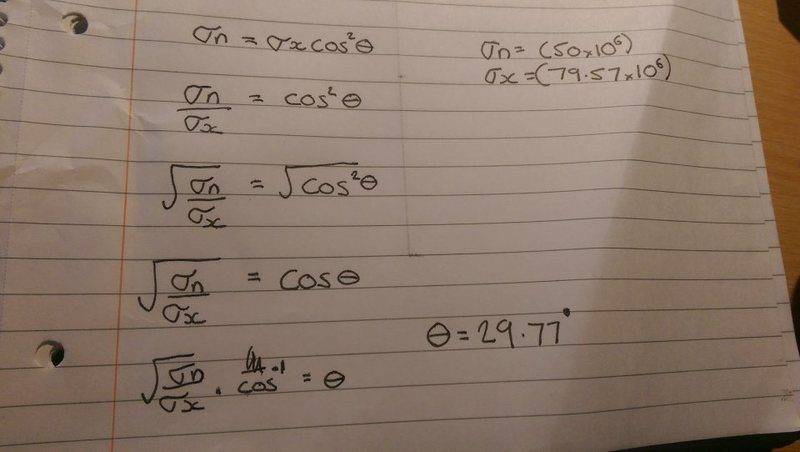
Not sure if I'm doing this right. I have an angle theta to find but the cosine has been squared. I brought over inverse cosine to multiply to leave theta on its own. I was told the answer should be closer to 37 degrees? Am I doing something wrong here?

IMAG0042.jpg
 
Physics news on Phys.org
Did you calculate it via

arccos(sqrt(50/79.57) ?
 
Mechaman said:
Not sure if I'm doing this right. I have an angle theta to find but the cosine has been squared. I brought over inverse cosine to multiply to leave theta on its own. I was told the answer should be closer to 37 degrees? Am I doing something wrong here?

View attachment 89616
On the 4th line from the bottom you have ##\frac{\sigma_n}{\sigma_x} = \cos^2(\theta)##
This is equivalent to ##\cos(\theta) = \pm \sqrt{\frac{\sigma_n}{\sigma_x}}##
If you take the inverse cosine of both sides, you can isolate ##\theta##. You are NOT multiplying by inverse cosine to get this.

There are many values of ##\theta## that satisfy the last equation above. One that I get is around 37.6°. Please show us the calculation you did.
 
  • Like
Likes   Reactions: Mechaman
Remember the notation ##cos^{-1}(\theta)## is not the same as ##1/cos(\theta)##.
 
  • Like
Likes   Reactions: Mechaman
Mark44 said:
On the 4th line from the bottom you have ##\frac{\sigma_n}{\sigma_x} = \cos^2(\theta)##
This is equivalent to ##\cos(\theta) = \pm \sqrt{\frac{\sigma_n}{\sigma_x}}##
If you take the inverse cosine of both sides, you can isolate ##\theta##. You are NOT multiplying by inverse cosine to get this.

There are many values of ##\theta## that satisfy the last equation above. One that I get is around 37.6°. Please show us the calculation you did.

Thanks for helping I worked it out as the same 37.56 degrees, my maths is a little rusty at the moment!
 
Mechaman said:
Thanks for helping I worked it out as the same 37.56 degrees, my maths is a little rusty at the moment!
Keep in mind that +/-. There's another value around 142°.
 

Similar threads

  • · Replies 4 ·
Replies
4
Views
3K
  • · Replies 19 ·
Replies
19
Views
3K
  • · Replies 33 ·
2
Replies
33
Views
5K
Replies
7
Views
2K
  • · Replies 2 ·
Replies
2
Views
2K
  • · Replies 4 ·
Replies
4
Views
2K
  • · Replies 8 ·
Replies
8
Views
2K
Replies
1
Views
2K
  • · Replies 3 ·
Replies
3
Views
4K
  • · Replies 7 ·
Replies
7
Views
2K