What is the limit using L'hospital's rule?

  • Thread starter Thread starter Avi1995
  • Start date Start date
Click For Summary

Homework Help Overview

The discussion revolves around finding a limit using L'Hospital's rule, particularly focusing on the function involving cotangent and tangent as x approaches certain values. Participants explore the conditions under which L'Hospital's rule can be applied and the nature of the limit itself.

Discussion Character

  • Exploratory, Assumption checking, Problem interpretation

Approaches and Questions Raised

  • Participants discuss the need to confirm that the limit is in an indeterminate form before applying L'Hospital's rule. There is an exploration of rewriting cotangent in terms of tangent and the subsequent setup for applying the rule. Some participants express confusion regarding the existence of the limit as x approaches infinity versus zero.

Discussion Status

The discussion is ongoing, with participants sharing their attempts to apply L'Hospital's rule and referencing external tools like Wolfram Alpha for verification. There is acknowledgment of potential discrepancies in the limit's existence based on different approaches, and some guidance has been offered regarding the setup of the problem.

Contextual Notes

Participants are considering the implications of the limit approaching both infinity and zero, with some suggesting that there may be a printing error in the textbook regarding the expected results.

Avi1995
Messages
21
Reaction score
0
Using L'hospitals rule, find the limit
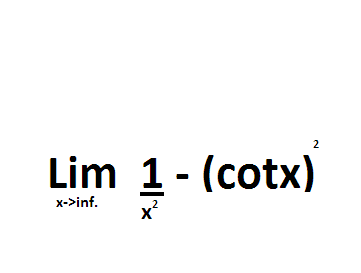
2rgdgmh.png


I seem to stuck using L'hospital's rule ,I replaced cotx=1/tanx but the derivatives of even 4th order are not simplying things.
 
Physics news on Phys.org
Before you even start with l'Hopital's rule you need to check you can write the limit in an indeterminant form 0/0 or infinity/infinity. Did you check that? And do you really mean lim x->inf??
 
Last edited:
Dick said:
Before you even start with l'Hopital's rule you need to check you can write the limit in an indeterminant form 0/0 or infinity/infinity. Did you check that?
Yes,
put cotx=(tanx)^-1, we have then
tan^2x-x^2
--------------
x^2tan^2x
Then we can use the rule.

But I tried wolfram alpha just now and found out that this limit does not exist.
http://www.wolframalpha.com/input/?i=limit+x%5E%28-2%29-%28cotx%29%5E2%2C++x-%3Einf

But instead x->0 exists.
http://www.wolframalpha.com/input/?i=limit+x%5E%28-2%29-%28cotx%29%5E2%2C++x-%3E0
This is the same answer given in textbook. Probably a printing error.
Sorry If I wasted your time.
 
Avi1995 said:
Yes,
put cotx=(tanx)^-1, we have then
tan^2x-x^2
--------------
x^2tan^2x
Then we can use the rule.

But I tried wolfram alpha just now and found out that this limit does not exist.
http://www.wolframalpha.com/input/?i=limit+x%5E%28-2%29-%28cotx%29%5E2%2C++x-%3Einf

But instead x->0 exists.
http://www.wolframalpha.com/input/?i=limit+x%5E%28-2%29-%28cotx%29%5E2%2C++x-%3E0
This is the same answer given in textbook. Probably a printing error.
Sorry If I wasted your time.

Yes, that's the way to set it up, and I'm sure they mean lim x->0. Given that you should get the right result after four derivatives.
 

Similar threads

Replies
6
Views
2K
Replies
17
Views
2K
  • · Replies 10 ·
Replies
10
Views
2K
  • · Replies 22 ·
Replies
22
Views
3K
  • · Replies 8 ·
Replies
8
Views
2K
Replies
4
Views
2K
  • · Replies 11 ·
Replies
11
Views
2K
  • · Replies 6 ·
Replies
6
Views
2K
  • · Replies 7 ·
Replies
7
Views
2K
  • · Replies 22 ·
Replies
22
Views
4K