What Is the Maximum Angle Before Crutches Slip on the Floor?

Click For Summary
SUMMARY

The maximum angle θMAX before crutches slip on the floor is determined by the coefficient of static friction, which is 0.90. The normal force acting on each crutch is expressed as Fcosθ, where F represents the force exerted by the user. Additionally, each crutch supports half of the user's weight, leading to the normal force being mg/2. Understanding the vector nature of forces is crucial for solving this problem, as it involves both horizontal and vertical force components.

PREREQUISITES
  • Understanding of static friction and its coefficient
  • Knowledge of vector forces and their components
  • Familiarity with normal force calculations in physics
  • Basic principles of equilibrium in mechanics
NEXT STEPS
  • Calculate the maximum angle θMAX using the formula involving static friction
  • Explore vector decomposition of forces in two dimensions
  • Study equilibrium conditions for forces in mechanical systems
  • Review examples of similar problems involving crutches or inclined planes
USEFUL FOR

Physics students, mechanical engineers, and anyone interested in understanding the mechanics of forces and friction in practical applications.

jehan4141
Messages
90
Reaction score
0
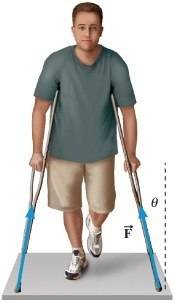
The person in the drawing is standing on crutches. Assume that the force exerted on each crutch by the ground is directed along the crutch, as the force vectors in the drawing indicate. If the coefficient of static friction between a crutch and the ground is 0.90, determine the largest angle θMAX that the crutch can have just before it begins to slip on the floor.
nw0173-nu.jpg


μ = 0.90
Ff = (Fn)μ
Untitled.png

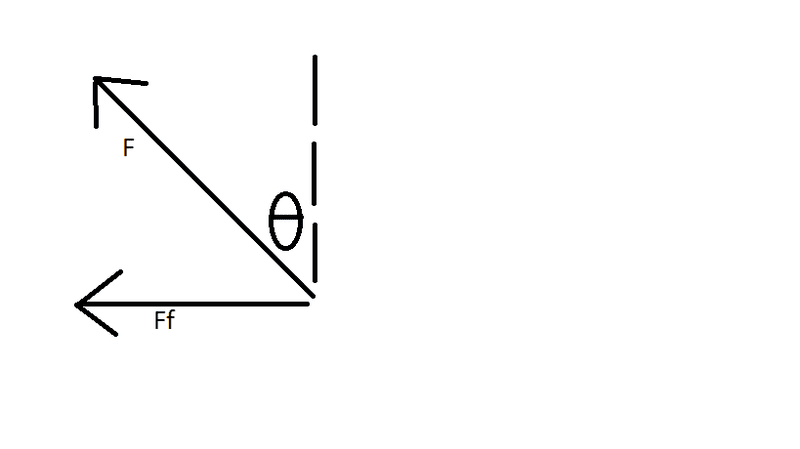
I know that I am missing a force for the problem to work, but I have thought about it for awhile and I can't seem to picture it. The normal force is supposed to be a force that is perpendicular to the surface...does that mean the normal force is Fcosθ? Is there supposed to be another force in the 4th quadrant? If yes, what is that force? Is it the force of the man pushing down on the crutch? If yes, does the force equal to F then?
 
Physics news on Phys.org
jehan4141 said:
The person in the drawing is standing on crutches. Assume that the force exerted on each crutch by the ground is directed along the crutch, as the force vectors in the drawing indicate. If the coefficient of static friction between a crutch and the ground is 0.90, determine the largest angle θMAX that the crutch can have just before it begins to slip on the floor.

View attachment 39317

μ = 0.90
Ff = (Fn)μ


View attachment 39318
I know that I am missing a force for the problem to work, but I have thought about it for awhile and I can't seem to picture it. The normal force is supposed to be a force that is perpendicular to the surface...does that mean the normal force is Fcosθ? Is there supposed to be another force in the 4th quadrant? If yes, what is that force? Is it the force of the man pushing down on the crutch? If yes, does the force equal to F then?

interesting situation.
Yes Normal force = Fcosθ , but interestingly, the normal force is mg/2 as well, since each crutch has to support half the man's weight.
So as the angle changes, F becomes bigger.
 
When dealing with problems like this, it is very important to remember that forces are not scalar numbers, but vectors, and therefore have magnitude and direction. As such you have:

\vec{F}=F_x \hat{i} + F_y \hat{j}

Thus you can have 2 equations:

\sum{F_x} = (Something)
\sum{F_y} = (Something)

Let us know if you get stuck again. We'll be glad to assist. :smile:
 

Similar threads

Replies
5
Views
5K
Replies
2
Views
16K
Replies
2
Views
1K
Replies
9
Views
2K
  • · Replies 1 ·
Replies
1
Views
5K
  • · Replies 1 ·
Replies
1
Views
8K
  • · Replies 7 ·
Replies
7
Views
2K
  • · Replies 9 ·
Replies
9
Views
2K
  • · Replies 10 ·
Replies
10
Views
6K
  • · Replies 4 ·
Replies
4
Views
3K