What is the minimum force required to move the box?

Click For Summary

Homework Help Overview

The discussion revolves around determining the minimum force required to move a crate up an incline, incorporating concepts from physics such as forces, friction, and angles. The original poster presents a problem statement and relevant equations, while also providing specific values for mass, angle, and friction coefficients.

Discussion Character

  • Exploratory, Assumption checking, Problem interpretation

Approaches and Questions Raised

  • Participants discuss the relationship between the applied force and the normal force, with some questioning the assumptions made in the calculations. There is a focus on identifying the correct equations needed to solve for the unknowns involved.

Discussion Status

The discussion is ongoing, with participants exploring different interpretations of the problem. Some have offered guidance on maintaining variables in equations rather than substituting numerical values too early, while others express uncertainty about how to proceed with the calculations.

Contextual Notes

Participants note the complexity introduced by the angle of the applied force affecting the normal force, which adds to the challenge of solving for the minimum force required.

thomovich
Messages
3
Reaction score
0
Homework Statement
What is the minim Force F necessary to make the crate start moving up the incline?
Relevant Equations
F_push=mgsin(ø)+F_f
F_f= µ_s mgcos(ø)
Problem Statement: What is the minim Force F necessary to make the crate start moving up the incline?
Relevant Equations: F_push=mgsin(ø)+F_f
F_f= µ_s mgcos(ø)

My values
m = 80kg
ø = 20
Fø = 15
static friction = 0,5
constant friction = 0,4
F _push = 80kg * 9.8 m/s^2 *sin(20) + 0,5 * 80kg * 9.8 m/s^2 * cos(20)
This gives 636,503N
Because the force is coming at an angle i divide my Newtons with cos
636,503N/cos(15) = 658,956 N required to make the crate move.
Attached below is the photo of the drawing.
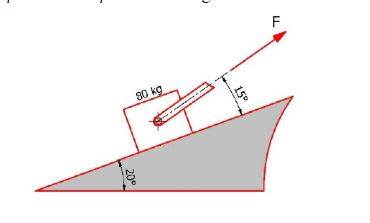
crate.JPG
 
Physics news on Phys.org
thomovich said:
F_f= µ_s mgcos(ø)
Careful! A more accurate version would be: F_f= µ_s N, where N is the normal force. (Since the applied force is at an angle, it will affect the normal force.)
 
Okay, that is true but in order to find my N i need to F and my task is to find F, can you lead in the direction of what equations I am looking for to solve this problem? Cause at this moment i don't know where to go forward that's why i went to the forum.
 
thomovich said:
Okay, that is true but in order to find my N i need to F and my task is to find F, can you lead in the direction of what equations I am looking for to solve this problem? Cause at this moment i don't know where to go forward that's why i went to the forum.
This is where algebra is useful. I can see you have been taught to plug in the numbers but that makes it difficult in this case.

You should keep ##F## and ##N## as variables and look at all the forces on the block.
 
  • Like
Likes   Reactions: CWatters
+1

There are two unknowns (F and N) but you can write two independent equations. Therefore it's solvable.
 
I am not saying you cannot solve i just do not know how :)
 
Start by writing an equation for the force components perpendicular to the plane. What must they add to?
 

Similar threads

Replies
92
Views
9K
  • · Replies 11 ·
Replies
11
Views
4K
  • · Replies 11 ·
Replies
11
Views
2K
  • · Replies 1 ·
Replies
1
Views
3K
  • · Replies 18 ·
Replies
18
Views
2K
  • · Replies 1 ·
Replies
1
Views
3K
  • · Replies 2 ·
Replies
2
Views
2K
Replies
7
Views
2K
Replies
12
Views
5K
  • · Replies 7 ·
Replies
7
Views
5K