What is the physics behind line vortices and their equations of motion?

  • Context: Graduate 
  • Thread starter Thread starter etotheipi
  • Start date Start date
  • Tags Tags
    Line Motion
Click For Summary

Discussion Overview

The discussion revolves around the concept of line vortices in fluid dynamics, specifically focusing on their physics and the derivation of their equations of motion. Participants explore theoretical aspects, mathematical formulations, and practical demonstrations related to line vortices.

Discussion Character

  • Exploratory
  • Technical explanation
  • Mathematical reasoning

Main Points Raised

  • One participant seeks clarification on the nature of line vortices and their equations of motion, noting that the velocity of a vortex is influenced by other vortices in the plane.
  • Another participant references H. Lamb's "Hydrodynamics" as a resource for understanding vortex motion.
  • A participant describes a line vortex as a line around which fluid circulates, likening it to the interaction of tornadoes and demonstrating the concept with smoke rings.
  • One participant presents a mathematical approach starting with the vorticity equation and discusses how the velocity potential for cylindrical vortices can be constructed, leading to a formulation of the motion of multiple vortices.
  • Participants share enthusiasm for visual demonstrations of line vortices, particularly through videos showing interactions of smoke rings.

Areas of Agreement / Disagreement

There is no consensus on the derivation of the equations of motion for line vortices, and multiple viewpoints and approaches are presented without resolution.

Contextual Notes

Participants express varying levels of familiarity with the mathematics involved, and some mathematical steps remain unresolved or are presented with assumptions that are not fully clarified.

Who May Find This Useful

This discussion may be of interest to students and professionals in fluid dynamics, physics, and engineering, particularly those exploring vortex dynamics and mathematical modeling in fluid systems.

etotheipi
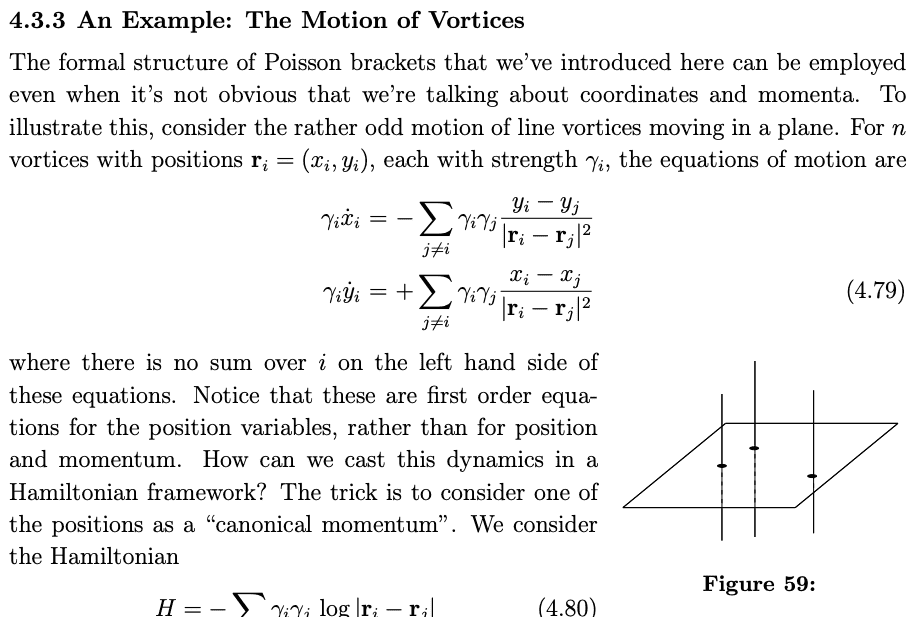
I'm getting really stuck with understanding this example:

1606399298947.png

(Source: page 98)

What is a line vortex, and how do we derive those equations of motion? All I can tell is that the velocity of a given vortex depends on a contribution from every other vortex in the plane, but I wondered if someone could explain the physics of this problem? Thanks
 
Last edited by a moderator:
Physics news on Phys.org
Have a look at the classic

H. Lamb, Hydrodynamics, Cambridge University Press

He has a long chapter on vortex motion.
 
  • Like
Likes   Reactions: etotheipi
Thank you, I booked it! I'll post something if I determine the derivation :smile:
 
A line vortex is a line around which the fluid circulates. Roughly speaking, the diagram is an idealisation of three tornadoes - their winds interact, either adding or opposing, and this moves the vortices around. A neat demo you can find on YouTube is blowing smoke (or vape) rings. The rings are line vortices curved round into loops, and two rings interact in visually intriguing ways.

I've long forgotten the maths, I'm afraid.
 
  • Like
Likes   Reactions: vanhees71 and etotheipi
Okay, after some reading I think I understand the construction now. Start with the vorticity equation,$$\frac{D\boldsymbol{\omega}}{Dt} = (\boldsymbol{\omega} \cdot \nabla) \boldsymbol{u}$$where the ##D/Dt## is the material derivative. If the flow is confined to a plane, then ##\boldsymbol{\omega} = \nabla \times \boldsymbol{u}## is orthogonal to the plane, which contains ##\nabla \boldsymbol{u}##. That means, the RHS is zero, and $$\frac{D \boldsymbol{\omega}}{Dt} = \boldsymbol{0}$$Vortices with cylindrical symmetry are described by a velocity potential ##\phi = k\theta##, i.e. ##\boldsymbol{u} = \nabla \phi = (k/r) \boldsymbol{\theta}##. If we have N vortices, then the resulting velocity potential is$$\phi(\boldsymbol{r}) = \sum_i^N k_i\theta_i$$where the ##\theta_i## are the angles of the line segments from the ##i##th vortex to the point ##\boldsymbol{r}##, w.r.t. the ##x## axis. Helmholtz tells us that any given vortex only experiences the velocity field arising due to all of the other vortices (and not due to itself), so $$\dot{\boldsymbol{r}}_i = \nabla_{\boldsymbol{r}_i} \left( \sum_{j \neq i}^N k_j \theta_j \right) = \sum_{j \neq i}^N k_j \nabla_{\boldsymbol{r}_i} \theta_j = \sum_{j \neq i}^N k_j \left( \frac{\boldsymbol{z} \times (\boldsymbol{r}_i - \boldsymbol{r}_j)}{|\boldsymbol{r}_i - \boldsymbol{r}_j|^2} \right)$$and when we break that into ##x## and ##y## components, I think that agrees with what Prof. Tong wrote (except the ##\gamma## terms are wrapped inside the ##k## terms here).
 
Last edited by a moderator:
  • Like
Likes   Reactions: vanhees71
Ibix said:
A neat demo you can find on YouTube is blowing smoke (or vape) rings. The rings are line vortices curved round into loops, and two rings interact in visually intriguing ways.

These things are indeed pretty neat! 😲

 
  • Like
Likes   Reactions: Ibix
That's a slightly more scientific video than I was thinking of. The one below is a guy doing tricks with an eCig, and he has a bit more control over the rings than the bucket gives you. About 1.50 and 2.35 you can see the rings he makes interacting - the latter is a classic where he blows one ring through another and they begin to orbit each other.
 
  • Love
Likes   Reactions: etotheipi

Similar threads

  • · Replies 10 ·
Replies
10
Views
2K
Replies
2
Views
2K
  • · Replies 22 ·
Replies
22
Views
1K
  • · Replies 7 ·
Replies
7
Views
2K
  • · Replies 1 ·
Replies
1
Views
2K
Replies
7
Views
5K
Replies
4
Views
945
  • · Replies 19 ·
Replies
19
Views
2K
  • · Replies 1 ·
Replies
1
Views
2K
Replies
30
Views
3K