What is the preheat temperature for the water entering the gas boiler?

Click For Summary

Discussion Overview

The discussion revolves around determining the preheat temperature of water entering a gas boiler, specifically in the context of designing a hairpin heat exchanger for a public shower system. Participants explore the calculations and design considerations necessary for effectively preheating incoming cold water using lukewarm water drained from the system.

Discussion Character

  • Technical explanation
  • Mathematical reasoning
  • Debate/contested
  • Homework-related

Main Points Raised

  • One participant seeks to calculate the preheat temperature of water leaving the heat exchanger, noting the need for a schematic diagram of the water circuit.
  • Another participant emphasizes the importance of providing context and prior attempts at solutions to facilitate assistance.
  • Some participants discuss the equation Q = UA * LMTD and the need for initial guesses in design parameters, particularly for the overall heat transfer coefficient U.
  • There is a suggestion that with an infinitely large heat exchanger, the outlet temperature could approach the temperature of the lukewarm water (38 °C), but this raises questions about the feasibility of such a design.
  • Participants express uncertainty about the correct values for LMTD and the implications of using certain temperatures in calculations, particularly when they lead to breakdowns in the equations used.
  • One participant mentions using the NTU-epsilon method for calculations, but expresses doubt about the accuracy of their results.
  • There are discussions about the number of showers that the system is designed to accommodate, indicating a potential misunderstanding of the system's scale.
  • Some participants clarify the roles of various parameters in the equations and the implications of their choices on the design process.

Areas of Agreement / Disagreement

Participants generally agree on the need for calculations and the use of specific equations, but there is significant uncertainty regarding the correct temperatures to use and the implications of those choices. Multiple competing views on the design approach and calculations remain unresolved.

Contextual Notes

Participants highlight limitations in the available information, particularly regarding temperature values and assumptions about flow rates. There is also mention of the need to consider factors such as fouling and the trade-off between investment and efficiency in the design of the heat exchanger.

Who May Find This Useful

This discussion may be useful for students and professionals involved in thermal engineering, heat exchanger design, and energy efficiency in plumbing systems.

Seta
Messages
5
Reaction score
1
Summary:: I need to know the preheat temperature of the water entering the gas boiler (which i think is the outlet temperature of the cold water Tc,o leaving the heat exchanger)

Hi, I'm doing a design project of a hairpin heat exchanger. The problem is:
In a public shower, the city water is heated in a gas boiler from 15 °C to 43 °C at an average flow rate of 2 kg/s. In an attempt to save energy consumption, it is proposed to collect the lukewarm water drained at the temperature of 38 ° C and pass it through a heat exchanger to preheat the incoming cold water (which is at 15 °C). If the dimensions of the space in which the heat exchanger will be installed are 1m x 3m x 1m, design a hairpin-type heat exchanger which must properly perform this task.
From here, i have to do a schematic diagram of the water circuit with different devices (position of the HX, pumps, valves, boiler,...), and do the different calculations.

My problem is, i couldn't calculate the preheat temperature of the water leaving the HX.

I've done the schematic diagram, is this the right way to do it, and should i add or remove something from it ?
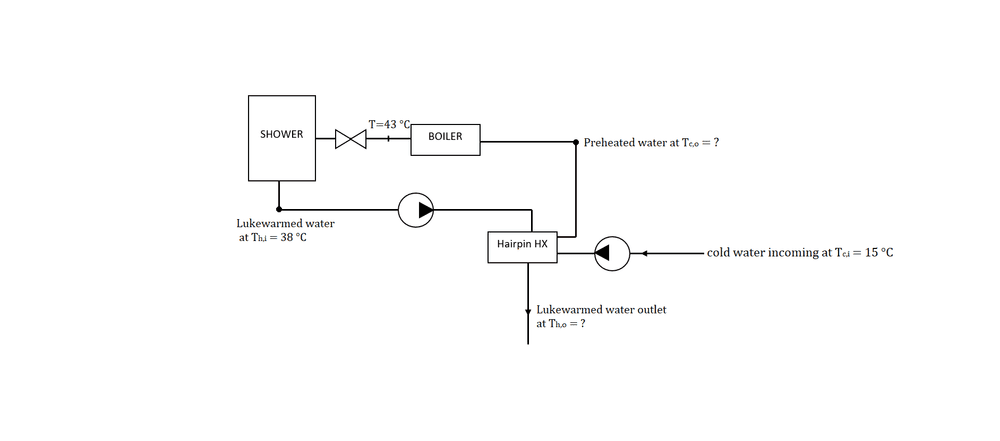
schematic diagram of the water circuit.png
 
Physics news on Phys.org
Hello @Seta , :welcome: !

Did you read the guidelines ? We are not allowed to help if you don't post your own attempt at solution.

Also, it would help if you provide some context and information to help us assist you at the proper level: what do you know about HX design , do you have access to the VDI Heat Atlas, ever seen Q = UA*LMTD etc. And who made the choice of a hairpin-type instead of a plate HX -- teacher ?
 
  • Like
Likes   Reactions: Lnewqban
Sorry, it's my first time using this forum.
What i want to do is to find the number of hairpins needed with : Q = UA_hp *LMTD*N_hp where A_hp is the area of the inner tube of one hairpin HX, and N_hp is the number of hairpins.

The problem here is that to find Q i have to know either the outlet temperature of the lukewarmed water Th,o or the preheated water Tc,o with : Q = m_c * Cp_c * ( Tc,o - Tc,i ) = m_h * Cp_h * ( Th,i - Th,o ).
Same thing goes for LMTD.

Then I'll calculate U by calculating the sum of the resistances, and to do so I'll have to find the convection coefficients inside the tube and in the annulus by calculating the reynolds number, nusselt number ...

The main problem here is the lack of information about the temperatures, that's what kept me stuck.

And yes, the teacher decided to use a hairpin type HX.

Thank you.
 
Good info!

The usual path in designing such a contraption is that you make a starting guess of U and if necessary refine in subsequent iterations. From Coulson and Richardson Vol 6: water/water shell and tube: 800-1500 W/(m2 ##\cdot## K). Or here 150-1200. So perhaps try 1000. (low flow water at low P allows thin pipes).

Seta said:
The main problem here is the lack of information about the temperatures, that's what kept me stuck.
You have approximately equal flowrates, so with an infinitely large exchanger you can preheat to the 38 ##^\circ##C (if you believe that number) and cool down to 15. The limit is size and in 3 m3 you can stuff a huge area of pipe. The tradeoff is investment versus efficiency: adding area doesn't give a good return on investment after a while.

Do the calculations with an equation solver (see engineeringtoolbox), or better: iterate in excel for good understanding or use the ##\varepsilon-##NTU method.

Check how sensitive (or rather insensitive) heat recovery percentage is under changes in UA once you are in the range 80-90%.

Allow some fouling and there you are !

Nice exercise; let us know how it goes :smile:
 
  • Like
Likes   Reactions: berkeman
From what i understand, i have to take Th,o = 15 °C and Tc,o = 38 °C , but if i do so, which value should i take for LMTD since ( Th,i - Tc,o ) = ( Th,o - Tc,i ) = 0 ?
On the other hand, when i asked my teacher about the preaheat temperature Tc,o , he said that it has to be calculated.
 
Seta said:
From what i understand, i have to take Th,o = 15 °C and Tc,o = 38 °C
That's with an infinitely big HX. No wonder LMTD breaks down !
So take e.g. 90% recovery: LMTD still breaks down but we know that in the limit ##\Delta T_A \rightarrow \Delta T_B## the LMTD goes like ##LMTD \rightarrow \Delta T_A## (don't we ? :smile: )

Seta said:
he said that it has to be calculated.
Sure. It follows from Q = UA LMTD
 
Alright, thank you so much !
 
  • Like
Likes   Reactions: berkeman
Sheer curiosity: how is it going ? I scribbled a few calculations and can imagine this is a meaningful and challenging exercise !
Also raises a few questions: the schematic suggests a single-shower application, but the 3 m3 seems a bit hefty for that ?

With 10 l/min and 23 ##^\circ##C ##\Delta##T, a maximum of 16 kW can be recovered, but then there is no ##\Delta##T left over (I think the professinals call that the 'approach').
If we aim for 80% that leaves ##\Delta##T = 4.6 ##^\circ##C meaning we need a UA of 3.5 kW/##^\circ##C

It can be done. Compare notes ?
 
Yes that's true, this isn't for one shower only, i should've added more.

Honestly, i am a little bit lost, i started calculations with 80% recovery :

q = 0.8 * 2 * 4.1786 * (43 - 15) = 187.2 kW // I took Cp_c at T = (43+15)/2 = 29 °C

Now i'll start to work with NTU-eps method:

q_max = m_c * Cp_c * (Th,i - Tc,i) = 192.234 kW // i took Cp_c at T = (38+15)/2 = 26.5 °C

==> eps = q / q_max

==> NTU = eps / (1-eps) // I took the heat capacity ratio equals 1 because the flowrates and the specific heat capacities are aproximately the same.

==> Uo * A_hp * N_hp = Cmin * NTU = m_c * Cp_c * NTU

And now, by first guessing Uo i can find the proper geometry, or i choose the dimensions first, then i'll calculate Uo.

I don't know if this the right way to do it, but i strongly doubt the results.
 
  • #10
I don't see the 43##^\circ## anywhere near the heat exchanger ?

Other than that:

I suppose you want to run 12 showers simultaneously ?

Seta said:
i strongly doubt the results
Why ? Not sure I follow this NTU method -- maybe more ime tomoow.

Seta said:
I took the heat capacity ratio equals 1 because the flowrates and the specific heat capacities are aproximately the same.
I agree.

A_hp ? N_hp ?
 
  • Like
Likes   Reactions: Seta
  • #11
Had to rehash my NTU stuff (almost never use it):
Seta said:
q = 0.8 * 2 * 4.1786 * (43 - 15) = 187.2 kW // I took Cp_c at T = (43+15)/2 = 29 °C ##\qquad## (1)

Now i'll start to work with NTU-eps method:

q_max = m_c * Cp_c * (Th,i - Tc,i) = 192.234 kW // i took Cp_c at T = (38+15)/2 = 26.5 °C ##\qquad## (2)

==> eps = q / q_max##\qquad## ##\qquad## ##\qquad## (3)

==> NTU = eps / (1-eps) // I took the heat capacity ratio equals 1 because the flowrates and the specific heat capacities are aproximately the same. ##\qquad## (4)

==> Uo * A_hp * N_hp = Cmin * NTU = m_c * Cp_c * NTU ##\qquad## (5)
ad 1:
The HX sees one input at 38, the other at 15 C. The 43 C is elsewhere, so it can't appear here​
I suppose the 0.8 is ##\varepsilon##​
I suppose the 2 is mass flow, 2 m3/s = 120 L/min, so 12 showers​
ad 2: I agree (but 3 digits is sufficient accuracy here ...)

ad 3:
No, ##q =\varepsilon\,q_{\,\text{max}}\ ##, so some 154 kW !

ad 4: Fully agree

ad 5:
I guess A_hp is a hairpin area and N_hp is their number :rolleyes:
Seta said:
And now, by first guessing Uo i can find the proper geometry, or i choose the dimensions first, then i'll calculate Uo.

I don't know if this the right way to do it, but i strongly doubt the results.

You have an initial guess for U. That gives you an area.
Pick a pipe diameter ##\Rightarrow## number of pipes. A check on the 3 m3.
Flow speed in the pipes, pressure drop, pipe wall thickness etc.

Then you might look at U again

good luck!

##\ ##
 
  • Like
Likes   Reactions: Seta

Similar threads

  • · Replies 10 ·
Replies
10
Views
3K
Replies
22
Views
4K
  • · Replies 7 ·
Replies
7
Views
4K
  • · Replies 20 ·
Replies
20
Views
6K
  • · Replies 50 ·
2
Replies
50
Views
12K
  • · Replies 2 ·
Replies
2
Views
2K
  • · Replies 44 ·
2
Replies
44
Views
8K
  • · Replies 1 ·
Replies
1
Views
2K
  • · Replies 5 ·
Replies
5
Views
4K
  • · Replies 1 ·
Replies
1
Views
2K
