What is the purpose of a capacitor in a voltage divider circuit?

Click For Summary
SUMMARY

The discussion centers on the role of capacitors in voltage divider circuits, specifically for measuring voltage from a 3S LiPo battery. Participants confirm that a capacitor, typically around 1uF, is essential for filtering noise and providing burst current to the ADC during measurements. It also serves as a protective measure against voltage spikes during battery removal. The total resistance for the voltage divider is confirmed to be effective within the range of 10-80 kΩ, with specific resistor values of 1.5 kΩ and 7.5 kΩ mentioned.

PREREQUISITES
  • Understanding of voltage divider circuits
  • Knowledge of ADC (Analog-to-Digital Converter) operation
  • Familiarity with capacitor functions in electronic circuits
  • Basic soldering skills for circuit assembly
NEXT STEPS
  • Research the impact of capacitor values on ADC performance
  • Learn about noise filtering techniques in electronic circuits
  • Explore PCB design for compact circuit assembly
  • Investigate the specifications and applications of 3S LiPo batteries
USEFUL FOR

Electronics hobbyists, circuit designers, and anyone involved in measuring battery voltages or building voltage divider circuits.

Borek
Mentor
Messages
29,170
Reaction score
4,598
I need a voltage divider to make it possible to measure voltage on the 3S LiPo battery that delivers around 11 V using a device that measures up to 4 V (approx). I can make one, no problem, just solder two resistors with resistances in the more or less 1:3 ratio (measured output is sent as a single byte value and is later scaled by the RC receiver before being displayed, so it doesn't matter how precise the divider is, as I can change the scaling constant). I know from googling that the total resistance of about 10-80 kΩ works, so it gives me enough information to buy resistors, trivial and no problem.

However, I googled for schematics, and found that on some of them there is an additional capacitor added on the output side. What role does it play?
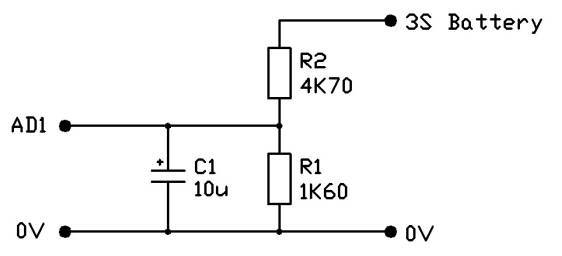
image004.jpg
 
Engineering news on Phys.org
It acts as a filter and a snubber during battery removal. If there are long lines to the battery you can pick up noise and get false readings.You can also get a high voltage spike on battery removal due to the inductance. 10uF seems a bit large for this purpose.

BoB
 
It does more than that. It filters the output full time since typically it's measured by an ADC which can return jumpy values due to noise when unfiltered. Though for any application 10uF is large. For that resistor network a 1uF capacitor would be ample in providing any filtering that may or may not be required by the ADC. Typically they run filtering routines internally that can do the same job, but they don't always.

Another thing the cap can do is provide the burst current required by the ADC to take measurements. Usually ADCs can handle source impedance up to about 2kΩ, but if source impedance is higher, the cap acts as a tank to provide the current needed to charge the ADC when it takes a measurement.

Generally it's good practice to place a cap across the terminals of an ADC. Just a bit of insurance to cover some things that may cause a problem. Kind of the same idea as putting a decoupling cap across the power supply pins on a chip when designing PCBs.
 
Last edited:
Thank you guys.

Soldering time. In case I disappear for the next few days it means I have blisters on my fingertips.
 
As you can guess, soldering is not my forte. It is a bit longer than I wanted, but it will still nicely fit inside the model (after being put in a heatshrink). I didn't want to solder three free ends at the same time, which is why I have removed the isolation in the middle of the wire. It also helped to keep elements separated (only the capacitor required additional isolation).

There are probably many ways to make it better. Actually it can be even bought for about $4... but where's the fun in that?

IMG_5626.jpg
 
Borek said:
... but where's the fun in that?
Nice divider. Now how about a multiplier?
image compliments https://www.ibiblio.org/

Cockcroft-Walton multiplier.jpg

[PLAIN said:
https://www.ibiblio.org/kuphaldt/electricCircuits/Semi/SEMI_3.html]A[/PLAIN] voltage multiplier of cascaded half-wave doublers of arbitrary length is known as a Cockcroft-Walton multiplier ...
 
Last edited by a moderator:
  • Like
Likes   Reactions: Borek
The moment my model will run on AC and will require high voltage I will consider making one :wink:
 
  • Like
Likes   Reactions: dlgoff
img_5626-jpg.105822.jpg


A ratio of 1:3 and the total resistance of about 10-80 kΩ? — not quite!
 
Borek said:
There are probably many ways to make it better.

That should do the job.

If you want to start making your own circuits, you should look into making PCBs yourself using surface mount components. With some 0603 size components that small circuit would be a square not much wider than the wires soldered to it. Actually it's not all that hard to do, looks harder than it is.

More than anything else the real trick with doing small PCBs using SMD components is having a good magnifier and workstation. For example attached is a photo of a small dual ESC I made for a micro RC helicopter. I assembled that PCB by hand under a stereoscope.
 

Attachments

  • ESC_2S-1.jpg
    ESC_2S-1.jpg
    43.6 KB · Views: 699
  • Like
Likes   Reactions: Borek
  • #10
NascentOxygen said:
A ratio of 1:3 and the total resistance of about 10-80 kΩ? — not quite!

Good enough - I know from googling that I am in the range people used. These are 1.5 and 7.5 kΩ (I know they look both identical), so the ratio is lower, but first - it makes place for stronger packets (like 4S), second - I was told conflicting information about the range measured by the AD, some say it is 0..3.3 V, some say it is 0..5 V. These resistors make me stay on the safe side.

And as you can see from the schematics I posted, even total of around 6 kΩ is OK.
 
  • #11
CraigHB said:
That should do the job.

It does. Already tested.
 
  • #12
Borek said:
These are 1.5 and 7.5 kΩ (I know they look both identical),
Ah, yes. ✔ (I see by enlarging the image it reveals the violet.)[/size]
 
  • #13
NascentOxygen said:
Ah, yes. ✔ (I see by enlarging the image it reveals the violet.)

They are so similar I had to use a multimeter to check I wasn't sold two identical ones. In the artificial light in my room and using a magnifying glass, even knowing they are different, I had still problems finding which is which.
 
  • #14
Borek said:
They are so similar I had to use a multimeter to check I wasn't sold two identical ones. In the artificial light in my room and using a magnifying glass, even knowing they are different, I had still problems finding which is which.
Quite. I don't understand why manufacturers don't make their band colours more distinct. With some it's difficult to discern whether a band is red or orange without having a second resistor with the other colour for comparison. Black vs. brown can be a problem, too.
 
  • #15
I find I also have issues reading the color codes on resistors. I find a LED flashlight helpful. The colors appear clearer under that light source. At times when I get frustrated trying to divine the color code I just give up and measure the resistor with a DMM with a readout made for old guys...lol

Cheers,

Billy
 

Similar threads

  • · Replies 78 ·
3
Replies
78
Views
6K
Replies
15
Views
2K
  • · Replies 32 ·
2
Replies
32
Views
3K
Replies
4
Views
3K
Replies
8
Views
2K
  • · Replies 23 ·
Replies
23
Views
7K
  • · Replies 5 ·
Replies
5
Views
2K
Replies
3
Views
2K
  • · Replies 19 ·
Replies
19
Views
3K
  • · Replies 19 ·
Replies
19
Views
5K