pinsky
- 95
- 0
I've been breaking my head a couple of hours to figure out the concept of momentum, and it's difference between kinetic energy. Here's what i came up with, please correct the things which are wrong.
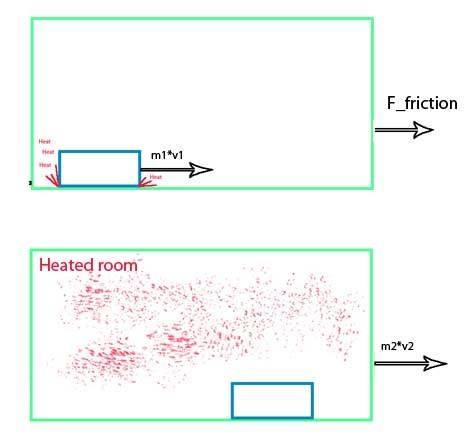
The blue object has a starting velocity v_1 so it has a momentum v_1 \cdot m_1[\tex].<br /> <br /> The green rectangle represents a closed system. <br /> <br /> As the blue object moves, it looses its kinetic energy do to friction, and at the same time it transfers the momentum to the system. Since there is a force on both the blue and the green rectangle, each of them is accelerating in the direction of the force.<br /> <br /> When all the kinetic energy is converted to heat, the blue object stops, and at that same time, all of the momentum has been transferred to the green rectangle.<br /> <br /> <br /> Just one thing, to avoid confusion. I am aware that I can't say that <blockquote data-attributes="" data-quote="" data-source="" class="bbCodeBlock bbCodeBlock--expandable bbCodeBlock--quote js-expandWatch"> <div class="bbCodeBlock-content"> <div class="bbCodeBlock-expandContent js-expandContent "> Since there is a force on both the blue and the green rectangle, each of them is accelerating in the direction of the force. </div> </div> </blockquote> because it would be normal that i observe the relative movement of the green object compared to the STATIC blue rectangle (because i defined it as the closed system).<br /> I did so on purpose. While trying to figure out the relationship between friction and momentum <br /> <blockquote data-attributes="" data-quote="" data-source="" class="bbCodeBlock bbCodeBlock--expandable bbCodeBlock--quote js-expandWatch"> <div class="bbCodeBlock-content"> <div class="bbCodeBlock-expandContent js-expandContent "> why was there a conservation of momentum if i loose speed do to friction? </div> </div> </blockquote>i tried observing a calculator on my desk.<br /> <br /> I push my calculator, it moves a bit and then stops do to friction. I couldn't see where the movement went because i considered my table the closed system and it didn't move when i pushed my calculator (at least not enough for me to notice :) ). <br /> If I could notice, i would see that the table transfer its momentum to the house floor, which transfers its momentum to the planet earth. <br /> <br /> I hope you understand why i called the green rectangle a closed system, and then observed he whole drawing from a even larger perspective. To me, limiting myself to a closed system (in the real meaning of that word) was the main problem of failing to understand momentum.<br /> <br /> <br /> This leads me to another conclusion.<br /> <br /> The kinetic energy of a moving object can't all be converted to heat (or sound) but must also partially be transferred to a different object in kinetic energy form.<br /> I think there must be a formula which defines how much of the energy must remain kinetic.
The blue object has a starting velocity v_1 so it has a momentum v_1 \cdot m_1[\tex].<br /> <br /> The green rectangle represents a closed system. <br /> <br /> As the blue object moves, it looses its kinetic energy do to friction, and at the same time it transfers the momentum to the system. Since there is a force on both the blue and the green rectangle, each of them is accelerating in the direction of the force.<br /> <br /> When all the kinetic energy is converted to heat, the blue object stops, and at that same time, all of the momentum has been transferred to the green rectangle.<br /> <br /> <br /> Just one thing, to avoid confusion. I am aware that I can't say that <blockquote data-attributes="" data-quote="" data-source="" class="bbCodeBlock bbCodeBlock--expandable bbCodeBlock--quote js-expandWatch"> <div class="bbCodeBlock-content"> <div class="bbCodeBlock-expandContent js-expandContent "> Since there is a force on both the blue and the green rectangle, each of them is accelerating in the direction of the force. </div> </div> </blockquote> because it would be normal that i observe the relative movement of the green object compared to the STATIC blue rectangle (because i defined it as the closed system).<br /> I did so on purpose. While trying to figure out the relationship between friction and momentum <br /> <blockquote data-attributes="" data-quote="" data-source="" class="bbCodeBlock bbCodeBlock--expandable bbCodeBlock--quote js-expandWatch"> <div class="bbCodeBlock-content"> <div class="bbCodeBlock-expandContent js-expandContent "> why was there a conservation of momentum if i loose speed do to friction? </div> </div> </blockquote>i tried observing a calculator on my desk.<br /> <br /> I push my calculator, it moves a bit and then stops do to friction. I couldn't see where the movement went because i considered my table the closed system and it didn't move when i pushed my calculator (at least not enough for me to notice :) ). <br /> If I could notice, i would see that the table transfer its momentum to the house floor, which transfers its momentum to the planet earth. <br /> <br /> I hope you understand why i called the green rectangle a closed system, and then observed he whole drawing from a even larger perspective. To me, limiting myself to a closed system (in the real meaning of that word) was the main problem of failing to understand momentum.<br /> <br /> <br /> This leads me to another conclusion.<br /> <br /> The kinetic energy of a moving object can't all be converted to heat (or sound) but must also partially be transferred to a different object in kinetic energy form.<br /> I think there must be a formula which defines how much of the energy must remain kinetic.
Attachments

Last edited: