High School What is the requirement for something to qualify as vector?

Click For Summary
SUMMARY

A vector is defined as an element of a vector space, which is a collection of objects that can be added together and scaled by numerical factors. The discussion clarifies that vectors are not limited to arrowed representations; matrices and functions can also qualify as vectors if they adhere to the axioms of vector spaces. The key takeaway is that an object can be considered a vector if it can be stretched or compressed by numerical factors, even in the absence of a specified vector space. Understanding the properties and axioms of vector spaces is essential for identifying vectors.

PREREQUISITES
  • Understanding of vector spaces and their properties
  • Familiarity with the axioms of vector spaces
  • Basic knowledge of linear algebra concepts
  • Ability to interpret mathematical functions and operations
NEXT STEPS
  • Study the axioms of vector spaces in detail
  • Learn about different types of vector spaces, including function spaces
  • Explore the concept of linear transformations and their relation to vectors
  • Investigate applications of vectors in physics and engineering contexts
USEFUL FOR

Students of mathematics, physics, and engineering, particularly those studying linear algebra and quantum mechanics, will benefit from this discussion. It is also valuable for educators seeking to clarify the concept of vectors in various contexts.

Wrichik Basu
Science Advisor
Insights Author
Gold Member
Messages
2,180
Reaction score
2,690
I have been reading Ramamurti Shankar's book "Principles of Quantum Mechanics". The author, in the first chapter, briefs out the elementary mathematics required for quantum mechanics.

Now, the author has described vector spaces, and made it very clear that only arrowed vectors that one studies in elementary physics, are not the only vectors, but matrices and functions may also be considered as vectors in a vector space consisting of such elements.

But how does something qualify as a vector? Does that quantity have to properly conform to the axioms of vectors (a picture from the book given below shows the axioms), or are there some other specific rules to which it must conform to qualify as a vector?
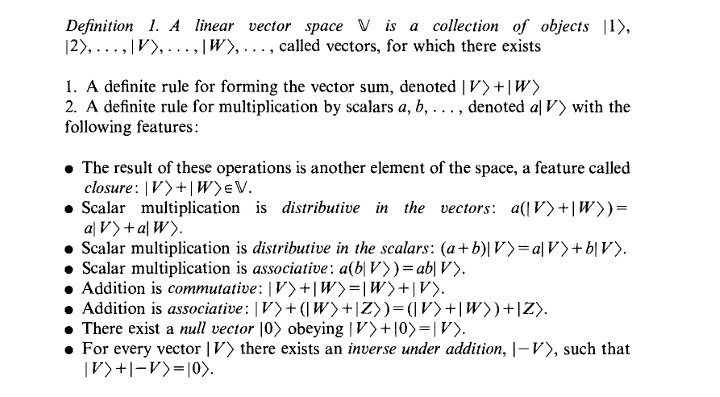
20170828_212841.png
 
Physics news on Phys.org
A vector is an element in a vector space. The image from your book shows the definition of a vector space.
 
Orodruin said:
A vector is an element in a vector space. The image from your book shows the definition of a vector space.
Yes. It shows the definition of a vector space. But in bullet points, it also shows some axioms followed by vectors. How can I understand any quantity is a vector? Can I only determine that if a vector space is already specified?
 
As stated in the picture "A linear vector space ... is a collection of objects, called vectors". There really is nothing more to it. An object is a vector if it is an element of a vector space.
 
  • Like
Likes Wrichik Basu
Orodruin said:
As stated in the picture "A linear vector space ... is a collection of objects, called vectors". There really is nothing more to it. An object is a vector if it is an element of a vector space.
OK, I see. So I can't make out a vector separately without a vector space specified.

Thank you for your input. :partytime::partytime::partytime:
 
For short: A vector is an object that can be added to others of its kind, as well as stretched or compressed, usually something with a direction and a length.

Of course this is very short. E.g. the factors for compression or stretching don't need to be real numbers. Sometimes it is only ##\{0,1\}## or just rational numbers. They do have in common, that they are commutative numbers and those unequal to zero can be inverted. Another point is the imagination of a vector as an arrow (direction and length). Although this is basically true, it is hard to imagine functions as arrows. However, e.g. continuous functions do form a vector space (##(f+g)(x)=f(x)+g(x)## and ##(c\cdot f)(x) = c \cdot f(x)## fulfill the criteria), so they are elements of a vector space and thus vectors, despite the fact that we do not associate arrows with them. So the picture of arrows (e.g. forces or velocities) is often helpful, but isn't helpful in all cases.

Wrichik Basu said:
OK, I see. So I can't make out a vector separately without a vector space specified.
You can. If you simply consider one object, which can be stretched and compressed by numerical factors (also negative ones), then you get a vector space and your object is up to length the only element, i.e. a vector. But, yes, formally it is again a vector space.
 
  • Like
Likes Wrichik Basu
Wrichik Basu said:
Yes. It shows the definition of a vector space. But in bullet points, it also shows some axioms followed by vectors. How can I understand any quantity is a vector? Can I only determine that if a vector space is already specified?
The definition may have made it confusing by called the elements vectors at the beginning. They are just symbols of elements in a set. If the elements and the set has the properties specified, then it is a vector space and the elements are vectors. I believe that the definition is still formally correct as it is, but confusing if you think that "called vectors" means anything other than the properties that follow in the definition.
 
  • Like
Likes Wrichik Basu

Similar threads

  • · Replies 15 ·
Replies
15
Views
3K
  • · Replies 9 ·
Replies
9
Views
2K
  • · Replies 15 ·
Replies
15
Views
3K
  • · Replies 7 ·
Replies
7
Views
3K
  • · Replies 1 ·
Replies
1
Views
4K
  • · Replies 12 ·
Replies
12
Views
4K
  • · Replies 16 ·
Replies
16
Views
5K
  • · Replies 6 ·
Replies
6
Views
11K
Replies
7
Views
3K
  • · Replies 14 ·
Replies
14
Views
4K