What Is the Stiffness Constant k of the Spring?

Click For Summary

Homework Help Overview

The discussion revolves around a spring-mass system where a weight is suspended from a rigid support by a spring with a stiffness constant k. A pendulum is also involved, which is set to oscillate horizontally. Participants explore the relationship between the spring's stiffness constant and the oscillation characteristics of the system.

Discussion Character

  • Exploratory, Conceptual clarification, Assumption checking, Mixed

Approaches and Questions Raised

  • Participants discuss the forces acting on the spring and pendulum, with some attempting to derive the stiffness constant k based on oscillation frequencies. Questions arise regarding the periodic nature of the motion and the assumptions made about the system's behavior.

Discussion Status

The discussion is ongoing, with various interpretations of the system's dynamics being explored. Some participants have provided insights into resonance and the relationship between the pendulum and spring oscillations, while others question the assumptions and seek clarification on specific points.

Contextual Notes

There are constraints regarding the assumptions made about the motion of the weight and pendulum, as well as the lack of specific numerical values that could clarify the system's behavior. Participants note the potential for chaotic behavior in the system under certain conditions.

upender singh
Messages
14
Reaction score
0
1:question
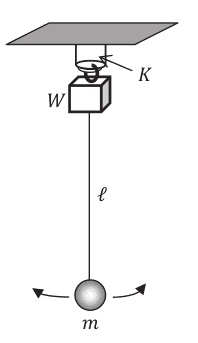
A weight W is suspended from a rigid support by a hard spring with stiffness constant k . The spring is enclosed in a hard plastic sleeve, which prevents horizontal motion, but allows vertical oscillations. A simple pendulum of length l with a bob of
mass m (mg<<W) is suspended from the weight W and is set oscillating in a horizontal line with a small amplitude. After some time has passed, the weight W is observed to be oscillating up and down with a large amplitude (but not hitting the sleeve). It follows that the stiffness constant k ‬ must be:

  1. k=4w/l
  2. k=2w/l
  3. k=w/l
  4. k=w/2l
ans:1
problem.png


2:relevant equations
w^2=k/m

3:attempt
Please hint me where to start. I tried balancing the forces but that brought me nowhere.
 
Last edited:
Physics news on Phys.org
the pendulum mass has vertical acceleration component (v^2/r) as it swings.
The spring must pull the mass upward to provide that acceleration, so the mass pulls the spring downward.
If the timing of the pendulum pulls is appropriate, the spring's oscillations will increase in Amplitude (resonance).
(the pendulum's downward pull does positive Work to the spring if the spring is moving downward, meanwhile).
 
thanks for the help lightgrav,

please reply if i am missing something

let Ω = oscillation frequency of spring mass system alone
let ω= oscillation frequency of the simple pendulum,
then mv^2/r =ml(Asinωt)^2 = mlA^2(1-cos2ωt)/2 , A being some constant
which says that driving force has a frequency= 2ω
equating both for resonance,
k*g/W = 4*g/l
k=4W/l

I assumed that mg won't contribute to the oscillations since mgcosθ≅mg for small θ.
 
@upender singh how did you get frequency =2w kindly post the steps .im trying for 4 days I am unable to so please post steps to get frquency of pendulum as 2 w
 
looks like a problem from the perturbation theory and not like a home work for beginners
 
  • Like
Likes   Reactions: Delta2
Rithishbarath said:
@upender singh how did you get frequency =2w kindly post the steps .im trying for 4 days I am unable to so please post steps to get frquency of pendulum as 2 w
The pendulum exerts max tension on the spring twice each pendulum period, which must be once per spring period.
 
  • Like
Likes   Reactions: etotheipi
haruspex said:
The pendulum exerts max tension on the spring twice each pendulum period,
why do you think that the motion is periodic?
 
wrobel said:
why do you think that the motion is periodic?
It is given by the problem that the weight W oscillates up and down with a large amplitude (also it says that the spring is encased in a plastic sleeve which prevents horizontal motion or swinging). I suppose the pendulum swings left and right in a periodic way too, why wouldn't that be the case?
 
You can not suppose anything after the system has been stated up. You must deduce all your assertions from the equations of motion.
 
  • Like
Likes   Reactions: Delta2
  • #10
Ok i admit i cannot make the equation of motion of the pendulum, indeed it doesn't look so simple and its motion might not be periodic afterall.
 
  • #11
If you simulate this problem numerically you will see a chaotic behavior
 
  • Like
Likes   Reactions: Delta2
  • #12
wrobel said:
You can not suppose anything after the system has been stated up. You must deduce all your assertions from the equations of motion.
No, we are given that the mass oscillates, and I think it reasonable to assume they mean regularly. We have insufficient information to deduce that from the equations of motion.
 
  • #13
The chaotic behavior is kind of obvious if we assume that the weight W is free to swing left and right (together with the up-down motion) but are you sure we are getting chaotic behavior if we restrict W to move only up and down?
 
  • #14
Last edited:
  • Like
Likes   Reactions: Delta2
  • #15
haruspex said:
No, we are given that the mass oscillates, and I think it reasonable to assume they mean regularly. We have insufficient information to deduce that from the equations of motion.
By the existence and uniqueness theorem the equations of motion contain the complete information about the system.
 
  • #16
wrobel said:
By the existence and uniqueness theorem the equations of motion contain the complete information about the system.
Yes, but we are not given the numbers, so the statement about steady oscillation is additional info. Or are you saying that no matter what the numbers such a system will always necessarily be chaotic, and therefore the question is unrealistic?
 
  • #17
haruspex said:
Yes, but we are not given the numbers, so the statement about steady oscillation is additional info
The question is why does such an oscillation exist? To answer this question one must write down the equations of motion and substitute the hypothetical "steady oscillation" into these equations. Do that and make sure that the equations will not be satisfied.
 
  • #18
My interpretation is that this a variant of the Wilberforce pendulum. We have two coupled harmonic oscillators where the pendulum frequency is at resonance with the spring-mass frequency and mechanical energy is transferred back and forth from one to the other. See post #6 by @haruspex.
 
  • Like
  • Informative
Likes   Reactions: etotheipi and Delta2
  • #19
Screenshot from 2020-06-12 15-54-13.png
$$L=\frac{m}{2}\Big(\dot y^2-2l\dot y\dot\varphi\sin\varphi+l^2\dot \varphi^2\Big)+\frac{M}{2}\dot y^2+mg(y+l\cos\varphi)+Mgy-\frac{ky^2}{2}$$
go ahead with considering this system as a linear one
 
Last edited:
  • Like
Likes   Reactions: Delta2
  • #20
wrobel said:
View attachment 264523$$L=\frac{m}{2}\Big(\dot y^2-2l\dot y\dot\varphi\sin\varphi+l^2\dot \varphi^2\Big)+\frac{M}{2}\dot y^2+mg(y+l\cos\varphi)+Mgy-\frac{ky^2}{2}$$
go ahead with considering this system as a linear one
I'm still not completely clear on what you are saying. Are you saying that a nonlinear system with two degrees of freedom is necessarily chaotic regardless of the details?
 
  • #21
haruspex said:
I'm still not completely clear on what you are saying.
see #17
haruspex said:
Are you saying that a nonlinear system with two degrees of freedom is necessarily chaotic regardless of the details?
No. This system is chaotic but it is just for infirmation.
 
  • #22
This reference treats the more general problem in which the spring is not constrained to move only vertically. A bit more than past the halfway mark, in section "Another type of motion?", the author summarizes the motion described by OP albeit in more detail:
  • If the bob is started with almost entirely vertical oscillations, gradually the vertical oscillations subside and a swinging motion occurs.
  • Swinging motion subsides and is replaced by a springing motion as before, and the process repeats.
  • The motion appears planar (but is really elliptical).
  • The “swing plane” rotates each time we return to swinging motion.
It is interesting to note that the spring constant chosen by the author for this study is equal to one of the four choices in this question. Farther below this section the author also discusses energy-dependent chaotic behavior in this system.

It is not clear to me what effects (if any) of constraining the spring to move only vertically would be on the motion of the pendulum bob. Perhaps the swing plane is prevented from rotating. Nevertheless, it seems to me that the motion as described by the OP is possible and that it is not necessarily chaotic.
 
  • #23
kuruman said:
the author discusses the motion described by OP
what is it motion described by OP? please write the formulas
##y(t)=\ldots,\quad \varphi(t)=\ldots## (for ##y## and ##\varphi## see the picture at post #19)
 
Last edited:
  • #24
The motion described by the OP is qualitative. I am not disputing the equations you posted in #19.
upender singh said:
A simple pendulum of length l with a bob of mass m (mg<<W) is suspended from the weight W and is set oscillating in a horizontal line with a small amplitude. After some time has passed, the weight W is observed to be oscillating up and down with a large amplitude (but not hitting the sleeve).
 
  • #25
kuruman said:
The motion described by the OP is qualitative.
Can this motion be expressed by mathematical formulas?
 
  • #26
wrobel said:
Can this motion be expressed by mathematical formulas?
Yes, the formulas are shown in the link I provided in post #22.
 
  • #27
kuruman said:
Yes, the formulas are shown in the link I provided in post #22.
please give the page
 

Similar threads

  • · Replies 7 ·
Replies
7
Views
2K
  • · Replies 4 ·
Replies
4
Views
2K
  • · Replies 5 ·
Replies
5
Views
3K
  • · Replies 9 ·
Replies
9
Views
2K
  • · Replies 6 ·
Replies
6
Views
2K
  • · Replies 5 ·
Replies
5
Views
2K
Replies
1
Views
48K
  • · Replies 1 ·
Replies
1
Views
7K
Replies
3
Views
2K
  • · Replies 3 ·
Replies
3
Views
5K