What is the Tension in the Left Cable Holding a 2000 Pound Block at 30 Degrees?

  • Thread starter Thread starter Cassie1014
  • Start date Start date
  • Tags Tags
    Cable Tension
Click For Summary

Homework Help Overview

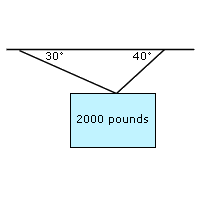
The problem involves a 2000 pound block being held by two ropes at angles of 30 degrees and 40 degrees, requiring the determination of the tension in the left cable. The subject area pertains to statics and equilibrium in physics.

Discussion Character

  • Exploratory, Conceptual clarification, Mathematical reasoning

Approaches and Questions Raised

  • Participants discuss labeling forces acting on the block and the implications of equilibrium. Suggestions include creating a free body diagram and resolving tension forces into components. There are hints about applying Newton's laws and considering the net force on the block.

Discussion Status

Guidance has been offered regarding the use of free body diagrams and the application of Newton's laws. Multiple interpretations of the problem setup are being explored, particularly concerning the forces acting on the block.

Contextual Notes

Participants note the requirement to round answers to the nearest whole number and the constraint of not entering units.

Cassie1014
I can't figure this out for the life of me .

A large, 2000 pound block is being held by two ropes that were attached to a horizontal beam. The rope on the left made a 30 degree angle, the rope on the right made a 40 degree angle (see image). What is the tension in the left cable?

HINT: Round to the nearest whole number. Do not enter units.
math.gif
 
Physics news on Phys.org
Start by labeling all the forces acting on the block. Hint: Since the block is in equilibrium, what can you say about the net force on it?
 
Maybe you should replace the block by a single black dot at the point of intersection of the ropes. What forces are the block experiencing from the ropes and in which directions are these forces? Can you think of any other forces acting on the block?
 
1) Draw a free body diagram showing the tension forces in both strings: call them T1 and T2 if you want.
2) Write down Newton's law -> Sum of forces = ma; since this object is in equilibrium though, sum of forces = 0.
3) Resolve T1 and T2 into their respective x and y components, and then apply Newton's law to each component...
e.g. T2X - T1X = 0 where T1X and T2X and the x-components of T1 and T2 respectively..
Then you'll have two equations in two unknowns; use your knowledge of linear systems to solve for them and you'll be fine. :D
 
A Classic in Statics :!) . Hehe 2 eqs, 2 unknowns.
 

Similar threads

  • · Replies 7 ·
Replies
7
Views
3K
  • · Replies 18 ·
Replies
18
Views
2K
Replies
3
Views
2K
  • · Replies 2 ·
Replies
2
Views
2K
Replies
1
Views
7K
Replies
24
Views
4K
  • · Replies 11 ·
Replies
11
Views
7K
Replies
5
Views
2K
  • · Replies 6 ·
Replies
6
Views
7K
  • · Replies 2 ·
Replies
2
Views
2K