SUMMARY
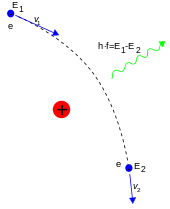
Kramer's Law defines the spectrum of Bremsstrahlung radiation emitted by charged particles, particularly electrons, when they are decelerated in the vicinity of atomic nuclei. The theoretical basis for the shape of this spectrum is rooted in the assumptions about the energy distribution of the incident electrons, which are typically modeled using a Gaussian distribution. This law is crucial for understanding the interactions between high-energy electrons and matter, particularly in fields such as medical physics and radiation therapy.
PREREQUISITES
- Understanding of Bremsstrahlung radiation
- Familiarity with Gaussian distribution in statistics
- Knowledge of electron interactions with matter
- Basic principles of quantum mechanics
NEXT STEPS
- Research the mathematical derivation of Kramer's Law
- Explore the applications of Bremsstrahlung in medical imaging
- Study the impact of electron energy distribution on radiation spectra
- Learn about advanced modeling techniques for particle interactions
USEFUL FOR
Physicists, medical physicists, and researchers in radiation therapy who seek to deepen their understanding of electron interactions and radiation spectra.