What is the variable theta of omega in a series RL cct?

Click For Summary

Discussion Overview

The discussion revolves around the variable "theta of omega" in the context of a series RL circuit, specifically focusing on its relationship to the phase angle between voltage and current. Participants explore the mathematical expression for this variable and its implications in circuit analysis, as well as the conceptual understanding of phase angles in electrical circuits.

Discussion Character

  • Homework-related
  • Technical explanation
  • Conceptual clarification
  • Debate/contested

Main Points Raised

  • One participant questions why tan θ(ω) = ωL/R and seeks clarification on what θ(ω) represents and its relation to current.
  • Another participant provides a trigonometric explanation involving the relationship between sine and cosine functions, suggesting that θ can be defined in terms of these functions.
  • A different participant asserts that θ(ω) is the phase angle between voltage and current, noting that it is frequency-dependent, unlike other angles in the circuit.
  • There is mention of a potential relationship involving tan [-θ(ω)+90°] = R/Lω, with one participant indicating that this would validate their answer if true.
  • One participant expresses satisfaction with their mathematical approach but seeks a deeper conceptual understanding of the theta angle.

Areas of Agreement / Disagreement

Participants express varying levels of understanding regarding the interpretation of θ(ω) and its mathematical derivation. There is no consensus on the conceptual implications of the phase angle, as some seek clarification while others provide differing explanations.

Contextual Notes

Participants reference specific equations and trigonometric identities but do not resolve the underlying assumptions or definitions related to the phase angle and its implications in circuit analysis.

Who May Find This Useful

Students studying electrical circuits, particularly those looking to understand phase relationships in RL circuits and the mathematical expressions associated with them.

kl055
Messages
26
Reaction score
0
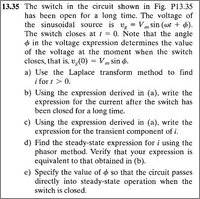
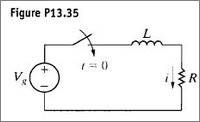
What is the variable "theta of omega" in a series RL cct?

Homework Statement


Hi

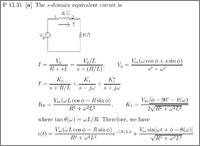
I'm not looking for a complete solution to this problem. My question concerns just one specific part of the solution to part A:
why is tan θ(ω) = ωL/R?

and what θ(ω) represent? how does it relate to the current? I took the introductory EC course almost two years ago so I need a refresher. Which section should I review? (I am using Electric Circuits 9ed by Nilsson)

I was able to complete the entirety of part A except for that part.

Also, is it true that tan [-θ(ω)+90°] = R/Lω? If so, then my answer is correct because I got that answer, but in cosine form. So the +90 would validate my answer.

Homework Equations


PROBLEM
13_35.jpg


13_35_2.jpg

SOLUTION
13_35_S.jpg


The Attempt at a Solution

 
Last edited:
Physics news on Phys.org
welcome to pf!

hi kl055! welcome to pf! :smile:
kl055 said:
why is tan θ(ω) = ωL/R?

and what θ(ω) represent? how does it relate to the current?

Also, is it true that tan [-θ(ω)+90°] = R/Lω?]

it's simple trig …

Acosφ + Bsinφ = A(cosφ + (B/A)sinφ)

and cos(φ+θ) = cosφcosθ - sinφsinθ = cosθ(cosφ - tanθsinφ)

so if we define θ so that tanθ = -B/A,

then Acosφ + Bsinφ = (A/cosθ)cos(φ+θ) :wink:

(and tan(90°- θ) = cotθ = 1/tanθ)
 
Show us your computation of K1.

That way I can show you why θ(ω) = tan-1(ωL/R).
θ(ω) is part of the phase angle between voltage and current. It's the part that's a function of frequency wheras phi and -90 deg. are constant angles, independent of frequency.
 
IMG_20130520_225200.jpg


IMG_20130520_225235.jpg


IMG_20130520_225433.jpg


IMG_20130520_225510.jpg
I did a partial fraction expansion, solved the system of equations, then rewrote K1 using trig laws.
 
kl055 said:
IMG_20130520_225200.jpg


IMG_20130520_225235.jpg


IMG_20130520_225433.jpg


IMG_20130520_225510.jpg


I did a partial fraction expansion, solved the system of equations, then rewrote K1 using trig laws.

So you're happy with what you did, no more questions?
 
Yes. I don't have a problem with the math but I was wondering how to conceptually interpret the theta angle. You mentioned the "phase angle between voltage and current" which indicates that I need to review the phasor section of the textbook. Thanks for the help.
I've got quite a bit of reading to do =/
I'll post here again if I have trouble with the textbook's explanation.
 

Similar threads

  • · Replies 6 ·
Replies
6
Views
4K
  • · Replies 3 ·
Replies
3
Views
3K
  • · Replies 10 ·
Replies
10
Views
6K
  • · Replies 2 ·
Replies
2
Views
3K
  • · Replies 8 ·
Replies
8
Views
5K
  • · Replies 4 ·
Replies
4
Views
4K
  • · Replies 1 ·
Replies
1
Views
2K
Replies
5
Views
5K
Replies
2
Views
3K
  • · Replies 10 ·
Replies
10
Views
2K