What is the Wien bridge frequency proof and how do you solve it?

Click For Summary
SUMMARY

The Wien bridge frequency proof demonstrates that when the bridge is balanced, the frequency can be determined using the equation w=2*pi*f. The general solution for AC bridges is expressed as Z4 = (Z3/Z1)*Z2, where specific impedance values are defined as Z1 = R1, Z2 = R2 - j/wC2, Z3 = R3, and Z4 = (R4/jwC4)/(R4 + jwC4). The solution requires equating the real and imaginary parts of Z4 to zero, leading to the simplified equation R2R4C2C4*w^2 + 1 = 0.

PREREQUISITES
  • Understanding of AC circuit analysis
  • Familiarity with complex impedance
  • Knowledge of the Wien bridge circuit configuration
  • Proficiency in solving quadratic equations in complex form
NEXT STEPS
  • Study the principles of AC circuit analysis in depth
  • Learn about complex impedance and its applications in circuit design
  • Explore the mathematical derivation of the Wien bridge frequency equation
  • Investigate practical applications of the Wien bridge in electronic oscillators
USEFUL FOR

Electrical engineering students, circuit designers, and anyone involved in the analysis and design of AC circuits, particularly those working with Wien bridge configurations.

birdgirl
Messages
5
Reaction score
0
[SOLVED] Wien Bridge Frequency Proof

Homework Statement


The ac bridge circuit shown is called a Wien bridge (also Wein bridge).
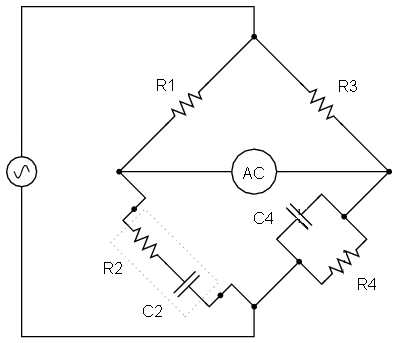
Wien Bridge.png


Show that when the bridge is balanced, frequency is found by the Eqn attached.
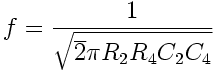
Eqn.png

Homework Equations


w=2*pi*f

Using the number from each branch as a guide, the general solution to AC bridges is Z4 = (Z3/Z1)*Z2

The Attempt at a Solution


I keep trying to solve for impedences to plug into the second equation provided, but my j values do not cancel and the equation left is rather messy (R2R4C2C4*w^2 +jw(RzR4C2 -R2C2 -R4C4) +1 = 0.

For my impedence values I have been using
Z1 = R1
Z2 = R2 -j/wC2
Z3 = R3
Z4 = (R4/jwC4)/(R4 +jwC4)

Any help with this would be greatly appreciated.
 
Physics news on Phys.org
I think Z_4 = \frac {-jR_4} {\omega C_4 (R_4 - \frac{j}{\omega C_4})}


Both the real and the imaginary parts of Z4 = (Z3/Z1)*Z2 must be 0
 
Actually, I think our Z4 values are the same, since -j = 1/j. But thank you! I managed to figure it out after you got me thinking about real and imaginary parts.

It's fairly simple, actually: I just had to equate the real parts from my equation so that R2R4C2C4*w^2 + 1 = 0 (and then I took absolute value).
 

Similar threads

  • · Replies 1 ·
Replies
1
Views
2K
  • · Replies 6 ·
Replies
6
Views
3K
Replies
4
Views
4K
Replies
39
Views
6K
  • · Replies 1 ·
Replies
1
Views
10K
  • · Replies 1 ·
Replies
1
Views
6K
Replies
4
Views
4K
  • · Replies 5 ·
Replies
5
Views
5K
Replies
3
Views
10K
Replies
6
Views
12K