How can I set a frequency in a Wien bridge oscillator

Click For Summary

Discussion Overview

The discussion centers around designing a Wien bridge oscillator and setting it to a specific frequency. Participants explore the relationship between component values (resistors and capacitors) and the frequency of oscillation, considering both theoretical calculations and practical constraints.

Discussion Character

  • Exploratory
  • Technical explanation
  • Debate/contested

Main Points Raised

  • One participant suggests that choosing a random value for either a resistor or capacitor and calculating the corresponding value for the other is a viable approach.
  • Another participant emphasizes the importance of practical considerations, such as the availability of component values and the effects of non-ideal components on the circuit's performance.
  • Concerns are raised about the impedance of components in the circuit, specifically that the impedances of R3 and C2 should be roughly equal at the operating frequency.
  • Participants note that close tolerance resistors are available in a wider range of values compared to capacitors, which may affect the accuracy of the frequency setting.
  • One participant challenges the formula for frequency provided by the original poster, suggesting it may be incorrect and recommending Aleph's advice.
  • Discussion includes the variability in capacitor tolerances and how this impacts the frequency calculation.

Areas of Agreement / Disagreement

Participants express differing views on the formula for frequency and the practical implications of component selection, indicating that multiple competing views remain without consensus on the best approach.

Contextual Notes

Participants highlight limitations related to component tolerances and the availability of standard values, which may affect the design process.

tburn
Messages
2
Reaction score
0
Hi all,
Im new here :-)
So I am designing a simple Wien bridge oscillator, and need it to be set to a specific frequency.

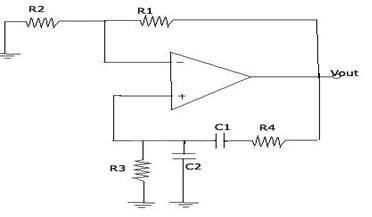
This is my circuit:
Untitled2.jpg


Where C1 = C and C2 = C
and R3 = R and R4 = R

Im using ω=1/(C2R2)
where C = my capacitor values and R = my Resistor values.

My problem is, however, how do I get it to equal ω?
Should I just set either C or R to a random value, and then work out the other?

Many thanks,
Tommy
 
Physics news on Phys.org
tburn said:
Hi all,
Im new here :-)
So I am designing a simple Wien bridge oscillator, and need it to be set to a specific frequency.

This is my circuit:
Untitled2.jpg


Where C1 = C and C2 = C
and R3 = R and R4 = R

Im using ω=1/(C2R2)
where C = my capacitor values and R = my Resistor values.

My problem is, however, how do I get it to equal ω?
Should I just set either C or R to a random value, and then work out the other?

Many thanks,
Tommy

Yes, you can do that.

This is where the Theoretical meets the Practical. Yes you could choose a random value for one of the components and then calculate a suitable value for its partner. But in the real world there are practical considerations, too. Things like, are the resulting component values available (are they even manufactured)? Do you you have the component values in stock? How do the component values compare to intrinsic or stray values in the other components? Non-ideal op-amps have finite input impedances and gain, wiring has some resistance, stray capacitance and inductance even if miniscule, and so on.

That said, if your working frequency is reasonably low (not radio frequencies etc.) then I'd suggest choosing a standard capacitor value and seeing what the corresponding resistor value would be. If it's not a practical value, adjust the capacitor value and try again. Rinse and repeat until your component values are reasonable and obtainable.
 
gneill said:
Yes, you can do that.

This is where the Theoretical meets the Practical. Yes you could choose a random value for one of the components and then calculate a suitable value for its partner. But in the real world there are practical considerations, too. Things like, are the resulting component values available (are they even manufactured)? Do you you have the component values in stock? How do the component values compare to intrinsic or stray values in the other components? Non-ideal op-amps have finite input impedances and gain, wiring has some resistance, stray capacitance and inductance even if miniscule, and so on.

That said, if your working frequency is reasonably low (not radio frequencies etc.) then I'd suggest choosing a standard capacitor value and seeing what the corresponding resistor value would be. If it's not a practical value, adjust the capacitor value and try again. Rinse and repeat until your component values are reasonable and obtainable.

Fantastic. Thanks very much for your answer.
 
Another practical consideration is that in the circuit diagram you have R3 and C2 in parallel. It would be "nice" if their impedances were roughly equal at the operating frequency. It probably doesn't matter to within a factor of 10, but you wouldn't want the impedance of C2 to be 1000 times bigger or smaller than R3.

Also, if you want an accurate frequency, searching component catalogs will show that close tolerance resistors are available in wider range of "preferred values" than close tolerance capacitors. You can easily get resistor values in the E96 series, but caps are likely to be restricted to E12.
 
AlephZero said:
if you want an accurate frequency, searching component catalogs will show that close tolerance resistors are available in wider range of "preferred values" than close tolerance capacitors. You can easily get resistor values in the E96 series, but caps are likely to be restricted to E12.

Not much help since as you say cap tolerances are looser and w is a function of RC.
 
tburn said:
Hi all,
Im new here :-)
So I am designing a simple Wien bridge oscillator, and need it to be set to a specific frequency.


Im using ω=1/(C2R2)
where C = my capacitor values and R = my Resistor values.

Your formula for w is incorrect.
Aleph's advice would be well taken.
 
rude man said:
Not much help since as you say cap tolerances are looser and w is a function of RC.

Caps with 1% tolerance are easy to get, but only in a small range of values. The next highest value above 10 is likely to be 12 or 15, not 10.1.
 

Similar threads

  • · Replies 3 ·
Replies
3
Views
3K
Replies
6
Views
2K
  • · Replies 27 ·
Replies
27
Views
7K
  • · Replies 34 ·
2
Replies
34
Views
6K
  • · Replies 4 ·
Replies
4
Views
2K
  • · Replies 7 ·
Replies
7
Views
4K
Replies
2
Views
2K
  • · Replies 1 ·
Replies
1
Views
2K
  • · Replies 9 ·
Replies
9
Views
3K
  • · Replies 4 ·
Replies
4
Views
1K