What is this tool and how is it used to study light?

Click For Summary
SUMMARY

The discussion focuses on the use of a semicircular prism, specifically the Laser Refraction Tank, for studying light refraction and reflection. Participants confirm that the tool is typically made of glass or plastic and is designed to facilitate the examination of light behavior at the glass-to-air interface. The semicircular design allows for easier observation of total internal reflection compared to rectangular prisms, as it simplifies the handling of light rays at the interface.

PREREQUISITES
  • Understanding of light refraction and reflection principles
  • Familiarity with optical tools such as prisms and protractors
  • Basic knowledge of total internal reflection concepts
  • Experience with experimental setups in physical science
NEXT STEPS
  • Research the properties and applications of semicircular prisms in optics
  • Learn about the principles of total internal reflection in detail
  • Explore the use of laser light sources in optical experiments
  • Investigate the differences between various types of prisms, including rectangular and semicircular
USEFUL FOR

Students and educators in physics, optical engineers, and anyone involved in experimental light studies will benefit from this discussion.

lightresearch
Messages
1
Reaction score
0
Hi!
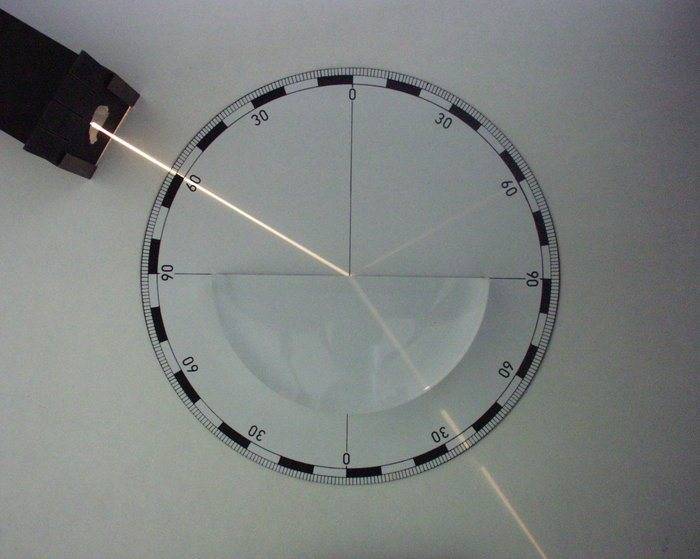
I'm doing a light research project and to have a refraction and reflection ( I don't know if it's like this in eglish) visual representation I came up with this photo. I don't know the name of this tool and also what is it made of? In my opinion is just a glass but I don't really know. Thanks!
F%C3%A9nyt%C3%B6r%C3%A9s.jpg
 
Science news on Phys.org
  • Like
Likes   Reactions: lightresearch
What nice about the semicircular prism is that you can more easily study light from glass to air (compared to a rectangular prism).
From the semicircular side, aim the light source at the origin of the semicircle (the midpoint of the straight edge).
Since the normal direction at the semicircular interface is radial, the light from the source is undeflected (as is evident from the photo)...
so that one just has to handle the rays at the flat glass-to-air interface (as opposed to two or more sets using a rectangular prism).
One can explore total-internal reflection more easily.
 

Similar threads

  • · Replies 5 ·
Replies
5
Views
2K
  • · Replies 1 ·
Replies
1
Views
3K
  • · Replies 19 ·
Replies
19
Views
6K
  • · Replies 11 ·
Replies
11
Views
2K
  • · Replies 6 ·
Replies
6
Views
1K
  • · Replies 4 ·
Replies
4
Views
1K
  • · Replies 1 ·
Replies
1
Views
4K
  • · Replies 6 ·
Replies
6
Views
1K
  • · Replies 16 ·
Replies
16
Views
3K
  • · Replies 26 ·
Replies
26
Views
6K