What kind of component should I insert here to convert 0-5V to 0-100V

  • Thread starter Thread starter bill.connelly
  • Start date Start date
  • Tags Tags
    Component Convert
Click For Summary

Discussion Overview

The discussion revolves around the challenge of converting a 0-5V signal from an A/D board to a 0-100V output for use in a biological application, specifically a "stimulus isolator." Participants explore various components and configurations to achieve this voltage conversion while maintaining isolation from the input signal.

Discussion Character

  • Exploratory
  • Technical explanation
  • Debate/contested
  • Mathematical reasoning

Main Points Raised

  • One participant describes the need for a voltage follower connected to a system requiring a 0-100V output, expressing confusion about how to isolate the output from the input.
  • Another participant suggests that normal op-amps may not handle 100 volts and mentions the possibility of using audio amplifier chips with a split power supply.
  • Concerns are raised about the functionality of optocouplers, which do not pass the input voltage to the output as initially thought.
  • A proposal is made to use an optocoupler to control a transistor that would manage the 100V supply, indicating a preference for a non-linear approach.
  • Participants discuss a related project that appears complex, with questions about the specifications and components used in that design.
  • A specific component, the DCP0105DS, is mentioned for its isolated output capability, allowing for series connections to achieve higher voltages.
  • Clarifications are made regarding the voltage levels referenced in the related project, with some participants debating the correct interpretation of the specifications.

Areas of Agreement / Disagreement

There is no consensus on a single solution or component for the voltage conversion and isolation. Multiple competing views and approaches are presented, with participants expressing uncertainty about the best method to achieve the desired outcome.

Contextual Notes

Participants express confusion over the appropriate configurations and components, particularly regarding the use of op-amps and optocouplers. There are unresolved questions about the specifications of related projects and the exact requirements for the voltage conversion.

Who May Find This Useful

Individuals interested in electronics design, particularly in applications requiring voltage isolation and conversion, may find this discussion relevant.

bill.connelly
Messages
21
Reaction score
0
Hi,

I'm trying to build what a biologist would call a "stimulus isolator". That is, I have a voltage follower connected to a system that I want to zap with 0-100V, so that the voltage follower doesn't see the voltage (much).

I have an A/D board that can put out 0 to 5 Volts. I want this converted to 0-100 V. The thing that vaguely complicates matter, is I that the resistance of the output (the input impedance of the system this is driving) will be variable.

I keep thinking op-amps, but then I get confused about how the Earth would be connected so that the output was isolated.
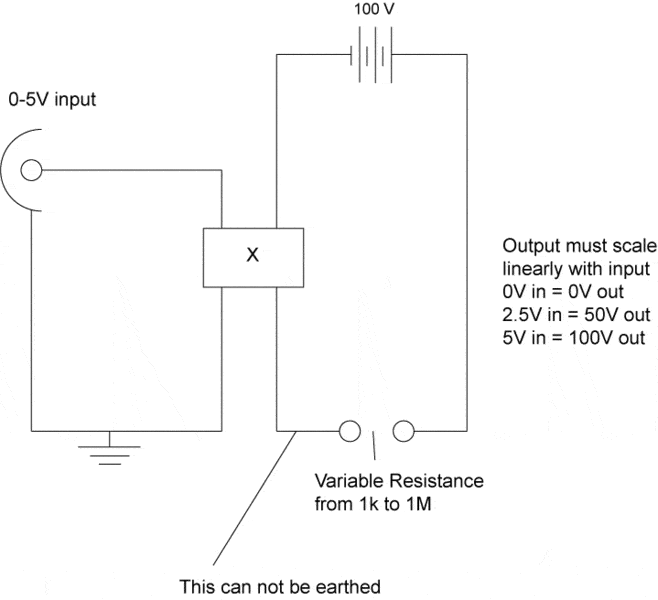
attachment.php?attachmentid=25743&stc=1&d=1273706690.gif


Previously I've used a photovoltaic relay (PVA1354) to do similar things, but now instead of gating the voltage, I want to control it.

Does anyone have any thoughts.

I apologize if this is monstrously retarded, I'm just a humble biologist.
 

Attachments

  • stimulus-isolator.gif
    stimulus-isolator.gif
    15.4 KB · Views: 669
Engineering news on Phys.org
Hi, I've had a few thoughts, how does this look?
attachment.php?attachmentid=25745&stc=1&d=1273712819.gif
 

Attachments

  • Finish-Stim-Isolator.gif
    Finish-Stim-Isolator.gif
    11.8 KB · Views: 646
You have the resistors the wrong way around. The bigger one should be across the opamp.

Normal opamps probably wouldn't handle 100 volts, but there are some audio amplifier chips that would go close. You would have to give them a split +50 volts--ground-- neg 50 volts supply.

And, sadly, optocouplers don't work like that. They need a small voltage to turn on and this produces light which makes a phototransistor turn on. This can then be used to switch an external voltage.
So, the input voltage is not passed on to the output.
 
Yeah, I though this would blow your average OP-amp...
Double dang about the optocoupler... I thought it seemed to good to be true... thanks for your thoughts anyway.

Okay, say I was fixed the resistor lay out, and reduced the power voltage to 50V (making the resistors 1kOhm and 9kOhm). Is there anything that can simply isolate an input?
 
Last edited:
Okay, say I was fixed the resistor lay out, and reduced the power voltage to 50V (making the resistors 1kOhm and 9kOhm). Is there anything that can simply isolate an input?

Can't think of anything. It might be better to have an optocoupler being turned on by your 5 volt supply and then the output of this could turn on a transistor which controlled the 100 volt supply which you already have.

Doing this in a linear manner would pose a problem.

I hope you do not intend to harm small furry critters with this setup. I like furry critters.
 
No, no... no furry creatures... cancer cells removed from a human decades ago...

This guy has posted something similar
http://www.nbb.cornell.edu/neurobio/land/PROJECTS/SIU/index.html
Except it seems very complicated. I can't figure it out enough to simplyfy it (I can't even figure out what the first transistor is for).

Also, he sais that Vcc = 6 volts, but he actually means 100V right?
 
Last edited by a moderator:
The attached is a suggestion for a starter circuit.
 

Attachments

bill.connelly said:
No, no... no furry creatures... cancer cells removed from a human decades ago...

This guy has posted something similar
http://www.nbb.cornell.edu/neurobio/land/PROJECTS/SIU/index.html
Except it seems very complicated. I can't figure it out enough to simplyfy it (I can't even figure out what the first transistor is for).

Also, he sais that Vcc = 6 volts, but he actually means 100V right?

No, I imagine that he means Vcc=5V (okay, he's probably powering this with 4 AAs, so maybe it is 6V). The output is 90V, however.

The first transistor is just to ensure that the input to the 4066 is around 6V or so (I believe):
http://www.fairchildsemi.com/ds/CD%2FCD4066BC.pdf

The beauty of the DCP0105DS is that it has a fully isolated output--the isolation is built in and the outputs are said to be floating. For that reason, the output from 3 of these (which are outputting 30V between the positive and negative rails) can be put in series to output 90V. TI seems to make this part now:
http://focus.ti.com/lit/ds/symlink/dcp0105.pdf

However, you'll note that the output amplitude adjustment happens at the output via the potentiometer.

EDIT: Reading through the description above the circuit diagram, I believe they state everything I just did above!
 
Last edited by a moderator:
Thanks Skeptic
I've added in the isolators where I think you wanted them, is this correct?
attachment.php?attachmentid=25750&stc=1&d=1273738309.gif
 

Attachments

  • New-Isolator.gif
    New-Isolator.gif
    7.1 KB · Views: 593
Last edited:
  • #10
Yes, thanks.
 

Similar threads

  • · Replies 16 ·
Replies
16
Views
7K
  • · Replies 3 ·
Replies
3
Views
4K
Replies
5
Views
4K