What Needs to Be Integrated in a Convolution Problem?

  • Thread starter Thread starter powderchick81
  • Start date Start date
  • Tags Tags
    Convolution
Click For Summary
SUMMARY

The discussion focuses on the steps required to set up integration for convolution problems in signal processing. Key steps include flipping the impulse function, moving the function h(t) over x(t) across five regions, and determining the appropriate bounds for integration. The integration itself involves calculating the area under the curve defined by the product of the impulse amplitude and the slope of the line, specifically integrating A*mx from 0 to t, resulting in (A*m*t^2)/2. Additionally, participants are encouraged to explore the convolution of two impulses with different amplitudes, A and B.

PREREQUISITES
  • Understanding of convolution in signal processing
  • Familiarity with impulse functions and their properties
  • Basic knowledge of integration techniques in calculus
  • Ability to manipulate linear equations and slopes
NEXT STEPS
  • Study the properties of convolution in signal processing
  • Learn how to perform convolution with different types of signals
  • Explore the mathematical derivation of convolution integrals
  • Practice solving convolution problems involving multiple regions
USEFUL FOR

Students preparing for tests in signal processing, engineers working with convolution in systems analysis, and anyone seeking to deepen their understanding of integration in the context of convolution problems.

powderchick81
Messages
3
Reaction score
0
OK. I understand almost everything I need to know in order to do a convolution problem except how to set up what needs to be integrated. The way my professor does it is:

1) flip the impuse
2) move h(t) over x(t) - we usually do this in 5 different regions
3) for each region the bounds have to be chosen and this I can do but how do I figure out what needs to be integrated?
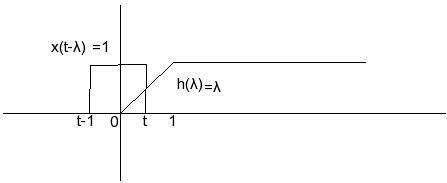
convolution.jpg


for this problem you have
0<t<(t-1) and the limits of integration are from 0 to t but what needs to be integrated.

I don't know if I'm getting caught up on the math or what but I do know that I'm completely lost with this. If someone could explain it to me in detail I would greatly appreciate it. I have a test tomorrow and don't want to fail it.
 
Physics news on Phys.org
Hi, if the amplitude of the impulse is A, and the slope is line equation is y=mx+b (m is the slope, b is 0), you must integrate A*mx from 0 to t. In this case you would get (A*m*t^2)/2

Try the convolution of two impulses, one with amplitude A and another with B.
 

Similar threads

  • · Replies 4 ·
Replies
4
Views
3K
  • · Replies 10 ·
Replies
10
Views
3K
  • · Replies 3 ·
Replies
3
Views
6K
  • · Replies 1 ·
Replies
1
Views
1K
  • · Replies 3 ·
Replies
3
Views
6K
  • · Replies 9 ·
Replies
9
Views
3K
  • · Replies 1 ·
Replies
1
Views
3K
  • · Replies 6 ·
Replies
6
Views
2K
  • · Replies 3 ·
Replies
3
Views
4K
  • · Replies 23 ·
Replies
23
Views
2K