What qualifies as an infinite discontinuity?

  • Context: Undergrad 
  • Thread starter Thread starter shinwolf14
  • Start date Start date
  • Tags Tags
    Discontinuity Infinite
Click For Summary
SUMMARY

An infinite discontinuity occurs when at least one of the one-sided limits of a function approaches infinity. In the discussion, a specific example is provided with the function f(x) defined as 1 for x ≤ 0 and 1/x for x > 0, illustrating that the left-hand limit approaches 1 while the right-hand limit approaches infinity. This confirms that the function exhibits an infinite discontinuity. The consensus among participants is that both one-sided limits do not need to approach infinity simultaneously for the function to qualify as having an infinite discontinuity.

PREREQUISITES
  • Understanding of limits in calculus
  • Familiarity with one-sided limits
  • Knowledge of types of discontinuities (removable, jump, infinite)
  • Basic proficiency in function notation and piecewise functions
NEXT STEPS
  • Study the definitions and examples of infinite discontinuities in calculus
  • Learn about essential discontinuities and their classifications
  • Explore asymptotic behavior of functions and their limits
  • Review the concept of removable discontinuities and how they differ from infinite discontinuities
USEFUL FOR

Students of calculus, mathematics educators, and anyone seeking to deepen their understanding of discontinuities in functions.

shinwolf14
Messages
14
Reaction score
0
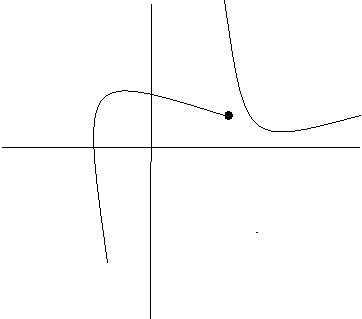
Hello everyone. I am currently having trouble actually defining what qualifies as an infinite discontinuity. I have read several sources that state that both of the one sided limits must approach infinity (positive, negative or both). My problem is what happens when only one of the one sided limits approach infinity and the other is finite. This is not a jump discontinuity because both of the one sided limits are not finite. According to the definition that I have read, it doesn't qualify as an infinite discontinuity either. I have crudely drawn what I am trying to describe. I am pretty sure this still is classified as an infinite discontinuity but I just wanted to be sure.
Ek28693.png
 
Physics news on Phys.org
shinwolf14 said:
Hello everyone. I am currently having trouble actually defining what qualifies as an infinite discontinuity. I have read several sources that state that both of the one sided limits must approach infinity (positive, negative or both). My problem is what happens when only one of the one sided limits approach infinity and the other is finite. This is not a jump discontinuity because both of the one sided limits are not finite. According to the definition that I have read, it doesn't qualify as an infinite discontinuity either. I have crudely drawn what I am trying to describe. I am pretty sure this still is classified as an infinite discontinuity but I just wanted to be sure.

Ek28693.png
I would call it an infinite discontinuity. A simpler example than your graph shows is
##f(x) = \begin{cases} 1 & \text{if } x \le 0 \\ \frac 1 x & \text{if } x > 0\end{cases}##
In my example, ##\lim_{x \to 0^-} f(x) = 1##, but ##\lim_{x \to 0^+} f(x) = \infty##

Another site I found would agree with me -- http://www.milefoot.com/math/calculus/limits/Continuity06.htm
An infinite discontinuity exists when one of the one-sided limits of the function is infinite.
I believe that their definition would also include the case where both one-side limits are infinite. If so, their definition would be clearer if it said "when at least one of the one-side limits of the function is infinite."
 
Mark44 said:
If so, their definition would be clearer if it said "when at least one of the one-side limits of the function is infinite."

This is what I assumed. When I learned Calculus 1, we classified this as an essential discontinuity, compared to the removable discontinuity. Obviously we went over infinite discontinuities but they typically were asymptotic
 

Similar threads

  • · Replies 1 ·
Replies
1
Views
980
  • · Replies 4 ·
Replies
4
Views
5K
  • · Replies 10 ·
Replies
10
Views
3K
  • · Replies 2 ·
Replies
2
Views
2K
  • · Replies 8 ·
Replies
8
Views
5K
  • · Replies 1 ·
Replies
1
Views
2K
  • · Replies 1 ·
Replies
1
Views
2K
  • · Replies 1 ·
Replies
1
Views
2K
  • · Replies 5 ·
Replies
5
Views
2K
  • · Replies 4 ·
Replies
4
Views
4K