What Vcc value should I typically use on an LM324 in PSpice?

  • Thread starter Thread starter kostoglotov
  • Start date Start date
  • Tags Tags
    Pspice Value
Click For Summary
SUMMARY

The LM324 operational amplifier can operate with a power supply voltage between 3V and 32V, as specified in its datasheet. For optimal performance, especially in achieving saturation responses, a supply voltage of VCC = 15V and VSS = -15V is recommended. The output voltage is significantly affected by the power supply values, and it is crucial to ensure that the op-amp remains within its linear region under all operating conditions. Proper analysis of the circuit's input and output voltage requirements is essential for selecting the appropriate power supply.

PREREQUISITES
  • Understanding of operational amplifier (op-amp) functionality
  • Familiarity with PSpice simulation software
  • Knowledge of LM324 datasheet specifications
  • Basic circuit analysis skills
NEXT STEPS
  • Review the LM324 datasheet for detailed specifications and guidelines
  • Learn about op-amp feedback configurations and their impact on performance
  • Explore PSpice simulation techniques for analyzing op-amp circuits
  • Study the concept of headroom in op-amp power supply design
USEFUL FOR

Electronics engineers, circuit designers, and students studying operational amplifiers and their applications in various circuits.

kostoglotov
Messages
231
Reaction score
6
I've checked documentation and it says anywhere between 3 and 30V to supply the LM324. But I couldn't find further guidelines.

My text explained that op amps need external power supplies, but provided no guidelines as to what value to make that supply value.

When analyzing this following circuit in PSpice, changing the power supply to the LM324's (even between 3 and 30) drastically changes the output voltages.
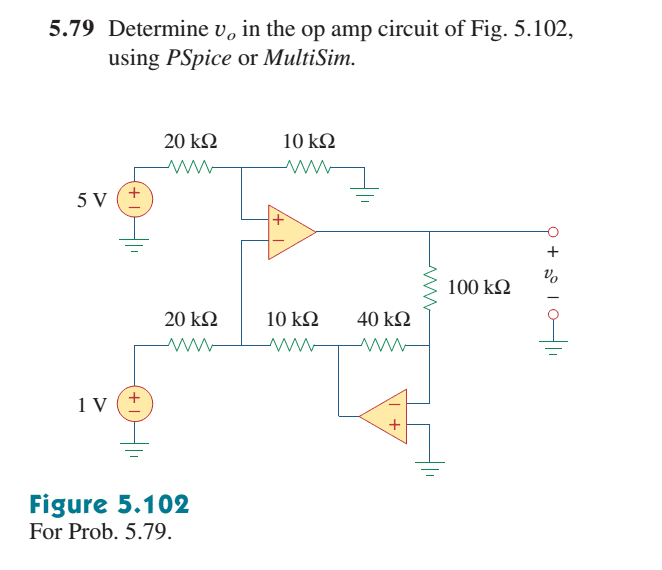
EguR5nx.png


imgur link:

The top op amp has no feedback loop, so I figure its power supply should be higher than 5V to get to a saturation response.

This is my circuit in PSpice as drawn up in PSpice with some values shown next to Voltage sources.
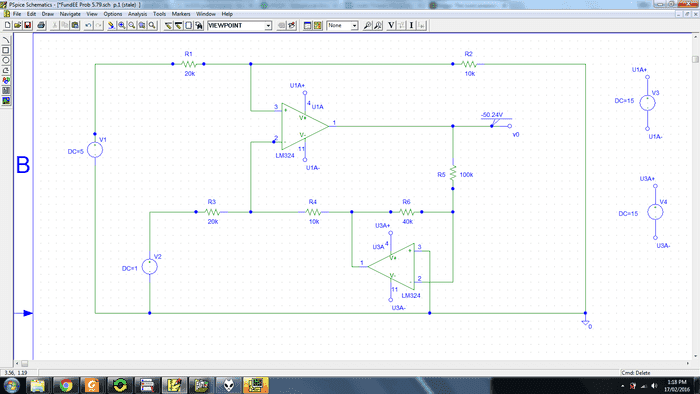
1h76t3y.png


imgur link: http://i.imgur.com/1h76t3y.png

According to the text, v0 should be -4.992V.

Now, if I take those op amp power supplies both to 30V, v0 becomes -5.005V...much closer to the text answer. Increasing op amp power supply beyond 30V causes no further changes, it seems to max out at -5.005V.

How are you supposed to know what power supply to use on an op amp? How does it depend on the circuit you're analyzing? What are some general guidelines?

Thank you in advance for any advice anyone can give :)
 
Engineering news on Phys.org
First off, both op amps have feedback. They share components in their feedback loops, that's all.

As to what power supply you should use with an op amp the first place to start is with the datasheet for the op amp. That will tell you what values of supply it will accommodate. Then you can choose the supplies based on the dynamic range you need in the circuit. You want to be sure that all the op amps stay within their linear regions (usually some fraction of the supply voltage) under all conditions.

The LM324 can handle 32V between its rails. Since the "text answer" is negative, the textbook is assuming split rails. Try VCC = 15V and VSS = -15V (instead of 0V) and see what happens.
 
  • Like
Likes   Reactions: kostoglotov
analogdesign said:
First off, both op amps have feedback. They share components in their feedback loops, that's all.

As to what power supply you should use with an op amp the first place to start is with the datasheet for the op amp. That will tell you what values of supply it will accommodate. Then you can choose the supplies based on the dynamic range you need in the circuit. You want to be sure that all the op amps stay within their linear regions (usually some fraction of the supply voltage) under all conditions.

The LM324 can handle 32V between its rails. Since the "text answer" is negative, the textbook is assuming split rails. Try VCC = 15V and VSS = -15V (instead of 0V) and see what happens.

It didn't change the result by much :P

UIMvUap.png


imgur link: http://i.imgur.com/UIMvUap.png
 
kostoglotov said:
It didn't change the result by much :P
what that does tell you about Op amps?

hint. this is why Op-amps are very very useful.
 
donpacino said:
what that does tell you about Op amps?

hint. this is why Op-amps are very very useful.

Well, actually, the output voltage changed an order of magnitude when I halved the voltage at the power supply. What didn't change the output much was switching the power terminals on the op amp from (+30 to 0) to (15 to -15).
 
kostoglotov said:
My text explained that op amps need external power supplies, but provided no guidelines as to what value to make that supply value.

When analyzing this following circuit in PSpice, changing the power supply to the LM324's (even between 3 and 30) drastically changes the output voltages.
Just using calculations and ignoring the power supply values at first, what do you get for the input and output voltages of the opamps in your first schematic?

Then you just need to ensure that your power supplies for the opamps are wide enough to stay away from those input and output voltages. As pointed out, you can refer to the LM324 datasheet to see what the input and output voltage ranges are with respect to the power supply voltages. :smile:
 
  • Like
Likes   Reactions: kostoglotov
EDIT oops Berkeman got there first ! Right On ...

kostoglotov said:
How are you supposed to know what power supply to use on an op amp? How does it depend on the circuit you're analyzing? What are some general guidelines?

Find by analyzing your circuit the most positive and ,most negative input voltages your opamp will 'feel' at its inputs.
Also the most positive and most negative output voltages your circuit will need from the opamp .

LM324 can drive its output to within ~1.5 volts of positive supply, so V+ needs to be at least that much above most positive output you'll need.
LM324 can drive its output to negative supply but only at low current, so give it a volt or so "headroom" there, too . Make V- a volt or so more negative than most negative output. In a pinch you could get away with less negative side headroom provided the opamp only has to accept a few microamps into its output pin. See chart beow.

LM324 has similar headroom requirements on its inputs. That's why you have to consider both input and output.
From LM324 datasheet
upload_2016-2-18_16-32-50.png


upload_2016-2-18_16-38-54.png


Spend some time with datasheets they're a wealth of practical information
 
  • Like
Likes   Reactions: kostoglotov

Similar threads

Replies
9
Views
7K
  • · Replies 20 ·
Replies
20
Views
7K
  • · Replies 21 ·
Replies
21
Views
3K
Replies
4
Views
6K
  • · Replies 15 ·
Replies
15
Views
3K
  • · Replies 12 ·
Replies
12
Views
3K
Replies
68
Views
7K
  • · Replies 5 ·
Replies
5
Views
2K
Replies
12
Views
3K
  • · Replies 7 ·
Replies
7
Views
2K