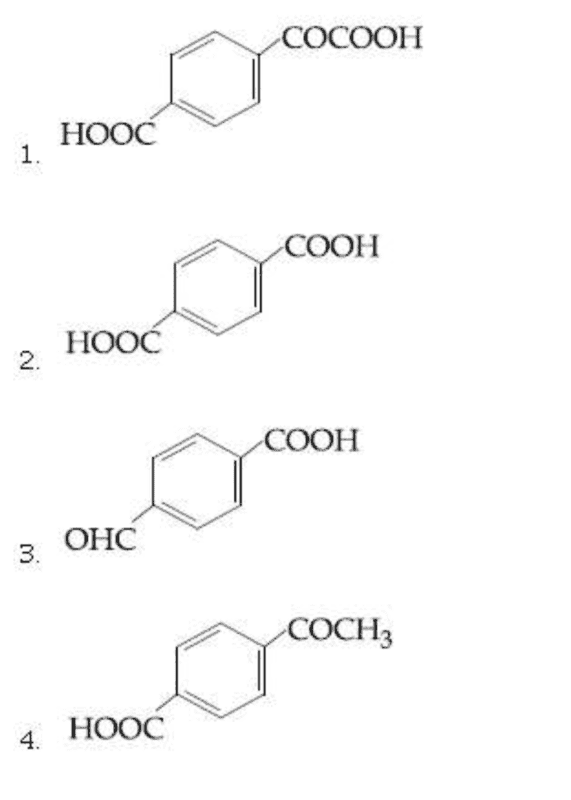
What will be the product of this organic reaction?

Click For Summary

Discussion Overview

The discussion revolves around predicting the products of an organic reaction involving toluene and KMnO4 as an oxidizing agent. Participants explore various aspects of the reaction, including the effects of different reagents and conditions, and the nature of the products formed. The conversation touches on concepts from organic chemistry, particularly oxidation reactions and the behavior of functional groups.

Discussion Character

  • Exploratory
  • Technical explanation
  • Debate/contested
  • Mathematical reasoning

Main Points Raised

  • Some participants express difficulty in determining the products of chemical reactions despite studying the concepts.
  • There is a discussion about the oxidation of toluene with KMnO4, with some suggesting it leads to benzyldehyde through the Etard reaction.
  • Others question the role of the oxidizing agent and whether the product depends on it, noting that KMnO4 and chromyl chloride are different reagents.
  • Some participants highlight that KMnO4 is a stronger oxidizer in acidic conditions compared to basic conditions, which could affect the reaction outcome.
  • There is mention of the potential formation of a carboxylic acid and subsequent reactions with bases like KOH, leading to the formation of potassium salts of carboxylic acids.
  • Concerns are raised about the clarity of the reaction steps and whether certain reactions are included to confuse students.
  • Some participants emphasize the importance of understanding the basic notation and conditions of the reactions to avoid confusion.

Areas of Agreement / Disagreement

Participants do not reach a consensus on the exact products of the reaction, with multiple competing views on the effects of different reagents and conditions. The discussion remains unresolved regarding the specific outcomes and mechanisms involved.

Contextual Notes

There are limitations in the discussion regarding the assumptions made about the reagents and the conditions under which the reactions occur. The participants also express uncertainty about the notation used in the original post and its implications for understanding the reaction.

Who May Find This Useful

This discussion may be useful for students and practitioners in organic chemistry seeking to understand the complexities of oxidation reactions and the influence of different reagents on reaction outcomes.

Adesh
Messages
735
Reaction score
191
Summary:: I'm always unable to find the products of a chemical reaction. No Matter how much concept I study I can't ever get products from reasoning.

Here is the question:

What is the major product of this reaction?
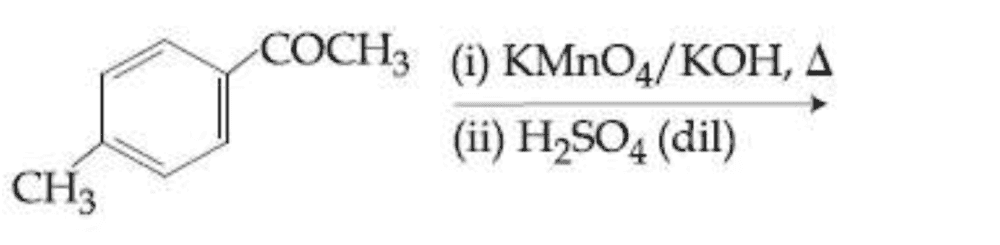
Question.png
.

OPTIONS :
Options.png
MY ATTEMPT :
First of all I can see that in question I have a benzene ring to which a methyl group is attached, on the other side we have a ketone. The structure of the molecule in question can be drawn as:
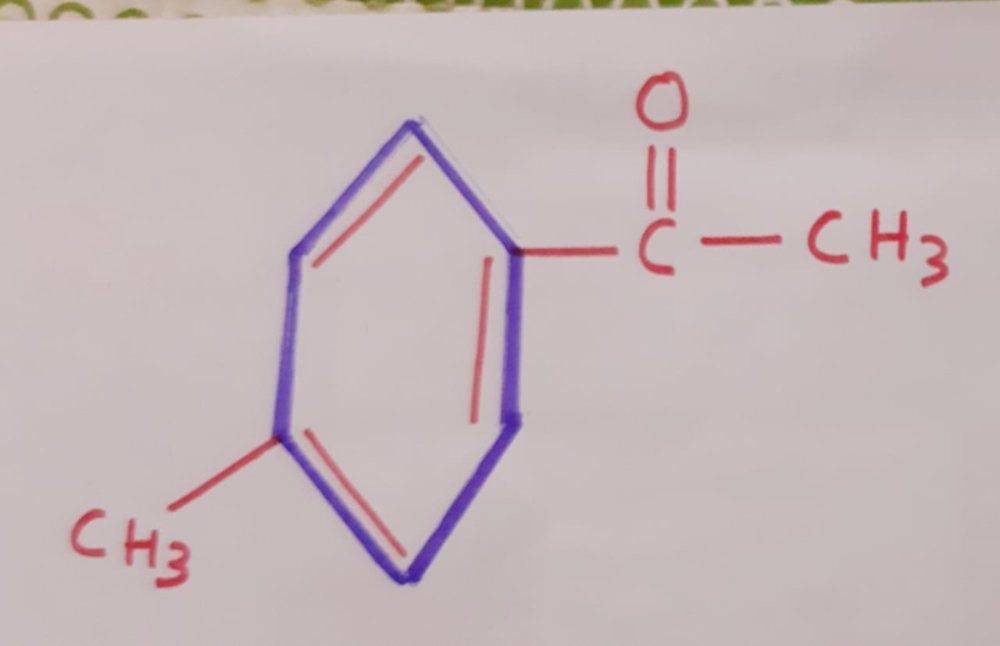
Molecule.jpeg
. Now, I know that oxidation (with strong oxidizing agents) of alcohols, aldehydes and ketones results in carboxylic acid. Therefore, I treat the above molecule (a ketone group) with strong oxidizing agent KMnO_4 we would would get something like this
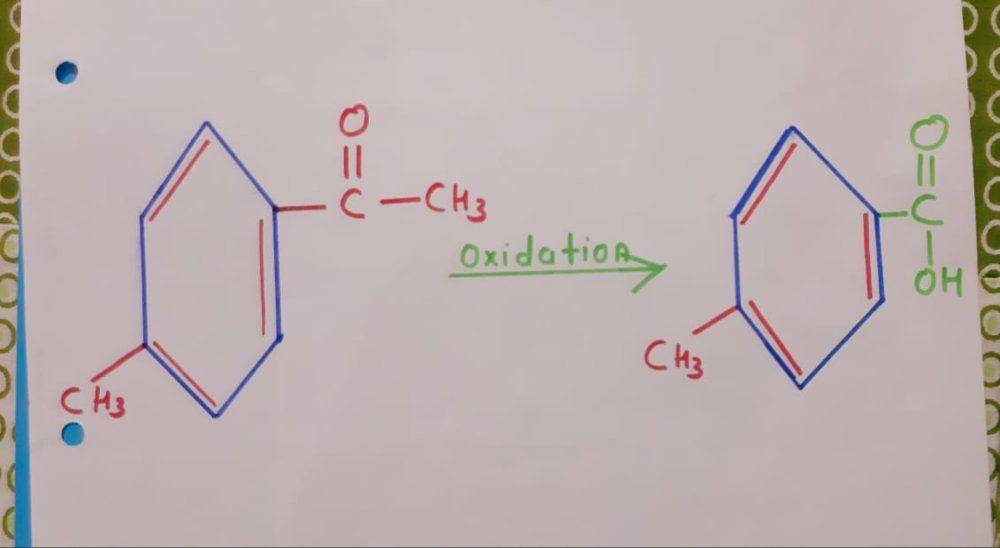
Reaction.jpeg
. (I really don't know what effect would KOH have on our molecule because as per my knowledge OH^- is a nucleophile and hence attacks reagents like alkyl chloride, benzyl chloride. In this case I have no idea what would happen).

This much being done, now we treat our carboxylic acid with sulfuric acid and according to me there will be no reaction. There are chances that benzene ring (which contains \pi electrons) can act as a base, but seeing the options I have to eradicate this idea.

The methyl group CH_3 which is attached to our starting molecule is, according to my studies, is not reactive. Alkenes undergo oxidation to form alkynes or alcohol (I may be wrong here, I said alkynes because removal of hydrogen from alkenes ,i.e. oxidation, would result in alkynes or the addition of OH , i.e. addition of oxygen to carbon, would result in alkyl alcohols). Alkanes can only be combusted,
Alkyl halides are almost never prepared by direct halogenation of alkanes. From the standpoint of synthesis in tha laboratory, an alkane is a dead end.
-Organic Chemistry by Morrison and Boyd
.

Thank you. Any help will be much appreciated.

P.S. :- I highly apologize for posting the images, but I have no other option. If you can suggest me any other way of drawing molecules (using latex or something) then please do suggest me.
 
Physics news on Phys.org
1) You’re pretty much stuck posting pictures for molecular structures. A LaTeX chemistry extension does exist, but as far as I can tell, it’s not installed on this forum.

2) What happens to toluene when it is exposed to KMnO4?
 
TeethWhitener said:
2) What happens to toluene when it is exposed to KMnO4?
I don’t know, how toluene can be oxidised?
 
TeethWhitener said:
1) You’re pretty much stuck posting pictures for molecular structures. A LaTeX chemistry extension does exist, but as far as I can tell, it’s not installed on this forum.

2) What happens to toluene when it is exposed to KMnO4?
I have searched on internet and found that it is something called Etard reaction. Hence, benzyldehyde will be formed, am I right?
 
Adesh said:
I have searched on internet and found that it is something called Etard reaction. Hence, benzyldehyde will be formed, am I right?
Is your oxidizer chromyl chloride?
 
  • Like
Likes   Reactions: Adesh
TeethWhitener said:
Is your oxidizer chromyl chloride?
Yes,Wikipedia writes so. Does product depends on the oxdizing agent? I thought that it is oxidation( addiction of oxygen in this case) that matters.
 
Adesh said:
Yes,Wikipedia writes so. Does product depends on the oxdizing agent?
Your OP stated the reagent was KMnO4, not chromyl chloride. And yes, the product depends on the oxidizing agent.
 
  • Like
Likes   Reactions: Adesh
TeethWhitener said:
Your OP stated the reagent was KMnO4, not chromyl chloride. And yes, the product depends on the oxidizing agent.
Okay. I don’t know the action of KMnO_4 on toluene, all I know is that KMnO_4 will oxidise my toluene.
 
  • #10
And... if a carboxylic acid is the product and that is in a solution of base, is there a further (trivial) reaction that is possible?
 
  • #11
chemisttree said:
And... if a carboxylic acid is the product and that is in a solution of base, is there a further (trivial) reaction that is possible?
What is the base? I think in first reaction we have to use either KMnO4 or KOH and then we have to use the sulfuric acid.
 
  • #13
No, the first reaction involves a heated (that’s what the ##\Delta## means) basic (from KOH) solution of KMnO4. The slash isn’t an either/or symbol. It may be that the reason you’re having so much trouble with chemistry is that you’re not understanding the basic notation.
 
  • Like
Likes   Reactions: Adesh
  • #14
Adesh said:
So, it seems to me that option (2) is right, is it really right?
I have no idea what you mean by option 2.

edit: I see, you mean in the OP.
 
  • Like
Likes   Reactions: Adesh
  • #15
Yes, #2 is the product I would expect. The important point here is that benzylic alkyl carbons tends to be significantly more reactive than other alkyl groups.
 
  • Like
Likes   Reactions: Adesh
  • #16
TeethWhitener said:
I have no idea what you mean by option 2.

edit: I see, you mean in the OP.
Now, how KMnO4 and basic KMnO4 going to differ in their action? Will the carboxylic acid that is formed going to donate an H to the base and accepts K from KOH?
 
  • #17
Adesh said:
Now, how KMnO4 and basic KMnO4 going to differ in their action? Will the carboxylic acid that is formed going to donate an H to the base and accepts K from KOH?
It more has to do with the strength of the oxidizer. Permanganate is a far stronger oxidizer in acid than in base.

edit: in fact, it wouldn’t surprise me to learn that KMnO4 in acid simply destroys the molecule entirely.
 
  • Like
Likes   Reactions: Adesh
  • #18
TeethWhitener said:
It more has to do with the strength of the oxidizer. Permanganate is a far stronger oxidizer in acid than in base.

edit: in fact, it wouldn’t surprise me to learn that KMnO4 in acid simply destroys the molecule entirely.
And that reaction with sulfur acid? Is given only to confuse the students?
 
  • #19
Again, what trivial reaction occurs between a carboxylic acid and a base (KOH)? Write out the product! You should have learned this in your first chemistry class.
 
  • Like
Likes   Reactions: Adesh
  • #20
Adesh said:
And that reaction with sulfur acid? Is given only to confuse the students?
See @chemisttree 's post above.
 
  • #21
The KOH is required for permanganate oxidations. Neutral permanganate decomposes to Mn(IV) and acidic permanganate decomposes to Mn(II).
 
  • Like
Likes   Reactions: Adesh
  • #22
chemisttree said:
Again, what trivial reaction occurs between a carboxylic acid and a base (KOH)? Write out the product! You should have learned this in your first chemistry class.
I will have K+ attached to oxygen, I mean I will get potassium salt of carboxylic acid (and these acids are attached to the benzene ring) and the leaving H will form water with OH-. Am I right?
 
  • #23
chemisttree said:
The KOH is required for permanganate oxidations. Neutral permanganate decomposes to Mn(IV) and acidic permanganate decomposes to Mn(II).
These are the end products of the reaction. KOH isn’t required for the oxidation. The acid actually increases the oxidative power of KMnO4, because its end product is so much more reduced. The reason KOH is added is actually to make the oxidizer weaker, because acidic KMnO4 has a tendency to chew everything organic up to pieces.
 
  • #24
TeethWhitener said:
These are the end products of the reaction. KOH isn’t required for the oxidation. The acid actually increases the oxidative power of KMnO4, because its end product is so much more reduced. The reason KOH is added is actually to make the oxidizer weaker, because acidic KMnO4 has a tendency to chew everything organic up to pieces.
Thank you for helping me. I have really enjoyed the conversation with you and you have taught me so many things. If you don't mind, I want to make a request to please give some advice (your personal) on how to approach for products of a chemical reaction.
 
  • #25
Adesh said:
I will have K+ attached to oxygen, I mean I will get potassium salt of carboxylic acid (and these acids are attached to the benzene ring) and the leaving H will form water with OH-. Am I right?
Yes. After the reaction you will have a solution of the dicarboxylate salt and a bunch of brown mud. Filtering gives a clear solution of the dicarboxylate salt. Treating that with the sulfuric acid gets you back to the dicarboxylic acid.
 
  • Like
Likes   Reactions: Adesh
  • #26
TeethWhitener said:
...The reason KOH is added is actually to make the oxidizer weaker, because acidic KMnO4 has a tendency to chew everything organic up to pieces.
Like this?

image.jpg
 

Attachments

  • image.jpg
    image.jpg
    77.6 KB · Views: 261
  • #27
chemisttree said:
Yes. Check the yield. Basic KMnO4 will give you closer to quantitative.
 
  • #28
:wink:
image.jpg
 
  • #29
Yes. This corroborates what I said in post 27
 

Similar threads

  • · Replies 4 ·
Replies
4
Views
2K
Replies
6
Views
2K
  • · Replies 3 ·
Replies
3
Views
3K
Replies
3
Views
3K
Replies
4
Views
5K
  • · Replies 6 ·
Replies
6
Views
3K
Replies
2
Views
2K
  • · Replies 13 ·
Replies
13
Views
5K
  • · Replies 4 ·
Replies
4
Views
4K
  • · Replies 1 ·
Replies
1
Views
2K