What's it called when a 3D shape can be made of 2D surfaces of all the same size

Click For Summary

Discussion Overview

The discussion revolves around identifying 3D shapes that can be constructed from 2D surfaces of the same shape and dimensions, specifically focusing on regular polyhedra and the conditions under which other shapes might also be capable of forming 3D structures. The scope includes theoretical exploration and mathematical reasoning.

Discussion Character

  • Exploratory
  • Technical explanation
  • Mathematical reasoning

Main Points Raised

  • One participant inquires about the term for 3D shapes made from identical 2D surfaces, providing examples like cubes and pyramids.
  • Another participant suggests the term "regular polyhedron" in response to the inquiry.
  • There is a discussion about the limitation of using equilateral shapes, noting that only triangles, squares, and pentagons can form such 3D shapes, while hexagons and higher-sided shapes present challenges.
  • A later reply mentions the Euler Formula and suggests that only five regular polyhedra exist, which correspond to the regular polygons with 4, 6, 8, 12, and 20 faces.
  • Participants express interest in exploring whether other convex or concave shapes can also create 3D structures using the same base shapes and how to determine this capability.

Areas of Agreement / Disagreement

Participants generally agree on the identification of regular polyhedra but express uncertainty regarding the existence of other shapes that can form 3D structures from identical 2D surfaces. The discussion remains unresolved regarding the broader applicability of this concept.

Contextual Notes

Limitations include the lack of detailed exploration into the conditions under which non-regular shapes might also form 3D structures, as well as the dependence on definitions of equilateral and regular shapes.

keysle
Messages
4
Reaction score
0
What's it called when a 3D shape can be made of 2D surfaces of all the same shape and dimensions?

To make a cube, I can use 6 4-sided-squares (of course they're 4 sided)
To make a pyramid (3 sided), I can use 4 3-sided-triangles

I can do this with pentagon as well (i don't know what the shape is called)

Eventually I can't do this as the sides of the shape increase because the remaining angle.


... after some thinking I realized I can only do this with 3 equilateral shapes.
3 sided
4 sided
and 5 sided
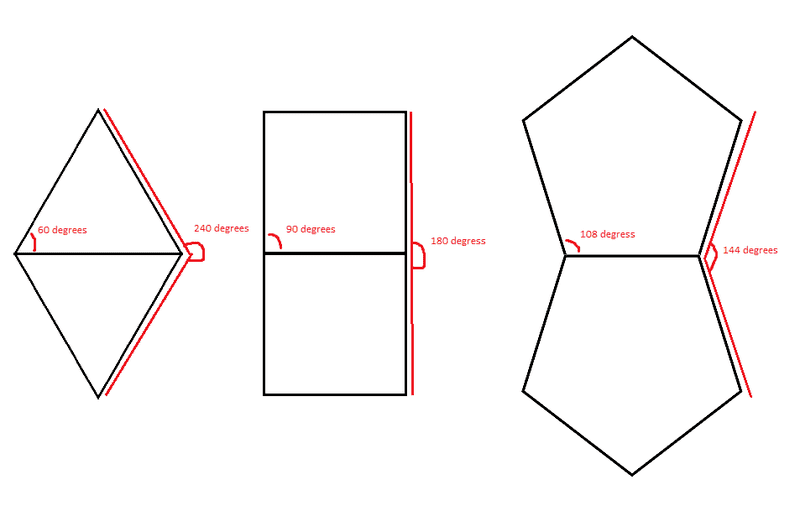
MRtiO.png


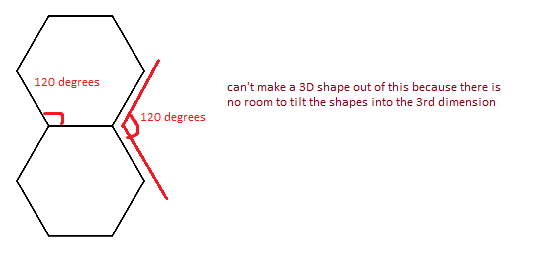
Once I get to the hexagon ... well

r6zJy.png


Now here's an even more interesting question: Are there any others shapes convex or concave equilateral or not that can be used to create a 3D shape? (where the base shapes remains the same)
If so how can one determine if a shape is capable of doing this?
 
Physics news on Phys.org
Regular polyhedron
 
Thanks!

Doesn't look like there are too many of those shapes.

Do you know about the second questions?
Now here's an even more interesting question: Are there any others shapes convex or concave equilateral or not that can be used to create a 3D shape? (where the base shapes remains the same)
If so how can one determine if a shape is capable of doing this?
 
keysle said:
What's it called when a 3D shape can be made of 2D surfaces of all the same shape and dimensions?

To make a cube, I can use 6 4-sided-squares (of course they're 4 sided)
To make a pyramid (3 sided), I can use 4 3-sided-triangles

I can do this with pentagon as well (i don't know what the shape is called)

Eventually I can't do this as the sides of the shape increase because the remaining angle.


... after some thinking I realized I can only do this with 3 equilateral shapes.
3 sided
4 sided
and 5 sided

MRtiO.png


Once I get to the hexagon ... well

r6zJy.png


Now here's an even more interesting question: Are there any others shapes convex or concave equilateral or not that can be used to create a 3D shape? (where the base shapes remains the same)
If so how can one determine if a shape is capable of doing this?

You can use the Euler Formula to prove, if I remember correctly, there are only five which are all regular polygons. 4,6,8,12,20
 

Similar threads

  • · Replies 2 ·
Replies
2
Views
2K
  • · Replies 12 ·
Replies
12
Views
3K
  • · Replies 4 ·
Replies
4
Views
4K
  • · Replies 42 ·
2
Replies
42
Views
8K
  • · Replies 1 ·
Replies
1
Views
3K
  • · Replies 2 ·
Replies
2
Views
1K
  • · Replies 4 ·
Replies
4
Views
3K
  • · Replies 7 ·
Replies
7
Views
2K
  • · Replies 6 ·
Replies
6
Views
2K
  • · Replies 5 ·
Replies
5
Views
3K