When using a DMM to check for a short to ground, why do you need one lead on ground?

  • Thread starter Thread starter fourthindiana
  • Start date Start date
  • Tags Tags
    Ground Lead Short
Click For Summary
SUMMARY

This discussion focuses on the necessity of connecting one lead of a multimeter to ground when checking for a short to ground in compressor motors. The multimeter measures resistance by applying a modest voltage, typically 1.5 volts, and requires a complete circuit for accurate readings. If one lead is not grounded, the circuit is incomplete, resulting in infinite resistance and no current flow. This principle is essential for HVAC technicians to accurately diagnose compressor issues.

PREREQUISITES
  • Understanding of multimeter operation and resistance measurement
  • Basic knowledge of electrical circuits and conductance
  • Familiarity with HVAC systems and compressor components
  • Knowledge of Ohm's Law and its application in troubleshooting
NEXT STEPS
  • Study the principles of electrical circuits and complete circuits
  • Learn about multimeter settings and their specific applications
  • Research HVAC compressor components and their functions
  • Explore advanced troubleshooting techniques for HVAC systems
USEFUL FOR

This discussion is beneficial for HVAC technicians, electrical engineers, and students in trade schools who are learning about electrical diagnostics and troubleshooting methods in compressor motors.

fourthindiana
Messages
162
Reaction score
25
TL;DR
When you use a multimeter to check for a short to ground on the compressor (or any other motor) on an air-conditioner, you are supposed to put one lead of the multimeter on one of the terminal spade of the compressor and hold the other lead of the multimeter to the metal casing of the air-conditioner to ground the lead out. I understand why you must attach one lead to one of the terminal spades of the compressor. But why does the other lead have to be attached to ground?
Back in December, I made a thread with a related topic as this titled "Ohm reading when there is a short in the condenser motor". But the question of this thread is distinct from the topic of my "Ohm reading when there is a short in the condenser motor" thread. Therefore, I have decided it would be best to create a new thread on this topic.

It's my understanding that a person can accurately check whether or not a compressor motor is shorted to ground in the following way: Hold one lead of the multimeter to ground. Then attach one lead of the multimeter to the common spade of the compressor. If there is infinite resistance, that is an indication that the compressor is not shorted to ground. Keep one lead of the multimeter to ground, and attach the other lead of the multimeter to the start winding spade of the compressor. If there is infinite resistance, the start winding is not shorted to ground. If there is a resistance reading less than infinite resistance, the start winding is shorted to ground. Then keep one lead of the multimeter to ground, and attach the other lead of the multimeter to the run winding spade of the compressor. If there is infinite resistance, the run winding is not shorted to ground. If there is resistance less than infinite resistance, the run winding is shorted to ground.

In my thread "Ohm reading when there is a short in the condenser motor", PF member jim hardy told me that when a multimeter is set to a resistance scale, the multimeter actually directly measures not resistance but conductance. jim hardy said that the multimeter applies a modest voltage, typically 1.5 volts from its internal battery, and the multimeter measures the current that flows into the conductance of whatever I am measuring.

Zero current means no conductance which means infinite resistance.

Below is a ladder diagram which shows my understanding of how a person would check for a short to ground:
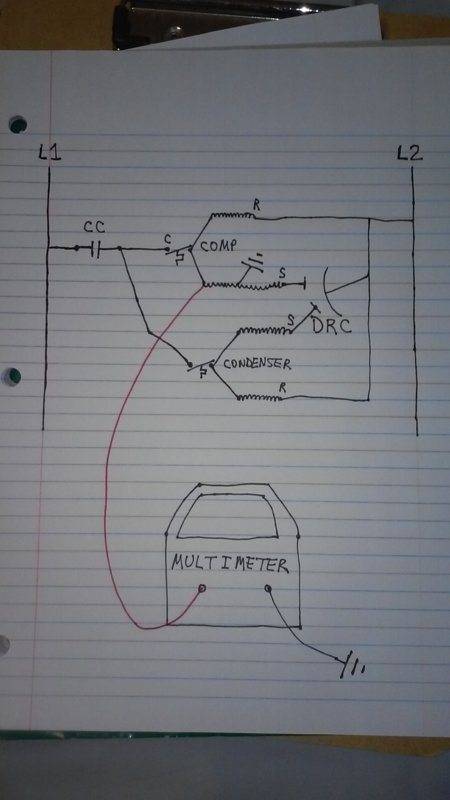
Compressor short to ground.jpg


I have seen videos on youtube in which HVAC technicians have checked for shorts to ground on compressors in air-conditioners, and the HVAC technicians always attached one lead of the multimeter to ground and then attached the other lead of the multimeter to a terminal spade of the compressor.

When an HVAC technician is checking for a short to ground on a compressor, I fully understand why the HVAC technician must attach one lead of the multimeter to one of the terminal spades of the compressor, but I don't fully understand why the HVAC technician must attach the other lead to ground. I understand that the multimeter measures resistance by applying a modest voltage from the multimeter's internal battery, and the multimeter measures the amount of current that flows into the conductance of whatever it is measuring.

Why does an HVAC technician have to have one lead of the multimeter attached to ground when checking for a short to ground on a compressor?

Does an HVAC technician have to have one lead of the multimeter attached to ground when checking for a short to ground on a compressor because having one lead of the multimeter attached to ground is necessary to have a complete circuit?
 
Engineering news on Phys.org
Your last paragraph is correct.

Forgive me but your question has a pretty obvious answer; so much so you’ve answered it yourself. Now, several times you’ve mentioned “current flowing into conductance”. There might lie your problem - current must flow into somewhere, then out then back to the source. A circuit.

To see if two points are connected electrically, you apply a meter probe to each point, and see if they complete a circuit.
 
  • Like
Likes   Reactions: davenn
Guineafowl said:
Your last paragraph is correct.

Forgive me but your question has a pretty obvious answer; so much so you’ve answered it yourself.

It might have been obvious to you, but it was not so obvious to me. I wanted confirmation. I still would like to get a second opinion from another PF member.
Now, several times you’ve mentioned “current flowing into conductance”. There might lie your problem - current must flow into somewhere, then out then back to the source. A circuit.

To see if two points are connected electrically, you apply a meter probe to each point, and see if they complete a circuit.

How do you see if they complete a circuit?
 
There was certainly no offence intended in my post; just a gentle push towards Jim Hardy’s adage: A question well stated is half answered. It’s hard to convey that manner in a written post so how about this: ;)

What is your background? Your diagram shows some reasonable level of understanding of motor faults, but your question suggests someone hasn’t hammered in your V’s, I’s and R’s.

If I gave you a plastic box with two terminals on it, and asked you to determine whether the terminals are connected (or shorted, if you like), how would you find out? You have no meter, only a battery, light bulb and wires.
 
  • Like
Likes   Reactions: davenn
Guineafowl said:
There was certainly no offence intended in my post; just a gentle push towards Jim Hardy’s adage: A question well stated is half answered. It’s hard to convey that manner in a written post so how about this: ;)

What is your background? Your diagram shows some reasonable level of understanding of motor faults, but your question suggests someone hasn’t hammered in your V’s, I’s and R’s.

I think I have hammered in my V's, I's, and R's. I am a student attending an HVAC program at a trade school. The only physics class I ever attended in my life was almost 20 years ago when I was a senior in high school.

If I gave you a plastic box with two terminals on it, and asked you to determine whether the terminals are connected (or shorted, if you like), how would you find out? You have no meter, only a battery, light bulb and wires.

I would connect a wire from the first terminal of the plastic box to the positive terminal of the battery, and I would connect a wire from the negative terminal of the battery to the light bulb, and then I would connect a wire from the light bulb to the second terminal of the plastic box. If the light bulb lights up, the two terminals on the plastic box are connected. If the light bulb does not light up, the two terminals on the plastic box are not connected. All this is assuming that the light bulb is not defective, and the battery still has charge in it, and all this assumes that the wires are not defective.
 
  • Like
Likes   Reactions: Guineafowl
Your meter on the HVAC motor is similar to the battery/bulb tester. It applies a voltage, like the battery; It has two open ends, like the two wires; it displays a reading if a circuit is made, like the bulb glowing.

And just like the meter, the bulb won’t register until both wires have made the circuit. Current can’t “flow into” something unless it can also flow out. Current flows through something, not either into or out of it.

In your diagram, draw an imaginary wire between the two ground symbols (which is, in effect, what’s happening). Can you now see the circuit?
 
  • Like
Likes   Reactions: fourthindiana
fourthindiana said:
I still would like to get a second opinion from another PF member.
https://www.allaboutcircuits.com/textbook/direct-current/chpt-1/electric-circuits/
 
  • Like
Likes   Reactions: Guineafowl
Guineafowl said:
Now, several times you’ve mentioned “current flowing into conductance”. There might lie your problem - current must flow into somewhere, then out then back to the source. A circuit.

In my thread "Ohm reading when there is a short in the condenser motor", PF member jim hardy said
"the multimeter measures the amount of current that flows into the conductance of whatever it is measuring." Frankly, I only made that statement using those words because that is what jim hardy said. As far as I know, there is no difference between "the multimeter measures the current that flows into the conductance of whatever it is measuring" and "the multimeter measures the current that flows through the circuit".
 
fourthindiana said:
In my thread "Ohm reading when there is a short in the condenser motor", PF member jim hardy said
"the multimeter measures the amount of current that flows into the conductance of whatever it is measuring." Frankly, I only made that statement using those words because that is what jim hardy said. As far as I know, there is no difference between "the multimeter measures the current that flows into the conductance of whatever it is measuring" and "the multimeter measures the current that flows through the circuit".
They are the same provided that your meter has two leads connected. Current doesn't flow into the meter unless it has a way to flow out.
 
  • Like
Likes   Reactions: davenn
  • #10
fourthindiana said:
the multimeter measures the amount of current that flows into the conductance of whatever it is measuring
Jim’s statement is absolutely correct as a description of how a meter measures resistance. But it’s understood that the meter can ONLY do that if a circuit has first been made.

Go back to your battery/bulb and wires. A break anywhere in the circuit will stop current flow in all parts. A circuit is a closed loop - it flows from source, through circuit, and back to source. By not probing ground with the second meter lead, you are breaking the circuit and stopping all current flow.

Could your confusion be related to the idea of ‘ground’ and the falsehood that ‘current always flows to ground’? It’s a very common misconception on here.
 
  • #11
Whenever you are measuring circuits with your mm, always think of measuring (voltage, current, ohms, etc.) from here (one lead) to there (the other lead). If you don't have a good idea of where "here" and "there" are, you are wasting you time (or worse).
 
  • Like
Likes   Reactions: Guineafowl and davenn
  • #12
fourthindiana said:
Does an HVAC technician have to have one lead of the multimeter attached to ground when checking for a short to ground on a compressor because having one lead of the multimeter attached to ground is necessary to have a complete circuit?

That's exactly right.
If the circuit is not completed by 'grounding' the second meter lead,
there's no current flow through the meter because
resistance is infinite,
same as saying conductance is zero.
244504

Current = Modest Volts/Ohms
Current = Modest Volts X Conductance
plug in infinity for ohms
plug in zero for conductance
do you get the same result for both ?

See ? You knew that already !

This is how you gain faith in your knowledge.

Try it on the next burnt out motor you encounter.

old jim
 
  • Like
Likes   Reactions: davenn, dlgoff and fourthindiana
  • #13
Thank you for your answer, jim hardy.
 
  • Like
Likes   Reactions: jim hardy
  • #14
fourthindiana said:
As far as I know, there is no difference between "the multimeter measures the current that flows into the conductance of whatever it is measuring" and "the multimeter measures the current that flows through the circuit".

You are correct.

I find it helpful to refer to a picture
then search for the best possible words to describe it.
It makes you think simple and refine your words. Dont be embarrassed to struggle for some time mak ing it unambiguous.. I edit repeatedly.

Thinking real simple now-----
In that picture above
the meter actually measures the current that flows through the little orange "Modest Voltage" block inside itself. That's where the measurement takes place.
In order to get through the meter and be measured, that current has to flow around the rest of the orange loop as shown.

It is often helpful to imagine yourself infinitesimally small, inside the wire and walking around the loop, as if you were carrying a single unit of charge. You have to stop when you encounter an air gap like a lifted lead.
Resistance you just have to squeeze through, but an open stops you dead in your tracks.

old jim
 
  • #15
One comment that may help you sort this out.

The "Gnd" symbol in the ladder diagram you drew is a shorthand way of showing that every occurrence of the symbol represents the same connection.

Rather than show a wire going to everywhere that "Gnd" symbol is, they just substitute the symbol. That's doing the same thing as the "L1" and "L2" symbols in the diagram. You don't draw all the places in the plant that L1 and L2 go, you just label them and know that eventually they get back to a power station.

The same is true with the Gnd symbols, eventually all of them are connected together.

Hope this helps.

Cheers,
Tom
 
  • Like
Likes   Reactions: jim hardy
  • #16
"Ground" is a concept that confuses people a LOT.

You might think of it as just another wire , one that goes almost everywhere.
 
  • #17
jim hardy said:
I find it helpful to refer to a picture then search for the best possible words to describe it.
Wow. I've never really thought about the processes in that way/those words.
 
  • Like
Likes   Reactions: jim hardy

Similar threads

  • · Replies 11 ·
Replies
11
Views
4K
  • · Replies 1 ·
Replies
1
Views
2K
  • · Replies 14 ·
Replies
14
Views
6K
Replies
7
Views
12K
  • · Replies 25 ·
Replies
25
Views
6K
Replies
12
Views
3K
Replies
5
Views
1K
  • · Replies 5 ·
Replies
5
Views
5K
  • · Replies 25 ·
Replies
25
Views
5K
Replies
5
Views
6K