Where Did I Go Wrong in My Refraction Problem Solution?

Click For Summary

Homework Help Overview

The discussion revolves around a refraction problem from a physics textbook, specifically focusing on the behavior of light as it transitions between different media: water, plastic, and air. The original poster expresses confusion regarding their calculations and the apparent contradictions between their intuitive understanding and the mathematical results obtained.

Discussion Character

  • Mixed

Approaches and Questions Raised

  • The original poster attempts to solve the problem using both intuitive reasoning and mathematical equations, but finds inconsistencies between the two approaches. They explore the implications of light traveling from water to plastic and then from plastic to air, questioning the effects of the thickness of the plastic wall.
  • Some participants question the clarity of the original poster's reasoning and the labeling of parts of their solution, suggesting that the equations may have been misapplied or misunderstood.
  • Others suggest reconsidering the assumptions made about the distances and the context of the equations used.

Discussion Status

The discussion is ongoing, with participants providing feedback and raising questions about the original poster's reasoning and calculations. There is no explicit consensus yet, but several participants have offered clarifications and corrections that may help guide the original poster toward a better understanding of the problem.

Contextual Notes

Participants note that the problem involves a tank with a uniform thickness plastic wall, which may have been misinterpreted by the original poster. There is also mention of the need to clarify the definitions and contexts of the equations referenced from various textbooks.

Florian Geyer
Messages
95
Reaction score
29
Homework Statement
I am doing a problem on geometrical optics in which I need to find the image and object distances a curved refracting surface, the problem contains many parts, but I have problem only with the last two parts, which asked whether it is possible for the image distance to be greater than the image distance.
Relevant Equations
Lensmaker's equation for a single surface: ##\frac{n_1}{p} + \frac{n_2}{q} = \frac{n_2 - n_1}{R}##
Magnification formula: ##M = -\frac{n_1 q}{n_2 p}##
Hello esteemed members,
I hope this message will find you well,

I have encountered this problem in Serway and Jewitt 9e.
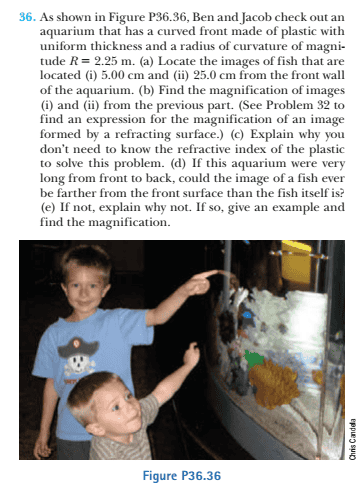
1708965308634.png

My problem is only with parts (d) and (e).
I tried to solve the problem in two ways, one is based on intuition, and the second is based on the equations, but the two method did not come hand in hand, which I think clearly means that I made a mistake.

Here is my attempt.

d) Yes this base of the fact that when light goes perpendicular form of medium of Greater n1 to another smaller n2, the image seems to be nearer to the surface for an observer on the second medium, and vice versa.
In this problem light travels between three mediums first between water and plastic and then from plastic to air.

From water to plastic ##n_1 < n_2## The image appears to be further from the wall of the aquarium (from the observer) than it really is.
From plastic to air ##n_1 > n_2## The image appears to be near to The Observer then it really is.
If the plastic wall is very thick (long from front to back), then the effect of this part is greater than the effect of water, does the image appears nearer to the observer.

e) ##\frac{n_1}{p} + \frac{n_2}{q} = \frac{n_2 - n_1}{R} \\
\Rightarrow q = n_2 \left( \frac{n_2 - n_1}{R} - \frac{n_1}{p} \right)^{-1} \\
(n_1 > n_2): (\text{from plastic to air}) ##
##R < 0 \quad (\text{neg}) ##
##n_2 - n_1 < 0 \quad (\text{neg})##
##\frac{n_2 - n_1}{R} > 0 \quad (\text{pos})##
##q = \left( \frac{n_2 - n_1}{R} - \frac{n_1}{p} \right)^{-1}##
(This is the difference between two positive numbers, but as the second term becomes bigger and bigger the quantity ##q## becomes negative)\\

We will study the two extremes when ##R\gg p \,## and when ##R\ll p##,
since all possible values of ##q## will be in between these two extremes.

i) ##p \ll R##:
##\Rightarrow q\approx n_2 (\frac{n_2-n_1}{R})^{-1}=(\frac{n_2 R}{n_2 -n_1})##
##m=\frac{-n_1 q}{n_2 p}##
##\Rightarrow m=- \frac{n_1(n_2 R)/(n_2-n_1)}{n_2 p}##
##\Rightarrow m=-\frac{n_1 R}{p(n_2-n_1)}=0 \quad## (since ##p\ll R##)


ii) ##p \gg R##:
##q \approx n_2 (\frac{-p}{n_1})
m=\frac{-n_1 q}{n_2 p}\Rightarrow m=-\frac{-n_1(-n_2 p/n_1)}{n_2 p}
\Rightarrow m=+1
##

The meaning of the previous values of ##m## is that ##q## can be very small compared to ##p## or equal to it.
The previous was the case from air to plastic.

after this we need to take the other boundary (from water to plastic) into consideration:

if we did the same for the water to plastic case, we will find out that:

##m=0 \quad \text{or} \quad m=1##

In both cased the image distance can either be equal to the body distance or very small in comparison to it.

This result from the math is in contradiction with the one I put first based on my intuition. The solutions manual also does not agree with the result gotten from the math, so please can you help me to understand where did I made mistakes?
 
Physics news on Phys.org
Florian Geyer said:
If the plastic wall is very thick (long from front to back),
It says the tank is long, not the plastic, which is just a shell of "uniform thickness".
What reason did you give in part c?
 
  • Informative
Likes   Reactions: Florian Geyer
haruspex said:
It says the tank is long, not the plastic, which is just a shell of "uniform thickness".
What reason did you give in part c?
Hell!!, now I understand... always the language is what causes my problems.
Anyways, for part (c) I answered that the thickness is very thin, thus it is effect is negligible.

now after I understood this, I think my method still applies on the case light traveling from water to air, the only difference is that we will study now only half what I have written, (only the case of plastic to air), but with changing the value of the refraction index of the plastic to that of water. Even with taking this into consideration, the magnification can have the values 0 or 1, which means the images distance cannot be greater than the object distance.
still the solutions manual says my solution is not correct.
 
Florian Geyer said:
Even with taking this into consideration, the magnification can have the values 0 or 1, which means the images distance cannot be greater than the object distance.
I don't follow your argument. Why not use the relevant equation you quote?
 
  • Like
Likes   Reactions: Florian Geyer
First I apologize for my late reply.

I meant even if we have only only two media i.e, water and air, everything I have written previously in my original post (until I wrote "after this we need to take the other boundary (from water to plastic) into consideration:") still apply here, and since this solution does not agree with the solutions manual (I haven't looked on the whole solution yet), then I think I have made a mistake.

In other words to understand how I tried to do the problem, look on my try on the original post, but replace the part (from plastic to air) by (from water to air), and everything the same... until you reach the part of (from water to plastic) and then ignore it.
 
haruspex said:
I don't follow your argument. Why not use the relevant equation you quote?
Anyway I will return to this problem maybe tomorrow in the evening (I got a metal block because of it), I will try to do it, if I could not I will return here and ask for more help.

Thank you a lot for taking time and considering my thread.
 
A couple of things were confusing me.
First, you labelled this part e), but it seems to still addressing d).
Secondly, for reasons I cannot discern, some of the equations after (i) and (ii) are missing when I read post #1, but show up below.

Florian Geyer said:
e) ##\frac{n_1}{p} + \frac{n_2}{q} = \frac{n_2 - n_1}{R} \\##
Note that for the flat plate case ##R=\infty##, which gives ##q=-p\frac{n_2}{n_1}##.
Shouldn't they both be positive? I suspect you got this equation from a context in which object and image were on opposite sides, so we need to flip the sign of q.

Florian Geyer said:
##q = \left( \frac{n_2 - n_1}{R} - \frac{n_1}{p} \right)^{-1}##
You dropped a factor ##n_2##.
Florian Geyer said:
(This is the difference between two positive numbers, but as the second term becomes bigger and bigger the quantity ##q## becomes negative)
You are asked about large p, not small p.
 
  • Informative
Likes   Reactions: Florian Geyer
haruspex said:
First, you labelled this part e), but it seems to still addressing d).
Yes, yes, but it seems they are very connected, e) is just explaining of part d), thus I get confused where shall I write the proof.

haruspex said:
Shouldn't they both be positive?
I am not sure, I just derived the equation from the textbook, but although the equation has derived from the case of a picture in the opposite direction of the body, but I think the equation is still valid to all the cases, whether the body and the picture are on the same side, or in two different sides. I have found it as written here in many textbooks (Halliday and Resnick, Sears and Zemasky, Serway and Jewitt... etc) I think it is a general equation which can be applies in both the previous cases. (If you think the problem in my solution is in this part, then I will be indented to you if you mention this).
Sears and Zemansky:
1709494836390.png

1709494862772.png

Serway and Jewitt:
1709494935205.png

1709494964707.png

Halliday and Resnick:
1709495080141.png


haruspex said:
Note that for the flat plate case R=∞, which gives q=−pn2n1.
This is exactly what I think, and which is written in my textbook (See the pictures above)

haruspex said:
You dropped a factor n2.
Thanks for correcting me, yes I missed that.
haruspex said:
You are asked about large p, not small p.
Yes, but I thought since I couldn't find what I wanted in the case of large p, then I shall study all the cases.

I know I need to restudy the whole chapter, and this is what I will do after this reply, again, a lot of thanks for considering my question.
 
Florian Geyer said:
I have found it as written here in many textbooks (Halliday and Resnick, Sears and Zemasky, Serway and Jewitt... etc) I think it is a general equation which can be applies in both the previous cases.
That the equation is given in all these sources is not the point. What you have not stated is what the distances represent in those texts.
Look at figure 2.4.3 in https://phys.libretexts.org/Bookshelves/University_Physics/University_Physics_(OpenStax)/University_Physics_III_-_Optics_and_Modern_Physics_(OpenStax)/02:_Geometric_Optics_and_Image_Formation/2.04:_Images_Formed_by_Refraction
The object and image are assumed to be on opposite sides of the surface, and the values are positive in that case. If the object is sufficiently close to the surface, on the concave side, and is in the denser medium (as is the case here) the image is on the same side as the object, so the equation produces a negative answer.

Since you are investigating whether q can be greater than p, on the same side, it would be less confusing to adopt the convention that they are positive on the same side, so flip the sign of q in the equation.
Having done that, combine the equation with q>p and see what results.
 
  • Informative
Likes   Reactions: Florian Geyer
  • #10
I forgot to add…
There is still the issue of the sign to use for R.
In the diagram I linked, the object is on the convex side of the surface; in this thread, it is on the concave side. So flip the sign of R as well.
 
  • Like
Likes   Reactions: Florian Geyer
  • #11
haruspex said:
That the equation is given in all these sources is not the point. What you have not stated is what the distances represent in those texts.
Look at figure 2.4.3 in https://phys.libretexts.org/Bookshelves/University_Physics/University_Physics_(OpenStax)/University_Physics_III_-_Optics_and_Modern_Physics_(OpenStax)/02:_Geometric_Optics_and_Image_Formation/2.04:_Images_Formed_by_Refraction
The object and image are assumed to be on opposite sides of the surface, and the values are positive in that case. If the object is sufficiently close to the surface, on the concave side, and is in the denser medium (as is the case here) the image is on the same side as the object, so the equation produces a negative answer.

Since you are investigating whether q can be greater than p, on the same side, it would be less confusing to adopt the convention that they are positive on the same side, so flip the sign of q in the equation.
Having done that, combine the equation with q>p and see what results.
First, I am indebted to you for you help, I finally got it right.
Secondly, next time, I'll try to do the problems before mastering the entire chapter—only when pigs fly!
 
  • #12
haruspex said:
I forgot to add…
There is still the issue of the sign to use for R.
In the diagram I linked, the object is on the convex side of the surface; in this thread, it is on the concave side. So flip the sign of R as well.
Yes, yes I figured this also.
A lot of thanks.
 
  • Like
Likes   Reactions: haruspex

Similar threads

  • · Replies 2 ·
Replies
2
Views
2K
Replies
7
Views
2K
  • · Replies 8 ·
Replies
8
Views
2K
  • · Replies 29 ·
Replies
29
Views
7K
  • · Replies 1 ·
Replies
1
Views
2K
  • · Replies 9 ·
Replies
9
Views
3K
  • · Replies 2 ·
Replies
2
Views
3K
  • · Replies 1 ·
Replies
1
Views
2K
  • · Replies 2 ·
Replies
2
Views
2K
  • · Replies 10 ·
Replies
10
Views
3K