Where does interference occur in light waves?
- Level: Undergrad
- Thread starter jaumzaum
- Start date
Join the discussion
Registration is free. Start your own thread to ask a follow-up.
87 replies · 15K views
Physics news on Phys.org
MarkoniF
- 56
- 0
Khashishi said:How do you aim for a specific pixel? If the pixel is smaller than a wavelength, forgetaboutit.
I don't know, depends on how fine resolution photo-sensor can be made. Do you know?
If it's larger than a pixel, you might be able to aim for it by using an aperture, but you lose a lot of photons hitting the aperture.
Losing photons due to aperture size is what we want, I think. This helps us to aim, as well as produce individual photons with some gap or time interval between them.
Last edited:
Science Advisor
- 2,116
- 611
MarkoniF said:Losing photons due to aperture size is what we want, I think. This helps us to aim, as well as produce individual photons with some gap or time interval between them.
To get single photons, you want to reduce the variance of your photon number distribution. That means you want to reduce the noise. Using an aperture reduces the amplitude or the mean of the photon number distribution, but the relative variance will stay the same and not be reduced. One cannot create single photons simply by reducing intensity.
MarkoniF
- 56
- 0
Cthugha said:Having high spatial resolution and single photon sensitivity at the same time is a major pain, but in principle possibly, for example by using a spad array or something. Creating single photons is also complicated, but possible. Creating single photons at a specific time interval is VERY complicated and you will get pretty rich if you can do that in a reliable manner in a non-lab surrounding. But at least you can do that with some mediocre fidelity.
I did read few weeks ago about some type of laser emitting individual photons at the rate of super-high time resolution.
I can assure you that they do not. Diffraction is always there, whether you have an intense beam or single photons. If you integrate over a large number of photons, the total diffraction pattern will be the same for intense beams or single photons under otherwise identical circumstances.
Having individual photons, what is the diffraction? Increase or whatever change in their individual amplitudes? Some probability cloud of possible trajectories as a sum of many of them, or what?
No, one should not interpret this as a photon size. The Mandel/Wolf, the bible of quantum optics devotes a whole subchapter to this topic. In a nushell, you run into severe problems trying to use this interpretation for polychromatic lightfields. For example, when you do the math, you will find out that the probability density to detect a photon peaks at a position which does not coincide with the maximum of the energy density. If you wanted to attribute something like a size to photons, the coherence length is a better measure than the diameter it can be focused on. Still, the coherence length should not be interpreted as a photon size. You still run into problems doing that.
Photons are typically treated as point particles which renders the concept of photon size obsolete. The underlying fields have some characteristic length scales like the mentioned coherence length.
Can we not say with certainty what is the distance between two amplitude peeks of a single photon by knowing its wavelength? Is that distance not real, and would it not describe "thickness" of individual photons?
Last edited:
Science Advisor
- 2,116
- 611
MarkoniF said:I did read few weeks ago about some type of laser emitting individual photons at the rate of super-high time resolution.
I read something somewhere is not really a good reference. Do you by chance have a link to the real reference? That makes it much easier to check whether that was just "second-hand" pseudoscientific journalism for the masses or a crude simplification of much more complex matter. Lasers typically emit coherent light which is about as far away from single photon emission as you can get.
MarkoniF said:Having individual photons, what is diffraction? Increase in their individual amplitude? Or some probability cloud of possible trajectories as a sum of many of them?
You do not have trajectories in standard quantum optics. You have probability amplitudes for certain events - typically detections. So if you repeatedly prepare single photon states with well defined momentum (which is already complicated) and a small "beam" diameter, you will find that the probability amplitudes for detection events away from the center of the beam and at larger distances from the initial beam diameter will increase with the distance traveled by the single photons.
MarkoniF said:Can we not say with certainty what is the distance between two amplitude peeks of a single photon by knowing its wavelength? Is that distance not real, and would it not describe "thickness" of individual photons?
If you are in the lucky situation of having a monochromatic single photon (which would be infinitely long in time by the way), you have at least a certain wavelength. However, typical photons are polychromatic. In any way the probability amplitude for detection events is typically nonzero over some area which is not at all related to the wavelength. Depending on the coherence properties of the emitter, the area in which detections are possible can range from micrometers to meters, maybe even kilometers. The wavelength is real, but can by no means be interpreted as a size or even thickness. You can have different light fields with the same wavelength, but very different detection probability distributions.
MarkoniF
- 56
- 0
Cthugha said:I read something somewhere is not really a good reference. Do you by chance have a link to the real reference? That makes it much easier to check whether that was just "second-hand" pseudoscientific journalism for the masses or a crude simplification of much more complex matter. Lasers typically emit coherent light which is about as far away from single photon emission as you can get.
I meant it is precise like laser, in a sense they could aim or focus those photons to narrow area on the sensor. I couldn't find that link. Found a lot of stuff about quantum dot LEDs. And also this interesting link, about sensor though, rather than photon emitter:
http://phys.org/news173957578.html
- "camera capable of filming individual photons one million times a second... a pixel that is 50 microns-by-50 microns, with a lot of functionality in it... high-precision lenses work amazingly well to lead the photons onto the photosensitive areas that are just 10 microns in size."
You do not have trajectories in standard quantum optics.
If we can detect individual photons then we know exactly what trajectory each photon went through. Light travels in straight lines, doesn't it?
You have probability amplitudes for certain events - typically detections. So if you repeatedly prepare single photon states with well defined momentum (which is already complicated) and a small "beam" diameter, you will find that the probability amplitudes for detection events away from the center of the beam and at larger distances from the initial beam diameter will increase with the distance traveled by the single photons.
I guess it depends on how well can we focus.
If you are in the lucky situation of having a monochromatic single photon (which would be infinitely long in time by the way), you have at least a certain wavelength. However, typical photons are polychromatic. In any way the probability amplitude for detection events is typically nonzero over some area which is not at all related to the wavelength. Depending on the coherence properties of the emitter, the area in which detections are possible can range from micrometers to meters, maybe even kilometers. The wavelength is real, but can by no means be interpreted as a size or even thickness. You can have different light fields with the same wavelength, but very different detection probability distributions.
Not wavelength, amplitude. Do individual photons have amplitude? Does that amplitude represent some actual distance?
Science Advisor
- 2,116
- 611
MarkoniF said:I meant it is precise like laser, in a sense they could aim or focus those photons to narrow area on the sensor.
With the right filtering you can focus any light to a narrow area. laser light is not that special in that respect.
MarkoniF said:I couldn't find that link. Found a lot of stuff about quantum dot LEDs.
Yes, you can get single photon sources by placing single quantum dots in microcavities. They are not really efficient, especially at room temperature, but you get single photons out.
MarkoniF said:And also this interesting link, about sensor though, rather than photon emitter:
http://phys.org/news173957578.html
- "camera capable of filming individual photons one million times a second... a pixel that is 50 microns-by-50 microns, with a lot of functionality in it... high-precision lenses work amazingly well to lead the photons onto the photosensitive areas that are just 10 microns in size."
Yes, this is a SPAD array. So what about it? 10 microns is still rather large, by the way.
MarkoniF said:If we can detect individual photons then we know exactly what trajectory each photon went through. Light travels in straight lines, doesn't it?
In fact, you cannot say anything about what happens between emission and detection. For the double slit experiment to work with single photons, it must be uncertain which slit a certain photon has taken. So if one could say light travels strictly in straight lines, there would be no interference in double slit experiments. Yet, there is interference.
MarkoniF said:I guess it depends on how well can we focus.
We were talking about diffraction. What does focusing have to do with that?
MarkoniF said:Not wavelength, amplitude. Do individual photons have amplitude? Does that amplitude represent some actual distance?
I do not get your question. Even for a classical em field the amplitude is given in Newton per coulomb or equivalently volts per meter. This is not a mechanical displacement amplitude related to distance via Hooke's law or something like that. You can associate single photons with probability amplitudes and you can often also find a description in terms of underlying fields.
MarkoniF
- 56
- 0
Cthugha said:Yes, this is a SPAD array. So what about it? 10 microns is still rather large, by the way.
I guess whether that's large or small would depend on photons amplitude. In any case the question is if we made pixels small enough whether a single photon could ever impact more than one pixel at once?
In fact, you cannot say anything about what happens between emission and detection. For the double slit experiment to work with single photons, it must be uncertain which slit a certain photon has taken. So if one could say light travels strictly in straight lines, there would be no interference in double slit experiments. Yet, there is interference.
And if we don't have any slits, wouldn't the path of each photon be along the shortest distance from the aperture opening to the pixel where it was detected? Maybe the path wouldn't be a straight line, maybe it would be a helical or sinusoidal line, but on average it surely wouldn't deviate too far from the shortest distance line.
We were talking about diffraction. What does focusing have to do with that?
I'm not sure, shouldn't focusing be opposing diffraction?
I do not get your question. Even for a classical em field the amplitude is given in Newton per coulomb or equivalently volts per meter. This is not a mechanical displacement amplitude related to distance via Hooke's law or something like that. You can associate single photons with probability amplitudes and you can often also find a description in terms of underlying fields.
I expected photon amplitude would be actual, or what you call "mechanical", displacement, or at least correspond to some actual distance in terms of whatever measurable effects, like the wavelength does.
Science Advisor
Homework Helper
- 30,609
- 7,550
You guys are are talking in circles when you are considering the 'size' of a photon because it is a non-concept. If any statement that you make doesn't apply to Long Wave EM then it is not valid. It's the acid test and should bring you down to the ground from flights of fancy.
What has pixel size specifically got to do with things? A detector of any size in wavelengths can detect an em wave - some are just easier to implement than others.
You are trying to be far too concrete in your description of a photon. The best I have read here is to associate the extent of a photon with coherence length but isn't even that just trying to force the idea to fit when it doesn't need to? If you come across a photon, from a random direction in space and you don't know what generated it, how can you assign it a 'coherence length'? If it was produced in a distant laser, will it have a different probability density function when going through two slits from a photon that was generated by a local atom having been randomly ionised? I though that photons were supposed to have just the one parameter - their energy. Is there a whole classification system for photons?
What has pixel size specifically got to do with things? A detector of any size in wavelengths can detect an em wave - some are just easier to implement than others.
You are trying to be far too concrete in your description of a photon. The best I have read here is to associate the extent of a photon with coherence length but isn't even that just trying to force the idea to fit when it doesn't need to? If you come across a photon, from a random direction in space and you don't know what generated it, how can you assign it a 'coherence length'? If it was produced in a distant laser, will it have a different probability density function when going through two slits from a photon that was generated by a local atom having been randomly ionised? I though that photons were supposed to have just the one parameter - their energy. Is there a whole classification system for photons?
Science Advisor
Homework Helper
- 30,609
- 7,550
Photons are a bit like 'holes' in semiconductors. You can treat them both as particles in the context of specific problems because that's how they happen to present themselves at the time. They exhibit momentum, for instance and they can be said to move around. But no one would seriously think that they could take a hole out of a piece of semiconductor and keep it in a box. its nature would change as soon as you grabbed it - it would become a simple +ion. Likewise, a photon only has relevance as a particle in certain contexts and its particular nature is not the same as that of a proton, for instance - which stays like a particle in more situations.
People wouldn't disagree with that view that holes are only a way of looking at how electrons move about in a semiconductor (largely, I think, because they do not feel that 'familiar' with them) but there is something about the (over?)confidence that people have with their personal ideas about light that they can't let go of the idea that a simple valid model for a photon actually exists.
All the Greats in QM acknowledge that it just isn't that simple and that if you think you understand it you don't. So why not just accept that any home brewed picture one might come up with is very very likely not be sufficient?
People wouldn't disagree with that view that holes are only a way of looking at how electrons move about in a semiconductor (largely, I think, because they do not feel that 'familiar' with them) but there is something about the (over?)confidence that people have with their personal ideas about light that they can't let go of the idea that a simple valid model for a photon actually exists.
All the Greats in QM acknowledge that it just isn't that simple and that if you think you understand it you don't. So why not just accept that any home brewed picture one might come up with is very very likely not be sufficient?
Science Advisor
Homework Helper
- 30,609
- 7,550
MarkoniF said:I guess whether that's large or small would depend on photons amplitude.
. . . . .
I expected photon amplitude would be actual, or what you call "mechanical", displacement, or at least correspond to some actual distance in terms of whatever measurable effects, like the wavelength does.
If a photon is to be as defined in QM and has energy that is dependent upon the frequency of EM it's associated then please tell me what you mean by "photon amplitude". Can you quote me anywhere reputable that you have read this expression?
Science Advisor
- 2,116
- 611
sophiecentaur said:You guys are are talking in circles when you are considering the 'size' of a photon because it is a non-concept.
Well, I said like five times now that there is no meaningful concept of photon size and at least once that they are treated as point particles...
MarkoniF said:And if we don't have any slits, wouldn't the path of each photon be along the shortest distance from the aperture opening to the pixel where it was detected? Maybe the path wouldn't be a straight line, maybe it would be a helical or sinusoidal line, but on average it surely wouldn't deviate too far from the shortest distance line.
As stated before, you cannot say anything about what happens between emission and detection for a single photon. You can define something like an average trajectory for an ensemble of identically prepared states (Science 332, pp. 1170-1173 (2011)), but that does not have any implication for single photons. You are having a way too classical concept of what photons are. Thinking about them as tiny balls flying through space is about as far away from a sensible description as you can get.
MarkoniF said:I'm not sure, shouldn't focusing be opposing diffraction?
Not really. Of course you can focus light somewhere, but behind the focus point, it will of course spread again. Even if you place a series of lenses, repeatedly focusing your light beam, it will broaden with distance.
Science Advisor
Homework Helper
- 30,609
- 7,550
Cthugha said:Well, I said like five times now that there is no meaningful concept of photon size and at least once that they are treated as point particles...
Yes, I realize you know that but the 'conversation' keeps throwing it up as a concept - along with some actual Pictures!.
But do you have an answer for my point about coherence length and the identical nature of photons? There's something still needs clearing up there, I think.
@MarkoniF
You are hanging on to this classical model and it will get you nowhere. This is all very Zen when you get down to it and you must chuck out many preconceptions, Grashopper.
MarkoniF
- 56
- 0
sophiecentaur said:If a photon is to be as defined in QM and has energy that is dependent upon the frequency of EM it's associated then please tell me what you mean by "photon amplitude". Can you quote me anywhere reputable that you have read this expression?
https://en.wikipedia.org/wiki/Photon
There are only three things marked on that diagram, wavelength, amplitude of electric field and amplitude of magnetic filed. Waves naturally have amplitudes just like they have a wavelength. How else would you know what is the wavelength if you don't know how far apart are the peaks of the amplitude?
Science Advisor
Homework Helper
- 30,609
- 7,550
MarkoniF said:https://en.wikipedia.org/wiki/Photon
There are only three things marked on that diagram, wavelength, amplitude of electric field and amplitude of magnetic filed. Waves naturally have amplitudes just like they have a wavelength. How else would you know what is the wavelength if you don't know how far apart are the peaks of the amplitude?
Again, you are confusing the classical wave with the photon. That diagram describes a Wave. Is there any mention of photons on it? You seem to be repeating the same thing to yourself, 'explaining it' to PF in your terms, drawing diagrams from inside your head and not accepting any new input about this. Photons and waves are DIFFERENT aspects of the same thing. If it were as straightforward as you seem to think then why would thousands (even more than that) of really clever Scientists have had a problem with it? Your model doesn't actually take you into QM, it just tinkers with the ancient 'corpuscular' theory and tries to make those little corpuscles a bit wiggly.
Everyone goes through this stage of thinking (I am not being patronising) and, once you start asking the sort of questions that you are asking, the ground is continually shifting. You sit there and 'the answer' comes into your head. Later, you realize that it isn't the answer but you modify and re-think. I compare QM with trying to grab the soap in the bath - you touch it with your fingers so you know it's there but it slips away when you put your hand round it. It is a lot easier to say what a photon isn't rather than what it is, which is why you are getting some negative reactions here. You must open your mind beyond where it is at the moment if you want a chance of progressing.
I'm afraid that I can quite confidently say that you have got it wrong, so far. It won't come to you - you have to go to it.

BTW, from the whole of that wiki article, why did you pick the one diagram that shows the classical description of a wave when photons are dealt with everywhere else?
Last edited:
Science Advisor
- 2,116
- 611
sophiecentaur said:Yes, I realize you know that but the 'conversation' keeps throwing it up as a concept - along with some actual Pictures!.
Yes, right. I definitely know what you mean.
sophiecentaur said:But do you have an answer for my point about coherence length and the identical nature of photons? There's something still needs clearing up there, I think.
Well, regarding your post about coherence length of some isolated photon encountered somewhere: Coherence length is a somewhat statistical concept. It is a good concept if you have huge intensity or can repeatedly prepare the same state, but if you have neither, it is rather pointless. Also, all photons within a coherence length are indistinguishable, which makes it quite clear that it should not be considered a size. If you have a lump of 16800000 indistinguishable photons, the coherence length of this bunch is obviously not related to a size concept for a single of these particles.
Regarding your other question: There is not really a classification for photons. There are classifications for different states of the light field (a hierarchy of correlation functions, the density matrix, the Wigner function...). These also allow one to identify whether one has a single photon or not, but obviously these only work for states you can prepare repeatedly.
MarkoniF
- 56
- 0
Cthugha said:As stated before, you cannot say anything about what happens between emission and detection for a single photon. You can define something like an average trajectory for an ensemble of identically prepared states (Science 332, pp. 1170-1173 (2011)), but that does not have any implication for single photons. You are having a way too classical concept of what photons are. Thinking about them as tiny balls flying through space is about as far away from a sensible description as you can get.
Not tiny balls, it's oscillating electromagnetic fields, where their oscillation is defined by their wavelength and amplitudes. That's what Maxwell said and found out the speed of propagation of such oscillating electromagnetic fields would be the speed of light. Coincidence?
Our unit for distance, whole General and Special Relativity, and much of the rest of the physics depends on this electromagnetic oscillation propagating in straight lines. That's also necessary for the speed of light be constant. Just because we have no practical explanation to what happens at the double slit doesn't mean have to abandon the idea photons propagate along straight lines.
Not really. Of course you can focus light somewhere, but behind the focus point, it will of course spread again. Even if you place a series of lenses, repeatedly focusing your light beam, it will broaden with distance.
Then for our experiment we obviously need to place the detector at focus point distance. But it's not really important if we can detect individual photons, so the critical question to answer is if we could make pixels small enough whether a single photon could ever impact more than one pixel.
Science Advisor
- 2,116
- 611
MarkoniF said:Not tiny balls, it's oscillating electromagnetic fields, where their oscillation is defined by their wavelength and amplitudes. That's what Maxwell said and found out the speed of propagation of such oscillating electromagnetic fields would be the speed of light. Coincidence?
Yes, so? What is your point? Again, please note that the amplitude is in electric field, not distance.
MarkoniF said:Our unit for distance, whole General and Special Relativity, and much of the rest of the physics depends on this electromagnetic oscillation propagating in straight lines. That's also necessary for the speed of light be constant. Just because we have no practical explanation to what happens at the double slit doesn't mean have to abandon the idea photons propagate along straight lines.
For all of that it is enough that light propagates along straight lines "on average". I do not like it very much, but Feynman's path integral formalism gives a model where photons do not strictly travel along straight lines and nevertheless you get standard results.
MarkoniF said:Then for our experiment we obviously need to place the detector at focus point distance. But it's not really important if we can detect individual photons, so the critical question to answer is if we could make pixels small enough whether a single photon could ever impact more than one pixel.
I still do not get what you mean by a single photon impacting on more than one pixel. You will never find a single photon detection event taking place on more than one pixel, but if you repeatedly prepare identical single photons, they will end up on very different pixels.
MarkoniF
- 56
- 0
sophiecentaur said:Again, you are confusing the classical wave with the photon. That diagram describes a Wave. Is there any mention of photons on it?
Is single photon not oscillation of electric and magnetic field? Does a singe photon not have wavelength? Can a single photon not be polarized? The title of the article is "photon", it also says: -"Einstein showed that, if Planck's law of black-body radiation is accepted, the energy quanta must also carry momentum p=h/λ, making them full-fledged particles." Full-fledged particles, they say.
You seem to be repeating the same thing to yourself, 'explaining it' to PF in your terms, drawing diagrams from inside your head and not accepting any new input about this. Photons and waves are DIFFERENT aspects of the same thing.
How are photons and waves different aspect of the same thing? What is that "thing"? Let me tell you, there is electric and magnetic fields, they are kind of particles since they have momentum, and they oscillate as they propagate, so there it is the wave too. You get exactly what you said, both particles and waves, two aspects of the same thing.
If it were as straightforward as you seem to think then why would thousands (even more than that) of really clever Scientists have had a problem with it? Your model doesn't actually take you into QM, it just tinkers with the ancient 'corpuscular' theory and tries to make those little corpuscles a bit wiggly.
That's not my model, it's what Maxwell came up with. Combined electric and magnetic field and it turned out they would oscillate while propagating at the speed of light. Then Einstein figured out they have momentum, making them "full-fledged particles", to quote Wikipedia.
BTW, from the whole of that wiki article, why did you pick the one diagram that shows the classical description of a wave when photons are dealt with everywhere else?
How about this:
https://en.wikipedia.org/wiki/Polarization_(waves)
...and this:
https://en.wikipedia.org/wiki/Circular_polarization
Does that have nothing to do with reality? Just an abstraction, a cartoon?
MarkoniF
- 56
- 0
Cthugha said:Yes, so? What is your point?
The point is that electromagnetic wave equation describes actual spatial wave where electric and magnetic fields oscillate, that is move "up-down"/"left-right" through actual spatial distance of their amplitudes as they propagate.
'Again, please note that the amplitude is in electric field, not distance.
What do you mean amplitude is "in electric field"?
Science Advisor
- 2,116
- 611
MarkoniF said:The point is that electromagnetic wave equation describes actual spatial wave where electric and magnetic fields oscillate, that is move "up-down"/"left-right" through actual spatial distance of their amplitudes as they propagate.
NO, the oscillations in an em wave do exactly not mean that. It is a change in the field strength along some direction. The change in field strength does not mean that something is literally moving up or down in this direction. Could you please provide a reference confirming that these are indeed mechanical-like oscillations and not oscillations in the electrical field as Wikipedia and many other sources say?
MarkoniF said:What do you mean amplitude is "in electric field"?
Exactly that: The electric field strength oscillates, it increases and decreases again and so on and so forth.
MarkoniF said:That's not my model, it's what Maxwell came up with. Combined electric and magnetic field and it turned out they would oscillate while propagating at the speed of light. Then Einstein figured out they have momentum, making them "full-fledged particles", to quote Wikipedia.
Maxwell did not come up with a model for photons. He came up with a great model for light beams and large numbers of photons. Speaking about single photons (ensembles of identically prepared single photons), you can only recover some analogue to Maxwell's equations in a probabilistic manner and considering many repeated runs of an experiment. However, you still run into conceptual problems. For example, there is a weak uncertainty relation between photon number and phase. As the photon number is precisely determined for a single photon, phase is pretty much undetermined. This is something you do not get out of Maxwell's model.
Last edited:
Science Advisor
Homework Helper
- 30,609
- 7,550
MarkoniF said:Not tiny balls, it's oscillating electromagnetic fields, where their oscillation is defined by their wavelength and amplitudes. That's what Maxwell said and found out the speed of propagation of such oscillating electromagnetic fields would be the speed of light. Coincidence?
Our unit for distance, whole General and Special Relativity, and much of the rest of the physics depends on this electromagnetic oscillation propagating in straight lines. That's also necessary for the speed of light be constant. Just because we have no practical explanation to what happens at the double slit doesn't mean have to abandon the idea photons propagate along straight lines.
Then for our experiment we obviously need to place the detector at focus point distance. But it's not really important if we can detect individual photons, so the critical question to answer is if we could make pixels small enough whether a single photon could ever impact more than one pixel.
Maxwell had nothing to do with Quantum Mechanics. His model was a classical one. It seems that you fail to see the difference (which is what this is all about). Your personal argument glides seamlessly between classical and QM and you don't even seem aware that you are doing it.
I notice you are still ignoring my challenge to relate this to Long Wave Radio. If you can't do this then your model has to be a dead duck. Btw, you don't mean "pixel"; you mean 'detector'. The detector on the shelf in your home (your radio receiver) is around 1/3000 of the wavelength of the lowest frequency it will receive perfectly well. How does that fit your idea of a photon, as you have described it, being 'focussed' onto a detector?
Can I ask what level of formal Physics and or Maths education you have? It could make a difference to how you appreciate some of what you have been reading recently.
MarkoniF
- 56
- 0
Cthugha said:NO, the oscillations in an em wave do exactly not mean that. It is a change in the field strength along some direction. The change in field strength does not mean that something is literally moving up or down in this direction. Could you please provide a reference confirming that these are indeed mechanical-like oscillations and not oscillations in the electrical field as Wikipedia and many other sources say?
It does mean electric and magnetic fields are actually moving, that's what electromagnetic wave equation describes. If they didn't then the plane of B field oscillation couldn't be perpendicular to the plane of E field oscillation, there wouldn't be any "plane", there couldn't be such thing as horizontal, vertical or circular polarization.
http://en.wikipedia.org/wiki/Electromagnetic_wave_equation
- "The electromagnetic wave equation is a second-order partial differential equation that describes the propagation of electromagnetic waves through a medium or in a vacuum. It is a three-dimensional form of the wave equation."
http://en.wikipedia.org/wiki/Electromagnetic_radiation
- "EMR has both electric and magnetic field components, which stand in a fixed ratio of intensity to each other, and which oscillate in phase perpendicular to each other and perpendicular to the direction of energy and wave propagation."
http://en.wikipedia.org/wiki/Electromagnetic_radiation
- "Electromagnetic radiation is a transverse wave, meaning that the oscillations of the waves are perpendicular to the direction of energy transfer and travel."
http://en.wikipedia.org/wiki/Electromagnetic_radiation
- "This diagram shows a plane linearly polarized EMR wave propagating from left to right. The electric field is in a vertical plane and the magnetic field in a horizontal plane."
Exactly that: The electric field strength oscillates, it increases and decreases again and so on and so forth.
That too, but unlike polarization plane, that is spatial oscillation, I don't think magnitude oscillation can be experimentally confirmed.
Maxwell did not come up with a model for photons. He came up with a great model for light beams and large numbers of photons. Speaking about single photons (ensembles of identically prepared single photons), you can only recover some analogue to Maxwell's equations in a probabilistic manner and considering many repeated runs of an experiment. However, you still run into conceptual problems. For example, there is a weak uncertainty relation between photon number and phase. As the photon number is precisely determined for a single photon, phase is pretty much undetermined. This is something you do not get out of Maxwell's model.
Single photons do too have specific polarization and wavelength. Inability to measure something with certainty doesn't mean it's actually undefined or unreal.
Last edited:
MarkoniF
- 56
- 0
sophiecentaur said:Maxwell had nothing to do with Quantum Mechanics. His model was a classical one. It seems that you fail to see the difference (which is what this is all about). Your personal argument glides seamlessly between classical and QM and you don't even seem aware that you are doing it.
Does QM in any way discredits photon is oscillation of electric and magnetic fields, with certain wavelength and polarization plane?
I notice you are still ignoring my challenge to relate this to Long Wave Radio. If you can't do this then your model has to be a dead duck.
How does that fit your idea of a photon, as you have described it, being 'focussed' onto a detector?
Do what? It's not MY model, stop flattering me please, you make me blush. It's common knowledge described in electrodynamics textbooks. So anyway, what is it "I" am ignoring, what is your objection about? What do you imagine would be the problem, something to do with focus? What is it?
Btw, you don't mean "pixel"; you mean 'detector'. The detector on the shelf in your home (your radio receiver) is around 1/3000 of the wavelength of the lowest frequency it will receive perfectly well.
I mean pixel, but I can call it "photoreceptor" if you prefer. Photo detectors are made of pixels with certain size, which is what defines detector resolution. These guys call them pixels as well:
http://phys.org/news173957578.html
- "camera capable of filming individual photons one million times a second... a pixel that is 50 microns-by-50 microns... "
Can I ask what level of formal Physics and or Maths education you have? It could make a difference to how you appreciate some of what you have been reading recently.
Let's just say I'm self-proclaimed know-it-all smarty-pants type of person, like you, and everyone else on the internet.
Last edited:
Science Advisor
Homework Helper
- 30,609
- 7,550
MarkoniF said:Does QM in any way discredits photon is oscillation of electric and magnetic fields, with certain wavelength and polarization plane?
Do what? It's not MY model, stop flattering me please, you make me blush. It's common knowledge described in electrodynamics textbooks. So anyway, what is it "I" am ignoring, what is your objection about? What do you imagine would be the problem, something to do with focus? What is it?
I mean pixel, but I can call it "photoreceptor" if you prefer. Photo detectors are made of pixels with certain size, which is what defines detector resolution. These guys call them pixels as well:
http://phys.org/news173957578.html
- "camera capable of filming individual photons one million times a second... a pixel that is 50 microns-by-50 microns... "
Let's just say I'm self-proclaimed know-it-all smarty-pants type of person, like you, and everyone else on the internet.
Yes. Completely and utterly. This is my whole point. Whatever you have read is either wrong or you are not reading the whole of what is written - as with your selective choice of the one diagram describing waves in the wiki article about photons. Did you actually read the whole of the caption beneath that diagram, which refers to 'hisorically'? What does the rest tell you?
Again, it is totally the other way round A very (infinitely) small detector has no resolution at all - it is omnidirectional. Basic diffraction theory. You may be referring to the focussing system or the 'wave gathering structure' that presents a receptor with an image with certain resolution. (Look up resolution of a lens or antenna.)
That is making a massive assumption about all the people who post on PF. Many of them are extremely well informed and come here to meet like minded contributors. The average level of BS on PF is well below the norm on the Web.
I see you spent a whole post 'explaining' some of the basic nature of EM waves but rather missing the point about what moves, physically and what doesn't move. Fields do not move. They just have a value at some point in space. A disturbance in a field can propagate in space as a wave in the same way that sound can propagate along a string without any of the string actually going anywhere, only the Electric and Magnetic fields do not themselves, represent a lateral movement of anything.
Science Advisor
Homework Helper
- 30,609
- 7,550
@MarcoinF
Please address my point about your ideas relative to Long Wave radio signals. It could be very enlightening for you. You seem to shy away from that concern of mine. Why?
Please address my point about your ideas relative to Long Wave radio signals. It could be very enlightening for you. You seem to shy away from that concern of mine. Why?
MarkoniF
- 56
- 0
sophiecentaur said:Yes. Completely and utterly. This is my whole point.
What are you talking about? You forgot to explain yourself. Can you articulate how do you imagine QM invalidates photons are oscillating electric and magnetic fields?
Again, it is totally the other way round A very (infinitely) small detector has no resolution at all - it is omnidirectional. Basic diffraction theory. You may be referring to the focussing system or the 'wave gathering structure' that presents a receptor with an image with certain resolution. (Look up resolution of a lens or antenna.)
I was talking about photo-detectors, such as photographic film, and they do have finite resolution defined by the pixel size. What's the problem?
I see you spent a whole post 'explaining' some of the basic nature of EM waves but rather missing the point about what moves, physically and what doesn't move.
You are missing the point and you are not saying anything but simply negating without any reason or explanation given. If the fields didn't move then the plane of B field oscillation couldn't be perpendicular to the plane of E field oscillation, there wouldn't be any "plane", there couldn't be such thing as horizontal, vertical or circular polarization. How do you arrive to your conclusion to disagree with this?
Fields do not move. They just have a value at some point in space.
http://en.wikipedia.org/wiki/Electromagnetic_wave_equation
- "The electromagnetic wave equation is a second-order partial differential equation that describes the propagation of electromagnetic waves through a medium or in a vacuum. It is a three-dimensional form of the wave equation."
Do you know what is wave equation? Do you know what is transverse wave? Do you know what "perpendicular oscillation" means? If you do, then how do you explain yourself thinking electromagnetic wave equation does not describe E and B fields are actually moving, that is oscillating perpendicularly to the direction of their propagation?
A disturbance in a field can propagate in space as a wave in the same way that sound can propagate along a string without any of the string actually going anywhere...
Are you suggesting light is longitudinal waves? Sound is longitudinal waves, light is transverse waves.
http://en.wikipedia.org/wiki/Electromagnetic_radiation
- "Electromagnetic radiation is a transverse wave, meaning that the oscillations of the waves are perpendicular to the direction of energy transfer and travel."
How do you explain yourself thinking there could be "perpendicular oscillation" without E and B field actually moving perpendicularly to the direction of travel?
...only the Electric and Magnetic fields do not themselves, represent a lateral movement of anything.
How did you come up with that?
http://en.wikipedia.org/wiki/Electromagnetic_radiation
- "The electric field is in a vertical plane and the magnetic field in a horizontal plane."
Do you realize charge magnitude +q and -q is scalar while E and B are vectors describing their lateral displacement? What do you think "vertical plane" and "horizontal plane" would be all about? How would you explain horizontal, vertical or circular polarization if there is no lateral plane of oscillation?
Please address my point about your ideas relative to Long Wave radio signals. It could be very enlightening for you. You seem to shy away from that concern of mine. Why?
I'd be happy too, but you missed to explain what do you imagine would be the problem. So I'm asking you again, what is it you would like me to explain? You seem to shy away from actually pointing any problem. It could be very enlightening for you if you did.
Science Advisor
Homework Helper
- 30,609
- 7,550
I imagine you have read about the 'duality' issue and that, for more than a hundred years, the two facets of Electromagnetism have been appreciated as being very different and do not apply at the same time.MarkoniF said:What are you talking about? You forgot to explain yourself. Can you articulate how do you imagine QM invalidates photons are oscillating electric and magnetic fields?
An array of sensors has no resolution at all unless an image is focussed on it. Whilst it is obvious that one photon can only activate one sensor on an array, that is not what is meant by resolution. (Look it up)I was talking about photo-detectors, such as photographic film, and they do have finite resolution defined by the pixel size. What's the problem?
Yes I know what a wave equation is and I can solve it. An equation that describes Forces (which is what a Field will exert on a charge, for instance) does not involve any movement at all. If there were some 'movement' of anything in the transverse direction of the fields then that would involve Work being done, which would mean Energy Loss. There is no energy loss because there is no movement.You are missing the point and you are not saying anything but simply negating without any reason or explanation given. If the fields didn't move then the plane of B field oscillation couldn't be perpendicular to the plane of E field oscillation, there wouldn't be any "plane", there couldn't be such thing as horizontal, vertical or circular polarization. How do you arrive to your conclusion to disagree with this?
http://en.wikipedia.org/wiki/Electromagnetic_wave_equation
- "The electromagnetic wave equation is a second-order partial differential equation that describes the propagation of electromagnetic waves through a medium or in a vacuum. It is a three-dimensional form of the wave equation."
Do you know what is wave equation? Do you know what is transverse wave? Do you know what "perpendicular oscillation" means? If you do, then how do you explain yourself thinking electromagnetic wave equation does not describe E and B fields are actually moving, that is oscillating perpendicularly to the direction of their propagation?
I know EM waves are transverse, which is why I compared them with waves on strings - which are also transverse. There is no motion of anything, in either case, in the direction of the propagation of the wave. In the case of mechanical waves, there is lateral movement but without energy loss because the KE and PE add together to give a constant level of energy because they are in phase quadrature . There is nothing of the sort in EM waves because there is no work, no PE and no KE.Are you suggesting light is longitudinal waves? Sound is longitudinal waves, light is transverse waves.
http://en.wikipedia.org/wiki/Electromagnetic_radiation
- "Electromagnetic radiation is a transverse wave, meaning that the oscillations of the waves are perpendicular to the direction of energy transfer and travel."
How do you explain yourself thinking there could be "perpendicular oscillation" without E and B field actually moving perpendicularly to the direction of travel?
How did you come up with that?
http://en.wikipedia.org/wiki/Electromagnetic_radiation
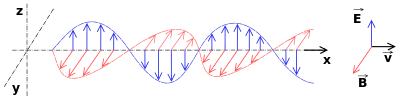
- "The electric field is in a vertical plane and the magnetic field in a horizontal plane."
Do you realize charge magnitude +q and -q is scalar while E and B are vectors describing their lateral displacement? What do you think "vertical plane" and "horizontal plane" would be all about? How would you explain horizontal, vertical or circular polarization if there is no lateral plane of oscillation?
I'd be happy too, but you missed to explain what do you imagine would be the problem. So I'm asking you again, what is it you would like me to explain? You seem to shy away from actually pointing any problem. It could be very enlightening for you if you did.
The problem is that, for long waves, according to your naive description of a 'wavelike photon' the photons would need to have a length of several wavelengths, which would put it at, perhaps ten kilometres. How would that be picked up on a detector that is only perhaps 10cm long? In your terms of 'resolution', how many 'pixels' would that cover? Certainly not one photon per pixel.
But we have seen that you didn't understand what the straighforward wiki article was telling you about photons - because you have only quoted what it says about waves. rather than reading a couple of pages from me, why not read that article, paying particular attention to what it says about photons and not waves?
Or this discussion
Or this
http://www.researchgate.net/post/What_is_the_cross_section_size_of_a_photon
Science Advisor
- 2,116
- 611
MarkoniF said:It does mean electric and magnetic fields are actually moving, that's what electromagnetic wave equation describes. If they didn't then the plane of B field oscillation couldn't be perpendicular to the plane of E field oscillation, there wouldn't be any "plane", there couldn't be such thing as horizontal, vertical or circular polarization.
ARGH. Again, do you have any peer reviewed references for that claim? These forums have rules you have agreed to, you know. The only spatial movement involved is in the direction the beam travels. The electric field amplitudes changing do not correspond to anything moving up and down. Increasing and decreasing in magnitude is something very different from moving. By the way, this is exactly what your wikipedia quotes say: The electric and magnetic field components oscillate - not something mechanical. So please: what exactly do you think is moving up and down?
If you have the patience, you can also check this thread: https://www.physicsforums.com/showthread.php?t=510552 which answered pretty much the same question.
MarkoniF said:That too, but unlike polarization plane, that is spatial oscillation, I don't think magnitude oscillation can be experimentally confirmed.
How about learning the basics before making bold claims?
MarkoniF said:Single photons do too have specific polarization and wavelength.
Maybe. You can prepare single photons as polychromatic and as polarized or partially polarized as you want to (or your equipment allows).
MarkoniF said:Inability to measure something with certainty doesn't mean it's actually undefined or unreal.
Uncertainty relations are not about inability to measure something. Please read up on the basics.
Last edited:
MarkoniF
- 56
- 0
sophiecentaur said:I imagine you have read about the 'duality' issue and that, for more than a hundred years, the two facets of Electromagnetism have been appreciated as being very different and do not apply at the same time.
Can you actually point anything specific in QM that contradicts my naive, yet beautifully elegant, notion how photons are oscillating electric and magnetic fields?
An array of sensors has no resolution at all unless an image is focussed on it. Whilst it is obvious that one photon can only activate one sensor on an array, that is not what is meant by resolution. (Look it up)
An array of photo-receptors has resolution defined by the size of those light-sensitive pixels, which is the property of that whole detector surface and independent of whether you focus image on it or not. I don't see it is obvious a single photon could not activate more than one pixel, I think that's very interesting question.
Yes I know what a wave equation is and I can solve it. An equation that describes Forces (which is what a Field will exert on a charge, for instance) does not involve any movement at all.
Force? Between what? No. There are no any lines of force when talking about single electric or magnetic fields, only field lines. You would need a separate "test" charge in order to speak of any force, and the vector of the force would be relative to the position of that test charge, nothing that would make E and B perpendicular to each other and perpendicular to the direction of their propagation.
If there were some 'movement' of anything in the transverse direction of the fields then that would involve Work being done, which would mean Energy Loss. There is no energy loss because there is no movement.
If there is no damping, there is no energy loss.
I know EM waves are transverse, which is why I compared them with waves on strings - which are also transverse. There is no motion of anything, in either case, in the direction of the propagation of the wave. In the case of mechanical waves, there is lateral movement but without energy loss because the KE and PE add together to give a constant level of energy because they are in phase quadrature . There is nothing of the sort in EM waves because there is no work, no PE and no KE.
I think it's pretty clear what "perpendicular oscillation" means and I think I provided plenty of references stating exactly that. Here is one more:
http://en.wikipedia.org/wiki/Electromagnetic_radiation
- "From the viewpoint of an electromagnetic wave traveling forward, the electric field might be oscillating up and down, while the magnetic field oscillates right and left..."
I don't know how more plainly that can be said, and if those vectors were not spatial, describing change in position, but some direction of "force" as you say, then surely someone somewhere would have mentioned it. So how about you now provide some reference that explains what is oscillating in electromagnetic wave if it's not E and B fields actually moving laterally to the direction of photon propagation?
The problem is that, for long waves, according to your naive description of a 'wavelike photon' the photons would need to have a length of several wavelengths, which would put it at, perhaps ten kilometres. How would that be picked up on a detector that is only perhaps 10cm long?
There is no any length, wavelength is simply defined by the distance where E and B fields (point field sources) cross paths, or the distance between the two points in space where they reach the peaks of their amplitude. What does length of the detector have to do with the wavelength? It's the amplitude that defines photon "thickness". Small or thin antenna would catch short bullets with about the same probability as it would catch long arrows, given they have the same thickness, so it would be the same for short and long wavelength photons.
In your terms of 'resolution', how many 'pixels' would that cover? Certainly not one photon per pixel.
It would depend on how big is the amplitude and how big pixels are, and also it would depend on how far away are these oscillating fields from the center line at the moment of impact. According to my naively literal and wonderfully marvelous interpretation a single photon could at most impact two pixels, under condition that we could make those pixels be at least half the size of their full amplitudes.
Last edited:
Similar threads
- Ostrados
- · Replies 7 ·
- Quantum Physics
- Replies
- 7
- greypilgrim
- · Replies 33 ·
- Quantum Physics
- Replies
- 33
- primarygun
- · Replies 6 ·
- Introductory Physics Homework Help
- Replies
- 6
- anuj
- · Replies 13 ·
- Special and General Relativity
- Replies
- 13