Where does the current go in this RL circuit?

Click For Summary
SUMMARY

The discussion centers on the behavior of current in an RL circuit when switch 2 opens while switch 1 is removed. It is established that the current in the inductor cannot change instantaneously and will continue to flow, potentially causing arcing at the switch contacts due to high voltage generated by the rapid change in current (di/dt). The energy stored in the inductor is released into the parasitic capacitance of the circuit, which limits peak transient voltage. Participants emphasized the non-ideal nature of components in real-world scenarios, highlighting the importance of considering practical implications in circuit design.

PREREQUISITES
  • Understanding of RL circuits and their components
  • Knowledge of parasitic capacitance in electrical circuits
  • Familiarity with the concept of di/dt and its effects on voltage
  • Basic principles of arcing and switch operation in electrical systems
NEXT STEPS
  • Research the effects of parasitic capacitance in RL circuits
  • Learn about inductive load arc suppression techniques
  • Explore the relationship between di/dt and voltage generation in inductors
  • Study practical applications of RL circuits in ignition systems
USEFUL FOR

Electrical engineers, circuit designers, and students studying electromagnetism and circuit theory will benefit from this discussion, particularly those interested in the practical implications of RL circuit behavior and arcing phenomena.

tomizzo
Messages
113
Reaction score
2
Hi there,

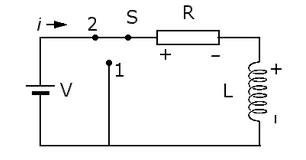
I'm struggling to wrap my head around a 'should-be-simple' problem involving an RL circuit. Referring to the image I've pasted below, what happens if we were to remove switch 1, and instead created a scenario where switch 2 simply opens? Where would the current go in the inductor?

I know that the current in an inductor can't instantaneously change, however, if switch 2 opens, it is now located on an abandoned branch thus can't allow current to flow...

How is the energy in the inductor is released?
ET93X.png
 
Engineering news on Phys.org
tomizzo said:
Hi there,

I'm struggling to wrap my head around a 'should-be-simple' problem involving an RL circuit. Referring to the image I've pasted below, what happens if we were to remove switch 1, and instead created a scenario where switch 2 simply opens? Where would the current go in the inductor?

I know that the current in an inductor can't instantaneously change, however, if switch 2 opens, it is now located on an abandoned branch thus can't allow current to flow...

How is the energy in the inductor is released?

ET93X.png
It flows into the parasitic capacitance of the circuit, which is mostly the parasitic capacitance of the inductor. That's what limits the peak transient voltage when you open S2 -- The inductor current charges the parasitic capacitance.
 
  • Like
Likes   Reactions: sophiecentaur and jim hardy
Interesting, I didn't suspect the answer would become a non-ideal situation. I will look further into this.

Much appreciated Berkeman and Jim!
 
  • Like
Likes   Reactions: jim hardy and berkeman
tomizzo said:
what happens if we were to remove switch 1, and instead created a scenario where switch 2 simply opens? Where would the current go in the inductor?
Considering ideal components, then the current will continue to flow on its path through the battery by jumping across the air gap between the opening switch contacts. This entails a high voltage, but that is available when di/dt is 'rapid'.

As Jim indicated, this reveals itself as sparking/arcing at the switch contacts as they open.
 
  • Like
Likes   Reactions: donpacino
ideal components exist only in our mind. So we must "tune" our thought experiments to come as close to reality as we need for the task at hand. We add to our mind's picture other ideal components to bring the circuit closer to reality.

The painless way to remember inductors is with this riddle:
"How high will an ideal inductor push the voltage?
To whatever is necessary to maintain current flow."Ideal inductors can make infinite volts. Ideal switches won't arc.
As your first post correctly suggested, "Something's got to give." Even if it's the insulation .

old jim
 
@tomizzo Your RL circuit co closely resembles an ignition that i just can't resist...

spark1.jpg
In gearhead jargon S is the points and C the condenser ,
and L is Coil - a tapped inductor with thousands of turns in the top but few in the bottom
R is is sized for a couple amps
C is sized maybe 0.22uf, to give dv/dt around 10 volts per microsecond so the switch contacts will have time to separate a bit before voltage gets high enough to arc there
Tapped coil produces a lot more voltage at its top than across those few turns near bottom
When voltage across C reaches a couple hundred volts voltage at top of the coil is enough to spark the plug.

That's inductance you can feel.
 
Last edited:
  • Like
Likes   Reactions: davenn and jim mcnamara
jim hardy said:
Ideal inductors can make infinite volts. Ideal switches won't arc.
I think we must concede that even an ideal mechanical switch may well arc. It comprises two metal contacts, they're ideal, they go from being in perfect contact to no contact in zero time, that's ideal, then they move apart as fast as you care to nominate, to as wide a spacing as you care to nominate. However you may wish to color this in, that ∞ value of ##\frac {di}{dt}## will still determinedly arc across the widening gap.
 

Similar threads

  • · Replies 19 ·
Replies
19
Views
2K
  • · Replies 2 ·
Replies
2
Views
2K
Replies
2
Views
7K
  • · Replies 14 ·
Replies
14
Views
4K
  • · Replies 10 ·
Replies
10
Views
6K
  • · Replies 12 ·
Replies
12
Views
5K
  • · Replies 3 ·
Replies
3
Views
3K
  • · Replies 1 ·
Replies
1
Views
7K
  • · Replies 26 ·
Replies
26
Views
7K
  • · Replies 5 ·
Replies
5
Views
2K