If you want to have it explained
Alexander350 said:
then it requires a bit of calculus.
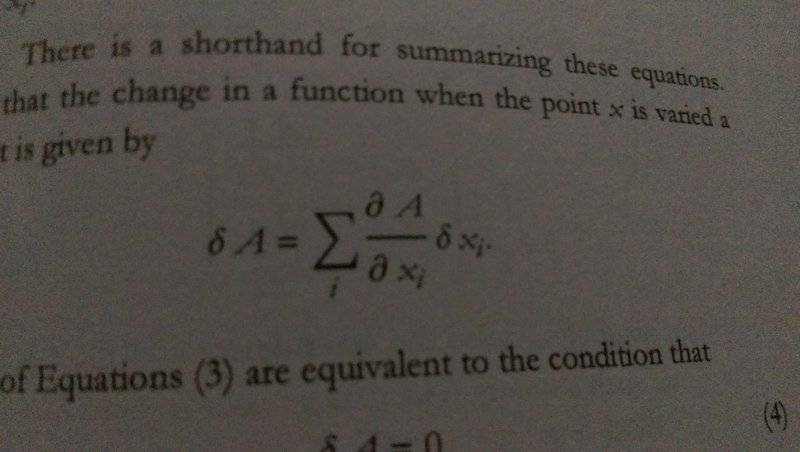
Namely, it is a theorem that if ##A## is a function depending on variables ##x_1,\ldots,x_n## and all partial derivatives ##\frac{\partial A}{\partial x_i}## exist as continuous functions, then the total derivative of ##A## is given by ##\nabla A = (\frac{\partial A}{\partial x_1},\ldots,\frac{\partial A}{\partial x_n})##. This implies that the change
$$
A(\mathbf{x} + \Delta{\mathbf{x}}) - A(\mathbf{x}) = \nabla{A} \cdot \Delta{\mathbf{x}} + O(\|\Delta{x}\|^2) \qquad (\ast)
$$
where ##\cdot## denotes the inner product, so
$$
\nabla{A} \cdot \Delta{\mathbf{x}} = \sum_i{\frac{\partial A}{\partial x_i}\Delta x_i}
$$
and ##O(\|\Delta{x}\|^2)## are terms of at least quadratic order. I believe that physicists then argue that as ##\|\Delta{x}\|## becomes "infinitesimally small", these quadratic terms can be neglected and what is left in ##(\ast)## is denoted ##\delta A##.