Where is the quantization term in Planck's Law?

Click For Summary
SUMMARY

The discussion centers on the quantization term in Planck's Law, specifically addressing the misconception surrounding its existence. Participants clarify that the quantization aspect is not explicitly present in Planck's Law but is derived from the partition sum of the quantized electromagnetic field. The term "n" associated with quantization, akin to Bohr's model, does not apply here. For a deeper understanding, "The Conceptual Framework of Quantum Field Theory" by Duncan is recommended as a resource for the derivation of Planck's radiation law.

PREREQUISITES
  • Understanding of Planck's Law and its application to Blackbody radiation.
  • Familiarity with quantum field theory concepts.
  • Knowledge of partition sums in statistical mechanics.
  • Basic grasp of energy quantization principles (E=hf).
NEXT STEPS
  • Study the derivation of Planck's radiation law in quantum field theory.
  • Read "The Conceptual Framework of Quantum Field Theory" by Duncan for historical context.
  • Explore the relationship between quantization and partition functions in statistical mechanics.
  • Investigate the implications of energy discreteness in quantum mechanics.
USEFUL FOR

Students of physics, particularly those studying quantum mechanics and thermodynamics, as well as educators seeking to clarify concepts related to Planck's Law and quantization.

Taulant Sholla
Messages
96
Reaction score
5
TL;DR
Where is the quantization term (the "n") in Planck's Law?
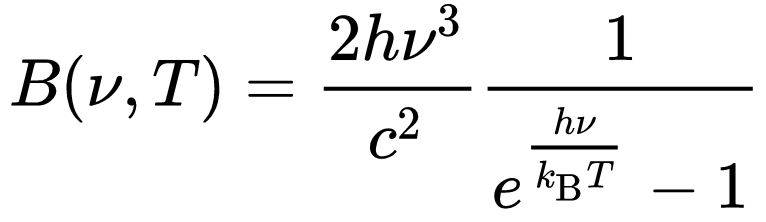
This is a very remedial question, so thanks in advance for you gentle indulgence :smile: Where do I find the quantization term (the "n") in Planck's Law?
pl.JPG
 
Physics news on Phys.org
I've no clue what you mean. I've never heard about a mysterious "quantization term". You get this equation by calculating the partion sum of the free quantized electromagnetic field.
 
  • Like
Likes   Reactions: weirdoguy
Really? No clue?

Planck coughed-up his equation that nicely fit Blackbody radiation curves. His great step was to state that energy occurs in discrete levels. Where is this discreteness found or how is it manifested in this law? Or is it not found in this law and simply contained in E=hf?
 
It's found in the derivation of the said partition sum ;-)).
 
With all due respect and utmost appreciation (really, thank you for your insights!) -- your responses provide zero assistance to a poster who clearly advertised the questions as intro/remedial. Maybe there's another forum where I should post this? Or maybe another responder might jump in?
 
Taulant Sholla said:
your responses provide zero assistance to a poster who clearly advertised the questions as intro/remedial.

You used phrase "quantization term" which I personally (and I suppose @vanhees71 also) did not see in any textbook. If you mean some natural paremeter ##n## like in Bohr quantisation then there is non in Planck's law. If you ask:

Taulant Sholla said:
Where is this discreteness found

then vanhees71 answered:

vanhees71 said:
It's found in the derivation of the said partition sum ;-))

If you ask where to find the derivation, well, The Conceptual Framework of Quantum Field Theory by Duncan comes to my mind, but that is quite an advanced book. He discusses it in historical context in the first chapter. Maybe others will provide simpler references.
 
That was not my question. I was just asking for a very simplified response to an admittedly remedial question. I posted to physics stack exchange and got what I needed.
 
I'm sorry that I answered to your question, which doesn't make sense to begin with. If you ask for a derivation of Planck's radiation law, I've of course assumed that you are familiar with the basics of quantum field theory and how to evaluate partition sums for non-interacting particles.
 
  • Like
Likes   Reactions: weirdoguy
Taulant Sholla said:
That was not my question.

Then you should work on phrasing your questions properly. We can only answer to what we see.
 
  • Like
Likes   Reactions: vanhees71
  • #10
Taulant Sholla said:
I posted to physics stack exchange and got what I needed.

Then this thread is closed.
 

Similar threads

  • · Replies 2 ·
Replies
2
Views
1K
  • · Replies 78 ·
3
Replies
78
Views
6K
  • · Replies 5 ·
Replies
5
Views
2K
  • · Replies 1 ·
Replies
1
Views
1K
  • · Replies 10 ·
Replies
10
Views
2K
  • · Replies 20 ·
Replies
20
Views
5K
  • · Replies 1 ·
Replies
1
Views
1K
  • · Replies 21 ·
Replies
21
Views
2K
  • · Replies 5 ·
Replies
5
Views
2K
  • · Replies 4 ·
Replies
4
Views
2K